Blogs & News
Search…

Why Employees Actually Use It
Employee participation cannot be sustained by organizational need alone. This article examines the value employees look for in a practice such as Baryons. Clarity, agency, constructive contribution, and less avoidable friction and gives sponsors a practical lens for earning trust.

How to Prove Human Performance Is Affecting Operating Results
CFOs and COOs need more than a broad engagement score to understand whether human-performance conditions are affecting execution. This article shows how to connect workforce conditions to observable operating behaviors, local process measures, and decision-ready pilot evidence over 90 days.

Going Deeper: The Thinking Partner and the Growth Partner
Both the Thinking Partner and the Growth Partner grow you. The difference is shape. A look at when to reach for each, and why depth is where the magic lives.

Why This Isn’t a Pulse Survey
Baryons is not another employee pulse survey. This blog explains the difference between periodic listening and longitudinal organizational signal, showing how Baryons helps CHROs and People leaders understand what changes between survey moments: clarity, momentum, alignment, strain, and emerging patterns that may matter before they become obvious symptoms.
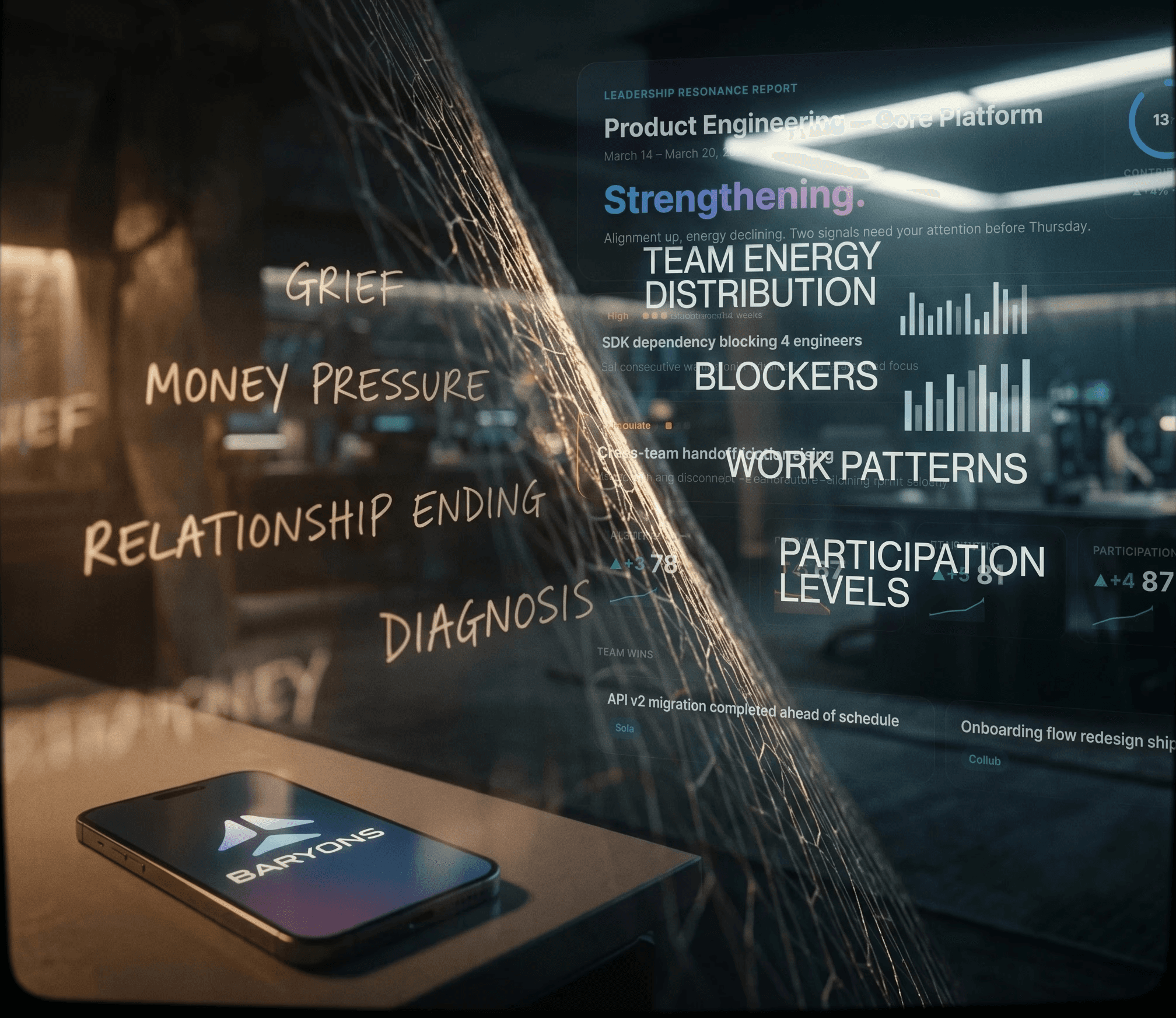
The Privacy Mesh
People tell their Baryon real things in an organizational context. The Privacy Mesh is how they can, while their leadership still sees a team's energy and never the contents of a life. Here is how that boundary actually holds.

Why Accountability Fails When Teams Don’t Have Clear Ownership Signals
Accountability often breaks before a missed commitment. This blog explains why unclear ownership, competing priorities, ambiguous decision authority, and different definitions of “done” turn accountability into blame and how stronger ownership signals help teams follow through with more trust, clarity, and consistency.

The Private Equity Operating Partner
The first 100 days are not just about finding value creation levers, they are about understanding whether the organization can execute the plan. This blog gives PE operating partners a practical lens for assessing decision clarity, ownership, leadership strain, coordination friction, operating discipline, and execution risk before those issues show up in missed targets or delayed value creation.

Pilot Scoping Guide: Workflow, Team, or Leadership?
A strong Baryons pilot starts with the problem, not the population. This blog helps executive sponsors choose the right 90-day pilot scope: workflow, team, or leadership. Based on what they are trying to understand earlier, where the business problem shows up, and what existing metrics still fail to reveal.

What Baryons Actually Does
Baryons helps leaders understand what is happening beneath business performance. This blog explains how unclear priorities, decision friction, manager strain, coordination breakdowns, and late execution risk all point to the same visibility gap and how Baryons turns individual reflection into anonymized, aggregated organizational signal.
Why Employees Actually Use It
Employee participation cannot be sustained by organizational need alone. This article examines the value employees look for in a practice such as Baryons. Clarity, agency, constructive contribution, and less avoidable friction and gives sponsors a practical lens for earning trust.
How to Prove Human Performance Is Affecting Operating Results
CFOs and COOs need more than a broad engagement score to understand whether human-performance conditions are affecting execution. This article shows how to connect workforce conditions to observable operating behaviors, local process measures, and decision-ready pilot evidence over 90 days.
Going Deeper: The Thinking Partner and the Growth Partner
Both the Thinking Partner and the Growth Partner grow you. The difference is shape. A look at when to reach for each, and why depth is where the magic lives.
Why This Isn’t a Pulse Survey
Baryons is not another employee pulse survey. This blog explains the difference between periodic listening and longitudinal organizational signal, showing how Baryons helps CHROs and People leaders understand what changes between survey moments: clarity, momentum, alignment, strain, and emerging patterns that may matter before they become obvious symptoms.
The Privacy Mesh
People tell their Baryon real things in an organizational context. The Privacy Mesh is how they can, while their leadership still sees a team's energy and never the contents of a life. Here is how that boundary actually holds.
Why Accountability Fails When Teams Don’t Have Clear Ownership Signals
Accountability often breaks before a missed commitment. This blog explains why unclear ownership, competing priorities, ambiguous decision authority, and different definitions of “done” turn accountability into blame and how stronger ownership signals help teams follow through with more trust, clarity, and consistency.
The Private Equity Operating Partner
The first 100 days are not just about finding value creation levers, they are about understanding whether the organization can execute the plan. This blog gives PE operating partners a practical lens for assessing decision clarity, ownership, leadership strain, coordination friction, operating discipline, and execution risk before those issues show up in missed targets or delayed value creation.
Pilot Scoping Guide: Workflow, Team, or Leadership?
A strong Baryons pilot starts with the problem, not the population. This blog helps executive sponsors choose the right 90-day pilot scope: workflow, team, or leadership. Based on what they are trying to understand earlier, where the business problem shows up, and what existing metrics still fail to reveal.
