Busy Teams Can Still Destroy Value When Execution Friction Goes Unseen

Activity is not the same as value creation
From a board or PE perspective, few signals are more misleading than visible activity.
The dashboards are full. Teams are moving. Meetings are happening. Hiring plans are progressing. AI investments are underway. On the surface, the organization looks engaged and productive.
And yet, value creation stalls.
We have seen this pattern repeatedly. Companies can look operationally active while quietly losing value through friction that never shows up cleanly in traditional metrics. Work gets done, but it does not compound. Effort increases, but output does not scale with it.
Effort is rarely the problem. Execution quality is.
Execution friction is often invisible until it becomes expensive
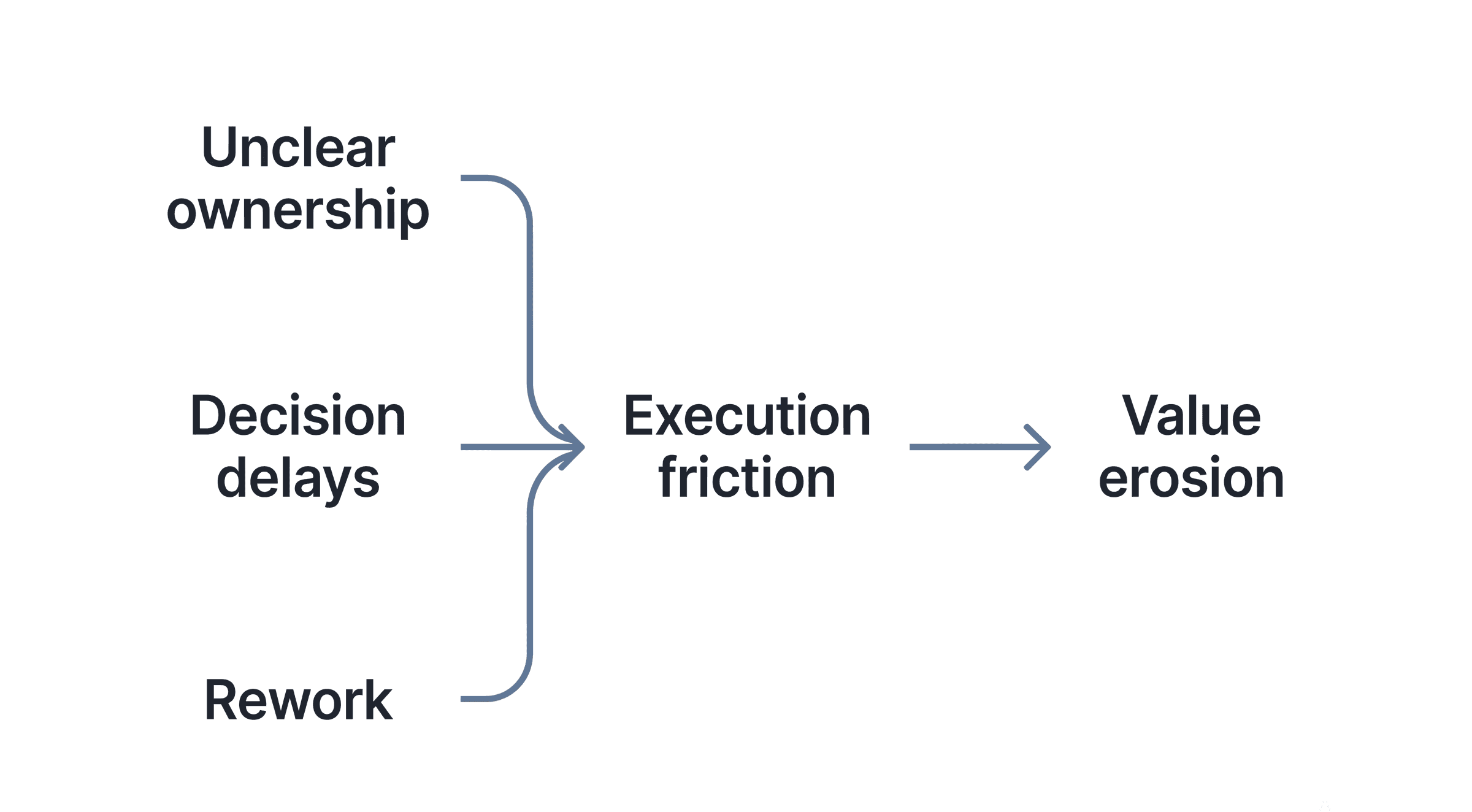
Most value erosion starts with small, compounding frictions.
Ownership is unclear, so decisions get delayed. Decisions are made, but reopened, so work gets redone. Dependencies stay hidden, so coordination slows. Priorities shift without explanation, so teams hedge instead of commit.
None of these look like a crisis on their own. Together, they create drag across the system, and the cost lands quietly, in missed targets, delayed initiatives, margin pressure, or unexpected attrition, long before anyone names the cause.
Why boards and investors often see it late
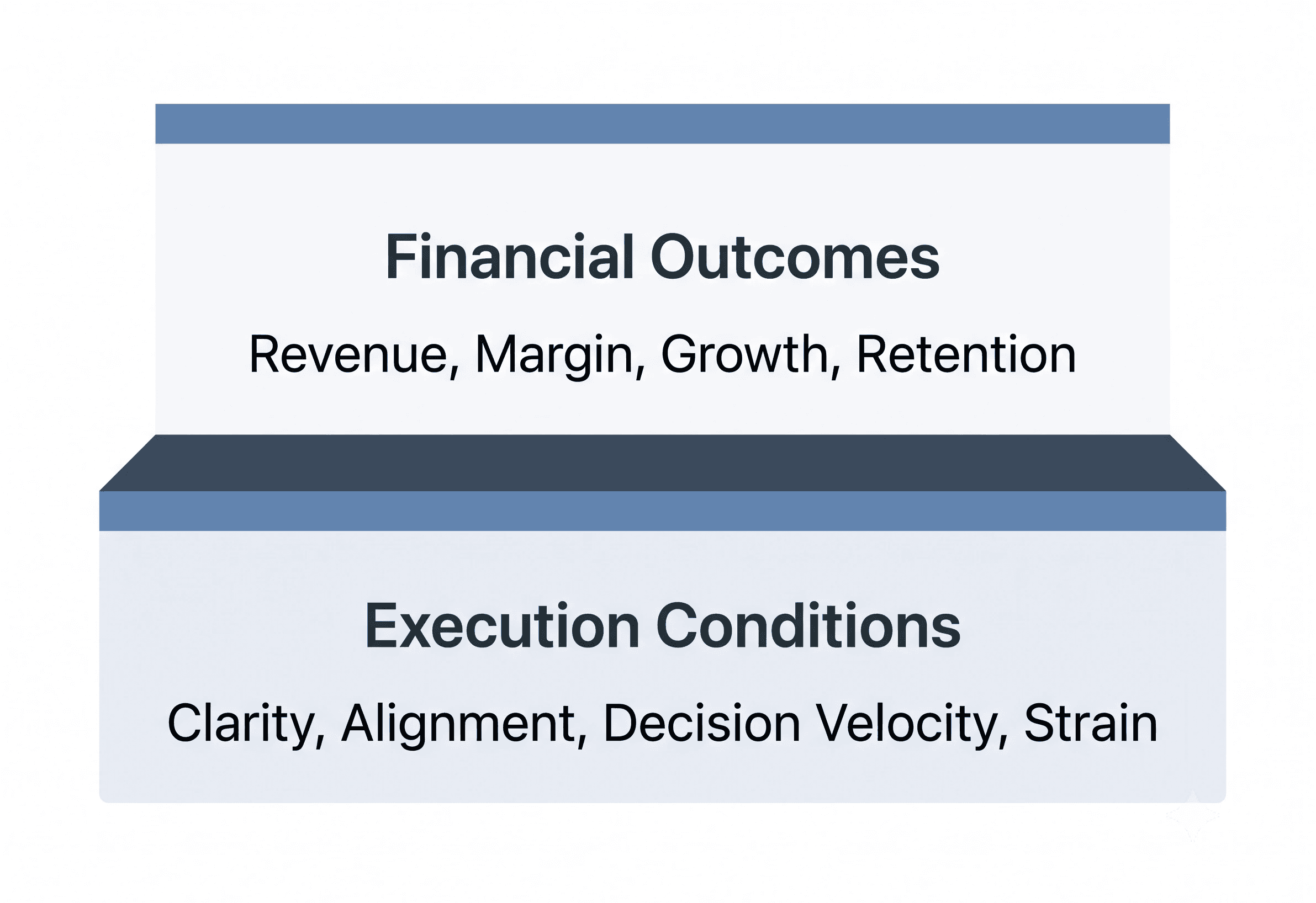
At the board level, visibility is typically structured around outcomes: revenue, margin, growth, retention, delivery timelines.
Those metrics matter. But they are lagging indicators of how the system is actually functioning day to day. By the time friction shows up in those numbers, it has already been operating inside the business for some time.
That is the gap. Leadership teams feel the strain. Managers compensate for it. Teams work around it. Without a clear signal layer underneath the outcome metrics, the organization cannot see execution friction early enough to address it cleanly.
Deloitte’s 2026 Human Capital Trends reinforces this dynamic. The research points to a tipping point where work complexity, speed, and coordination demands are increasing faster than most systems can adapt, and the result is often hidden inefficiency rather than visible failure. (deloitte.com)
The “busy but not aligned” pattern
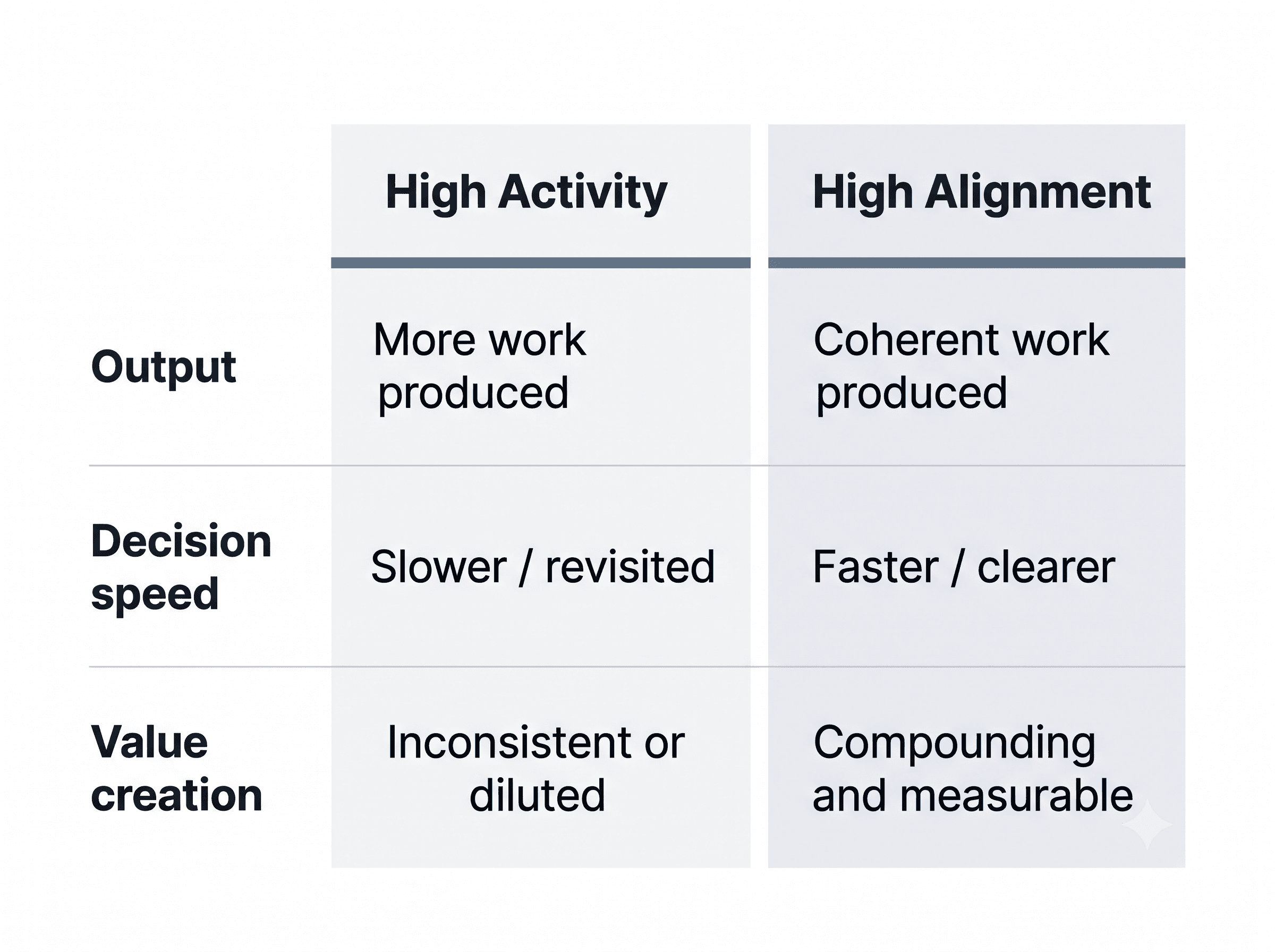
One of the clearest signals of execution friction is when teams are fully utilized but progress feels slower than it should.
We describe this as busy but not aligned. In these environments, the constraint is coordination.
Work expands because people are compensating for uncertainty. More time goes to clarifying, checking, aligning, and re-aligning. Meetings increase while shared understanding stays flat. Status updates start standing in for real coordination. The organization looks active, but momentum is inconsistent.
External data supports this pattern. Atlassian’s State of Teams 2025 found that teams spend roughly a quarter of their time searching for the information and context they need to do their work. That is a signal of coordination breakdown and missing clarity as much as it is a productivity issue. (atlassian.com)
Where value is quietly lost
From a value creation perspective, execution friction shows up in a few consistent ways.
It slows decision velocity, as teams hesitate or revisit choices already made. It increases rework, as work gets redone because direction never stabilized. It softens operating discipline, as ownership goes diffuse and follow-through weakens. It affects retention, as high performers disengage when effort stops translating into impact. And it compresses margins, since more effort is required to produce the same output.
None of this requires a dramatic failure. It accumulates quietly until the financial impact becomes visible.
Gallup’s 2026 workplace reporting provides another lens here. Declining engagement and manager strain are early indicators of a system under pressure, not just people metrics on their own, but signals that execution conditions are weakening in ways that will eventually reach performance. (gallup.com)
AI amplifies both strength and weakness
This matters even more in the current environment.
AI increases execution capacity. It enables faster output, faster analysis, faster iteration. What it does not do is resolve underlying coordination problems, and it often amplifies them instead.
If the organization is aligned, AI accelerates value creation. If the organization is misaligned, AI accelerates divergence.
Microsoft’s 2025 Work Trend Index points to organizations moving toward human-agent collaboration models, and that model depends on alignment. Without it, more output does not translate into more impact. (blogs.microsoft.com)
From a PE perspective, this means that technology investment alone is not sufficient to drive value creation. The operating layer around it determines whether that investment compounds or dissipates.
The missing layer: visibility into execution conditions
Most organizations have plenty of data. What they lack is visibility into how work is actually functioning beneath the surface.
Most systems capture outcomes. Fewer capture the conditions producing those outcomes.
That includes:
whether priorities are clear enough to act on
whether decision rights are understood
whether teams are aligned in how they interpret direction
whether strain is rising in ways that will affect performance
Without that visibility, leadership manages reactively. Intervention happens after the cost has already appeared, not while the friction is still small enough to address cleanly.
A different approach to value creation visibility
We think value creation requires a fuller picture: not just financial performance, but the human signal underneath it.
This is the problem Baryons was built to solve. Baryons is the Understanding Engine that turns daily conversations into organizational intelligence, on the same rhythm the friction actually builds on: continuous, not quarterly.
Through short daily voice conversations, Check-in and Check-out, people describe how work is actually being experienced. Baryons surfaces anonymized, aggregated patterns across clarity, alignment, confidence, and strain, and delivers them as a weekly Resonance Insights with an Act, Watch, and Amplify view: where to act now, where to keep watching, and where momentum is building and worth reinforcing.
Individual conversations stay private. Leaders see the pattern, not transcripts. That privacy mesh is what makes the signal honest in the first place.
The goal is operational visibility, the kind that shows leadership and investors whether the organization is functioning well enough to convert effort into value.
Signal before symptom, at the pace the business actually moves.
The board-level question
For boards and PE firms, the implication is straightforward.
The real question is whether the company can sustain and scale its performance, not just whether it is performing today. That shows up in questions like:
Are teams aligned on what matters most?
Is decision velocity improving or slowing?
Is execution becoming cleaner or more fragmented?
Are managers creating clarity, or quietly absorbing ambiguity on the organization's behalf?
If those questions are hard to answer, there is likely hidden friction in the system.
Final thought
Companies rarely lose value because people aren't working hard enough. They lose value because work isn't aligned, decisions aren't clear, and execution friction compounds unnoticed.
The organizations that outperform aren't just more active. They are more coherent, converting effort into coordinated action with less drag.
For boards and investors, that raises a different visibility requirement: not just what results are being produced, but how reliably the organization can keep producing them.
If that layer stays unclear, value creation is at risk, even when activity looks strong. And if your portfolio companies are showing this busy-but-not-aligned pattern, it's worth a closer look at the execution conditions underneath the numbers. That's exactly where earlier visibility protects and accelerates value.
More articles

The Handoff Problem: Why Execution Loses Context Between Teams
Execution friction is often blamed on effort, but it frequently begins when context, priorities, and decision boundaries weaken as work moves between teams. This article gives COOs and cross-functional leaders a practical way to improve translation quality and preserve strategic intent through the handoff.

Why Strategy Breaks as It Is Retold Across the Organization
Strategy often changes shape as leaders interpret and communicate it through multiple layers and functions. This article explains translation drift as a source of execution friction and offers a practical way for CEOs and COOs to surface divergence before it becomes a lagging business symptom.

The Manager Dependency Trap
Manager overload is not always a workload problem. This article examines how unclear priorities, decision boundaries, and trade-offs turn managers into a routing layer for routine ambiguity, and how COOs and CHROs can restore team agency without sacrificing coordination.
