Managers Are Not Failing. The System Is Overloading Them

The strain shows up at the manager first
We see a familiar pattern across organizations. When execution starts to wobble, the manager is usually where the strain shows up first. Priorities shift faster than they can translate them. Teams need more clarity than the calendar allows. Escalations keep rising while decision rights stay fuzzy. From the outside it can look like a manager capability problem. More often it is a bandwidth problem created by the system around them. We think of the manager bottleneck less as individual weakness and more as a structural signal that the organization is asking one role to absorb too much ambiguity, coordination, and emotional load.
That reading is harder to ignore. In Gallup’s January 2026 analysis of span of control, the average number of people reporting to managers rose from 10.9 in 2024 to 12.1 in 2025, while the share of managers overseeing 25 or more employees also increased. Gallup ties the trend to flatter structures and the "Great Flattening," where organizations remove layers and widen reporting spans in the name of efficiency.
The manager role has quietly become the overflow container
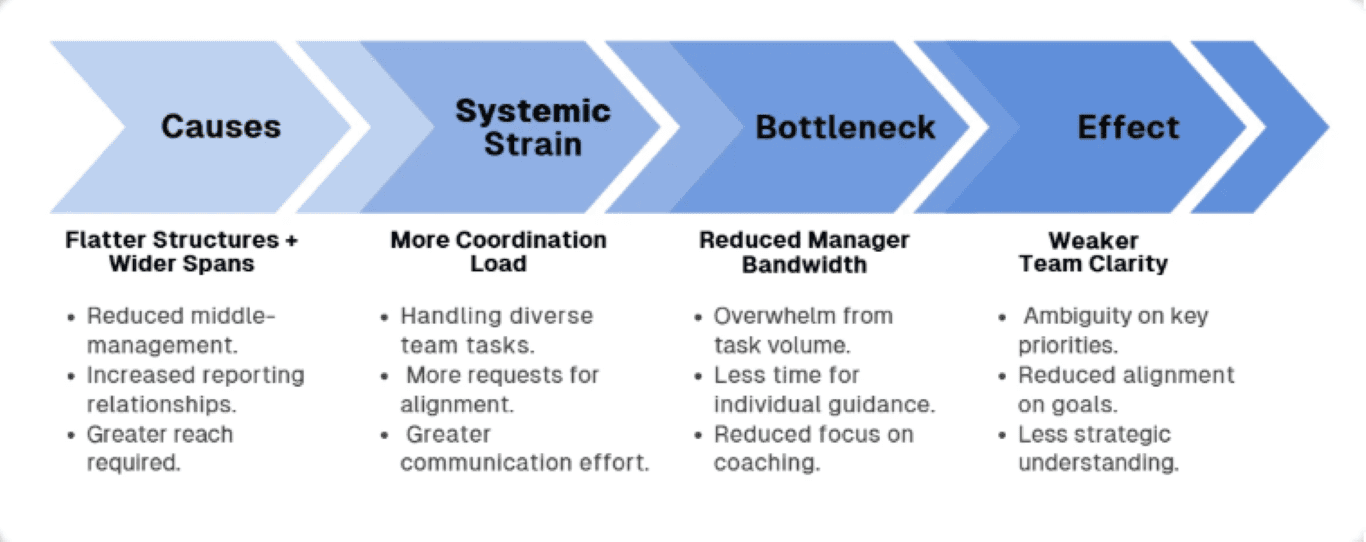
In many companies, managers now carry a strange mix of responsibilities. They are expected to drive accountability, coach people, translate strategy, absorb organizational change, hold morale steady, and spot risk early. At the same time they are given less time, wider teams, and more reporting surfaces to handle. That combination does not produce better leadership. It produces saturation.
We see that saturation in how the work gets experienced. Managers become message relays instead of sense makers. They spend more time coordinating than coaching. They move from helping teams think clearly to helping them keep up. Once the role becomes mostly administrative, the organization loses one of its most important clarity layers.
The external research points the same way. Gallup’s April 2026 workplace reporting says global employee engagement declined for a second straight year and that manager engagement dropped as well. On top of that, Gallup’s March 2026 leadership research found that under half of leaders excel at holding employees accountable, a weakness that managers notice and that threatens both engagement and performance. That is not a small leadership issue. It is evidence that the people expected to hold the system together are themselves under strain. (Gallup engagement; Gallup accountability)
Bandwidth, not intent, is the real constraint
When managers are overloaded, the first thing to go is not effort. It is judgment capacity.
That distinction matters. Most overloaded managers do not stop caring. They stop having room to interpret, prioritize, and intervene well. They default to the most visible request, the latest escalation, or the loudest stakeholder. Over time the work becomes more reactive and less coherent. Teams feel it as mixed signals, delayed decisions, unclear tradeoffs, and a sense that their manager is always present but rarely available.
This is why we keep saying alignment is not agreement. Alignment is decision clarity that survives layers and change. When managers lose the bandwidth to create that clarity, the organization pays in rework, hesitation, and quiet disengagement long before formal metrics fully capture it.
The challenge sharpens as work is redesigned around AI and flatter operating models. Microsoft’s 2026 Work Trend Index argues that as AI and agents take on more execution, human agency expands, and leaders need to rearchitect work so organizations can actually capture that agency. Deloitte’s 2026 Human Capital Trends makes a parallel point: organizations are at tipping points where speed, orchestration, and adaptability matter more, but few are redesigning work intentionally enough to support that shift. In other words, managers are being asked to lead through a new operating model before most organizations have really rebuilt the role around it. (Microsoft; Deloitte)
More dashboards do not fix a bandwidth problem
One of the most common mistakes we see is trying to support managers with more information while leaving their operating reality unchanged.
The instinct is understandable. If managers are overwhelmed, give them more reports, more visibility, more tools, more scorecards. But that usually deepens the bottleneck. More surfaces create more interpretation work. More alerts create more context switching. More dashboards create more hesitation, unless they reduce ambiguity in a way that is immediately usable. Dashboards describe what already happened. They rarely show what is starting to drift.
So the manager problem is not solved by enablement in the abstract. It is solved by making signal easier to trust and easier to act on. Managers do not need more theater around visibility. They need less guesswork: a clearer line of sight into where confidence is weakening, where strain is rising, where alignment is drifting, and what size of intervention actually fits the problem. That is what we mean by signal before symptom.
What a healthier manager system looks like
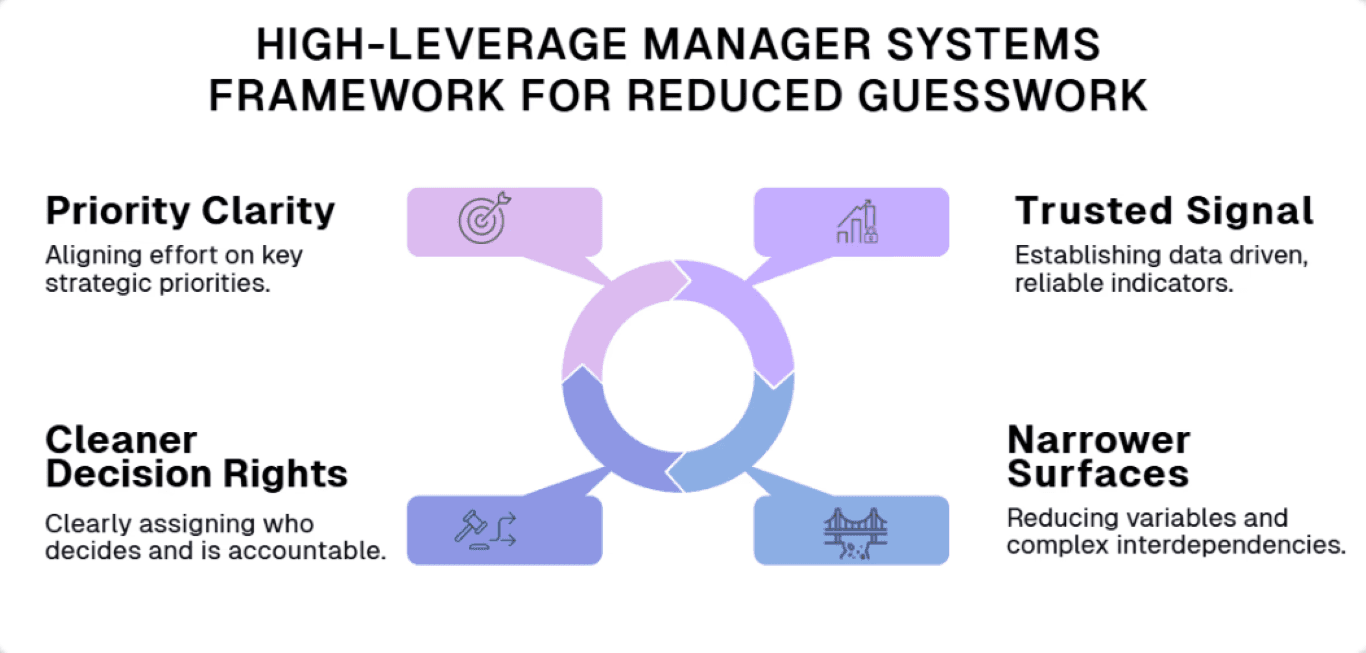
Healthier manager systems share a few qualities. They reduce interpretation load. They make priorities legible. They give managers earlier signal instead of later blame. And they help managers act before people issues harden into performance issues.
In practice that means doing fewer things, more clearly. It means narrowing the number of surfaces a manager is asked to watch. It means designing a better operating cadence, not just a better reporting cadence. And it means giving managers signal that reflects how work is actually being experienced, not how it was described after the fact.
This is where Baryons is built to help. Baryons is an Understanding Engine. It uses a low-friction, voice-based daily rhythm to help people prepare, reflect, and grow in the flow of work. From those conversations it produces a weekly Group Resonance Report that shows managers where alignment, confidence, energy, and strain are moving, and triages the week into three moves: where to act, where to watch, and where to amplify. No new survey to launch. No transcripts to read.
It works because a privacy firewall sits between the individual and the group. Personal detail never crosses into leadership reporting. Managers see patterns, not people's private words. Effect without cause. That is what lets the signal be both honest and usable, and it is what keeps Baryons from becoming one more surface to manage.
The real fix is role redesign, not manager heroics
When the manager role becomes a bottleneck, the answer is not to ask managers to be more resilient inside a broken design.
The answer is to redesign the conditions around the role. Narrow the noise. Clarify the decision boundaries. Reduce the coordination labor that never shows up in a job description. Give managers earlier signal so they can intervene while issues are still small enough to address cleanly.
That is why we see the manager bottleneck as a leadership design issue, not only a people-manager issue. If the organization wants sharper execution, it has to stop treating managers as infinite containers for ambiguity.
Final thought
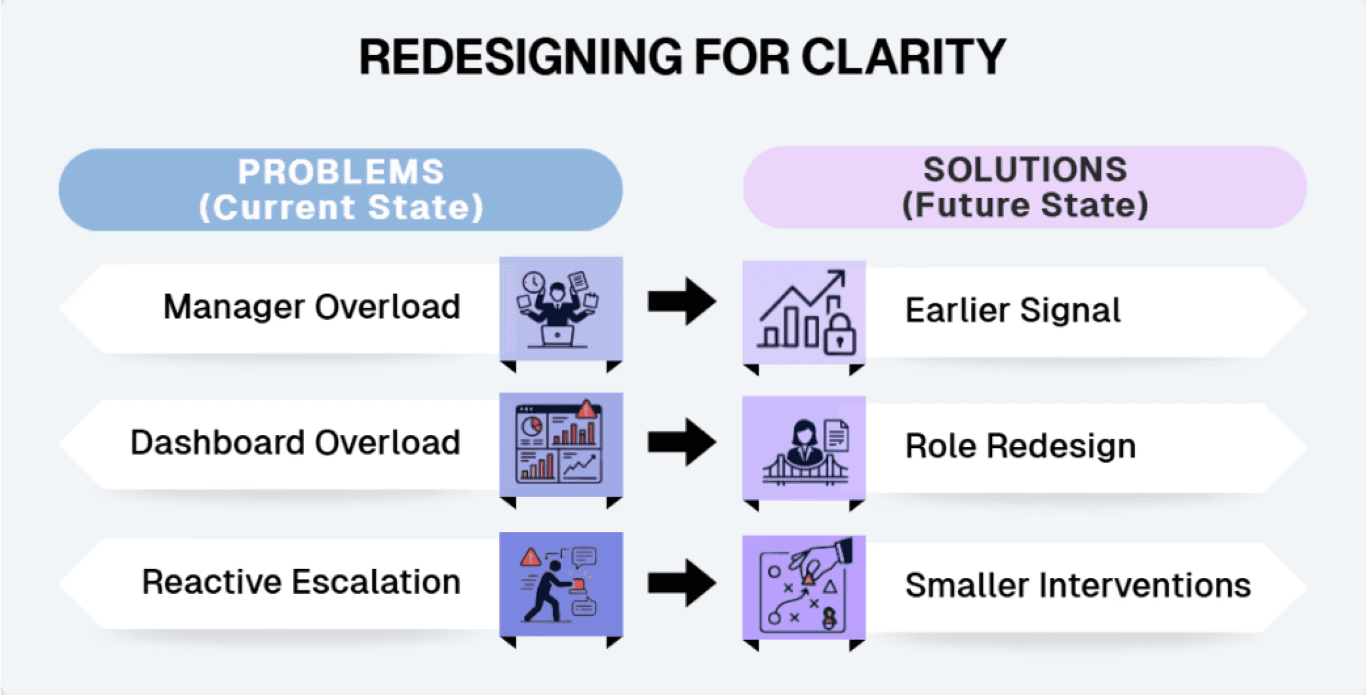
Managers are still the fulcrum between intent and execution. In too many organizations, that fulcrum is overloaded.
The more useful question is not "Why aren't managers performing better?" It is "What has the system asked managers to hold without enough clarity, signal, or room to lead well?"
If that question feels familiar, it may be time to look less at manager output and more at manager conditions. That is where earlier signal changes the conversation. If your team is working to reduce manager saturation and restore real leadership bandwidth, that is a conversation we would welcome.
See how Baryons works. Watch this video.
More articles

Going Deeper: The Thinking Partner and the Growth Partner
Both the Thinking Partner and the Growth Partner grow you. The difference is shape. A look at when to reach for each, and why depth is where the magic lives.

Why This Isn’t a Pulse Survey
Baryons is not another employee pulse survey. This blog explains the difference between periodic listening and longitudinal organizational signal, showing how Baryons helps CHROs and People leaders understand what changes between survey moments: clarity, momentum, alignment, strain, and emerging patterns that may matter before they become obvious symptoms.
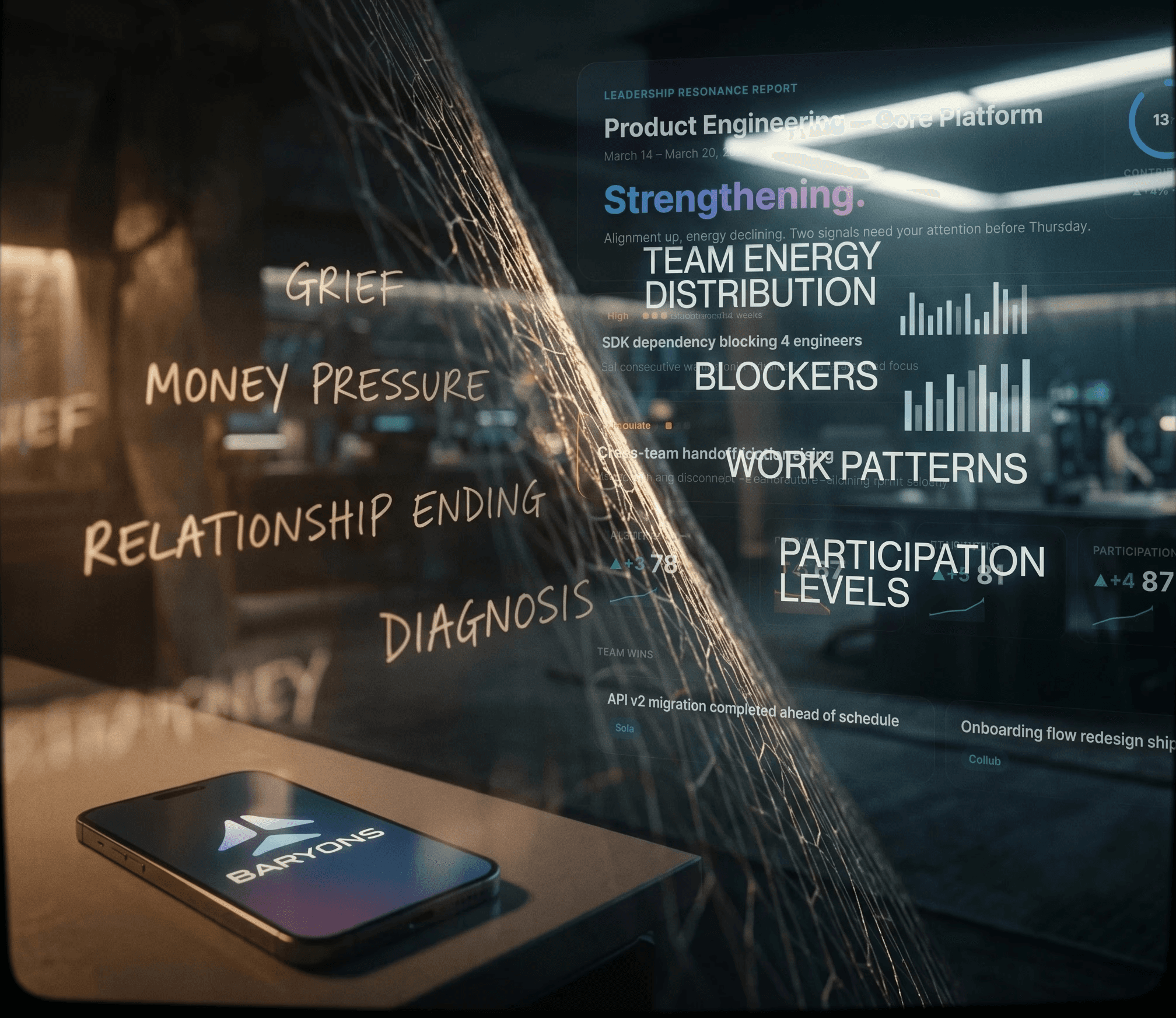
The Privacy Mesh
People tell their Baryon real things in an organizational context. The Privacy Mesh is how they can, while their leadership still sees a team's energy and never the contents of a life. Here is how that boundary actually holds.