Disengagement Is Rarely Sudden

It begins with meaning, not motivation
Most leaders recognize disengagement when it becomes visible. A drop in energy. Reduced participation. Lower output. Eventually, attrition.
But by the time disengagement shows up clearly, it has usually been building for a while. In many cases it does not begin with motivation. It begins with meaning. People stop seeing how their effort connects to impact. They live through repeated reversals, unclear priorities, and decisions that seem disconnected from what they were told mattered. Over time, belief erodes.
We think of this as a meaning break.
When effort stops translating into impact
High performers are usually not disengaged because they lack drive.
They disengage when the relationship between effort and outcome becomes unstable. When priorities change without explanation, when work gets redone repeatedly, or when contributions never connect to results, people start to question whether their effort matters. That erosion is subtle at first. But it compounds.
The research points the same way. Gallup's ongoing workplace reporting shows declining engagement and rising strain among managers, which often reflects deeper issues in how work is experienced. When clarity weakens and priorities shift, engagement follows.(Gallup engagement trends)
The APA's 2025 Work in America findings reinforce the point, showing how uncertainty and instability shape how people feel about work. Meaning is tied to predictability and clarity, not motivation alone. (APA report)
Meaning breaks are created by patterns, not events
Disengagement is rarely caused by a single moment. It is usually the accumulation of small breaks:
Priorities change, but the reason is never explained.
Decisions get reversed without visible tradeoffs.
Effort goes in, but outcomes stay unclear or delayed.
Recognition rewards visibility rather than contribution.
No single one of these may seem significant. Together they create a pattern where people stop trusting that their effort will translate into impact. That is when disengagement begins to form.
Motivation is the wrong starting point
When disengagement appears, the instinct is to add motivation. More communication. More recognition. More energy from leadership.
Those can help for a while. But they do not address the underlying issue once meaning has broken down. If people cannot see what matters or how their work contributes, motivation is hard to sustain.
So we tend to reframe disengagement as a clarity and continuity problem. When people have a clear line of sight between their work and outcomes, engagement tends to follow. When that line of sight breaks repeatedly, engagement declines regardless of effort.
Restoring meaning is about restoring continuity
What we see working in practice is not dramatic intervention. It is consistency. Leaders who restore meaning tend to do a few things well:
They make priorities explicit and stable enough to act on.
They explain what changed and why when direction shifts.
They connect individual contribution to broader outcomes.
They recognize impact, not just activity.
These are small moves, but they rebuild the relationship between effort and result. Deloitte's 2026 Human Capital Trends emphasizes the same ideas, pointing to trust, clarity, and work design as the conditions that sustain performance. Engagement is not a standalone metric. It is an outcome of how work is structured and experienced.(Deloitte 2026)
The role of earlier signal
The hard part with disengagement is that it becomes visible late. By the time a survey captures it or a manager fully notices, belief has already eroded. That is why earlier signal matters, and it is why continuity matters as much as any single reading.
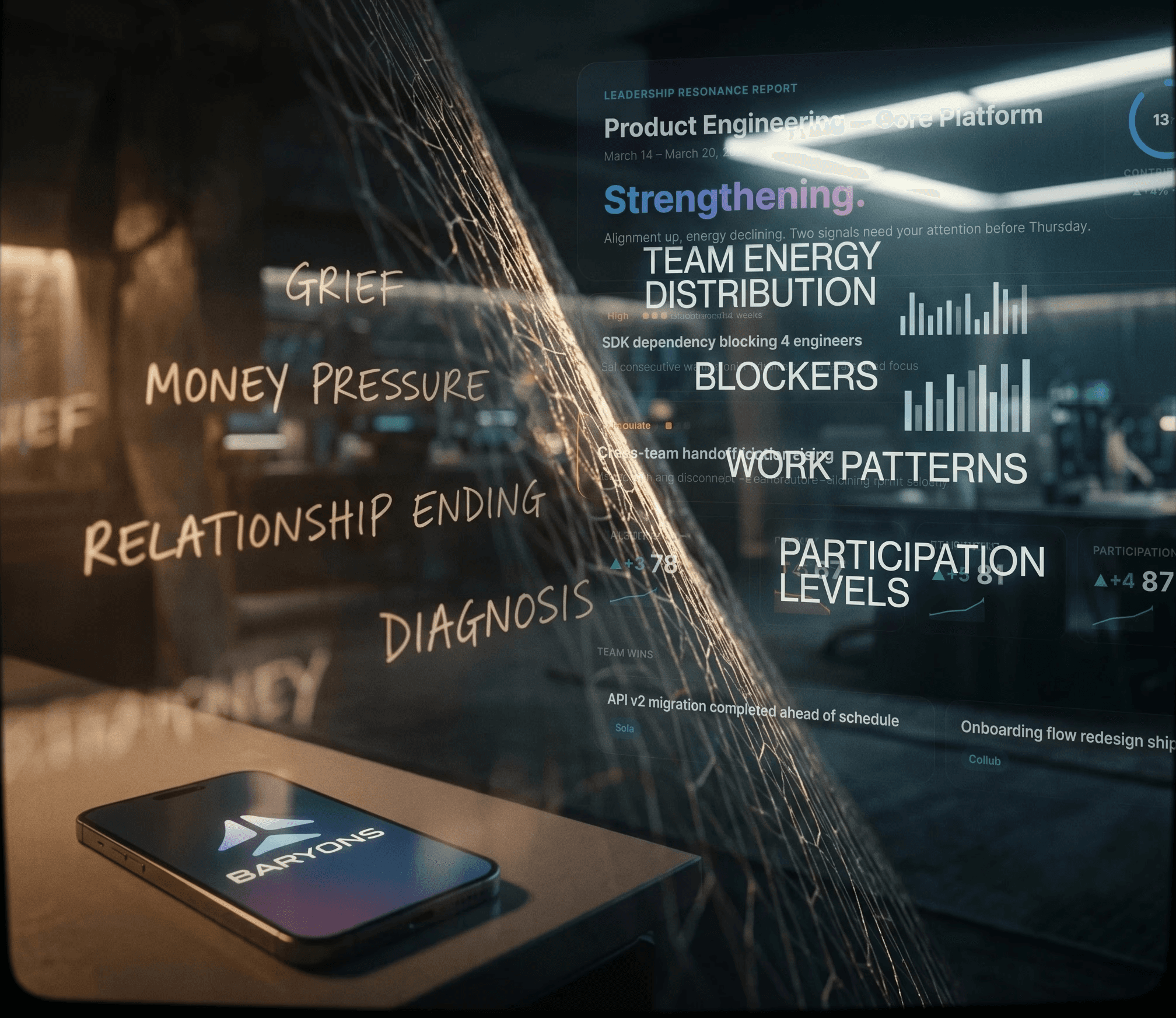
This is the work Baryons is built for. Baryons is an Understanding Engine. It uses a low-friction, daily voice rhythm and a memory that holds across conversations, so it can see when the line between effort and impact is starting to fray rather than catching it only after the fact. From that daily practice, the person gets their own weekly Resonance Report, and leaders get a Group Resonance Report that shows where confidence, clarity, and strain are moving, and where to act, watch, or amplify, while trust is still recoverable.
It works because people speak honestly, and people speak honestly only when it is safe. A privacy mesh sits between the individual and the organization. Leaders see patterns, not transcripts. Personal detail never crosses into group reporting. Effect without cause. That is what lets an early meaning break surface as signal instead of staying quiet until it reads as a resignation. The goal is the chance to close a loop, explain a decision, and reconnect effort to impact before belief is gone. That is signal before symptom.
Final thought
Disengagement is often described as a motivation problem. We see it differently. It is usually the result of accumulated meaning breaks, where effort stops reliably translating into impact.
So the question for leaders is not only "Are people motivated?" It is "Can people see that what they are doing matters, and does that belief hold over time?" If that connection is breaking, disengagement is already forming.
If your organization is working to strengthen that connection, earlier signal and clearer continuity can make a real difference before it shows up in performance or retention.
Curious how Baryons can reignite meaning and restore group engagement? Book a demo here or try it for yourself here - start free.
More articles

Going Deeper: The Thinking Partner and the Growth Partner
Both the Thinking Partner and the Growth Partner grow you. The difference is shape. A look at when to reach for each, and why depth is where the magic lives.

Why This Isn’t a Pulse Survey
Baryons is not another employee pulse survey. This blog explains the difference between periodic listening and longitudinal organizational signal, showing how Baryons helps CHROs and People leaders understand what changes between survey moments: clarity, momentum, alignment, strain, and emerging patterns that may matter before they become obvious symptoms.
The Privacy Mesh
People tell their Baryon real things in an organizational context. The Privacy Mesh is how they can, while their leadership still sees a team's energy and never the contents of a life. Here is how that boundary actually holds.