Burnout Rarely Starts Where We Think It Does
The usual explanation is incomplete
When burnout shows up in an organization, it is usually explained as a workload problem. Too many hours. Too many meetings. Too much pressure.
Sometimes that is true. But in many of the environments we work in, something else shows up earlier and more consistently: ambiguity. People are not only working hard. They are working without enough clarity to know what matters, what will hold, or whether their effort will translate into progress. That is a very different kind of strain.
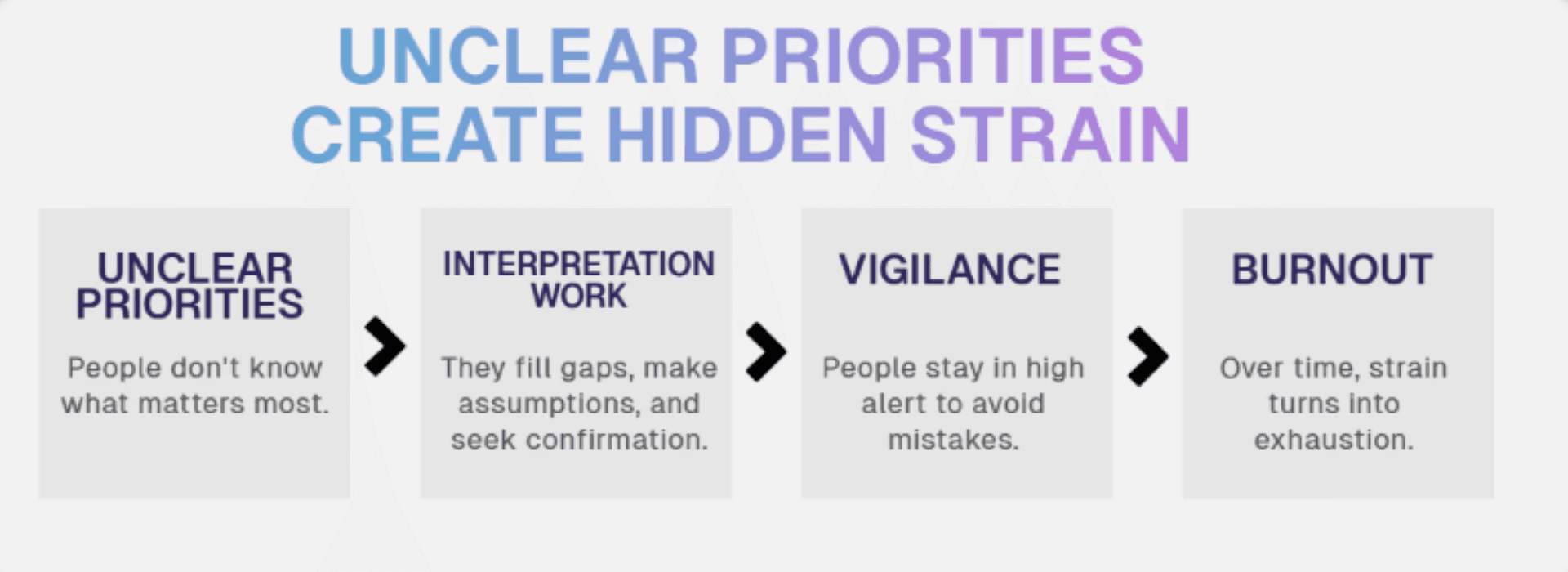
We think of burnout less as a function of volume and more as a function of instability. When priorities shift repeatedly, decisions get revisited, and direction stays unclear, people start spending energy not just doing the work but constantly interpreting it. That interpretation work becomes a hidden tax on attention, confidence, and motivation.
Ambiguity creates a different kind of exhaustion
Not all effort is equal.
There is a difference between working hard on something clear and working hard on something that keeps changing. The second is more draining, even at the same number of hours. It keeps people in a state of constant vigilance: recalibrating priorities, second-guessing direction, and protecting themselves from being wrong.
That dynamic is showing up across the workforce data. In the APA’s 2025 Work in America report, 54% of U.S. workers said job insecurity significantly impacts their stress levels, and 65% said their organization has been affected by recent policy changes. That level of uncertainty does not just increase pressure. It increases ambiguity about what will matter next. (apa.org)
Deloitte’s 2026 Human Capital Trends reporting reinforces this pattern. It highlights that organizations are operating in environments of continuous change, with many employees experiencing frequent shifts in priorities and structure. In that context, burnout is less about isolated overload and more about sustained instability. (Deloitte 2026 Human Capital Trends)
The early signals are easy to miss
Burnout does not usually begin with visible exhaustion. It begins more quietly.
People narrow their time horizon. They focus only on what is immediately in front of them. Curiosity drops. Cynicism rises. Conversations shift from possibility to protection. The work still gets done, but the quality of energy behind it changes.
These are early signals, not outcomes. They appear before attrition, before engagement scores fall, and before performance clearly declines. They get missed because most organizations are looking for lagging indicators rather than leading ones. The whole point of signal before symptom is to catch this shift while it is still quiet, because that is the only window where a light intervention still works.
Resilience is usually the wrong prescription
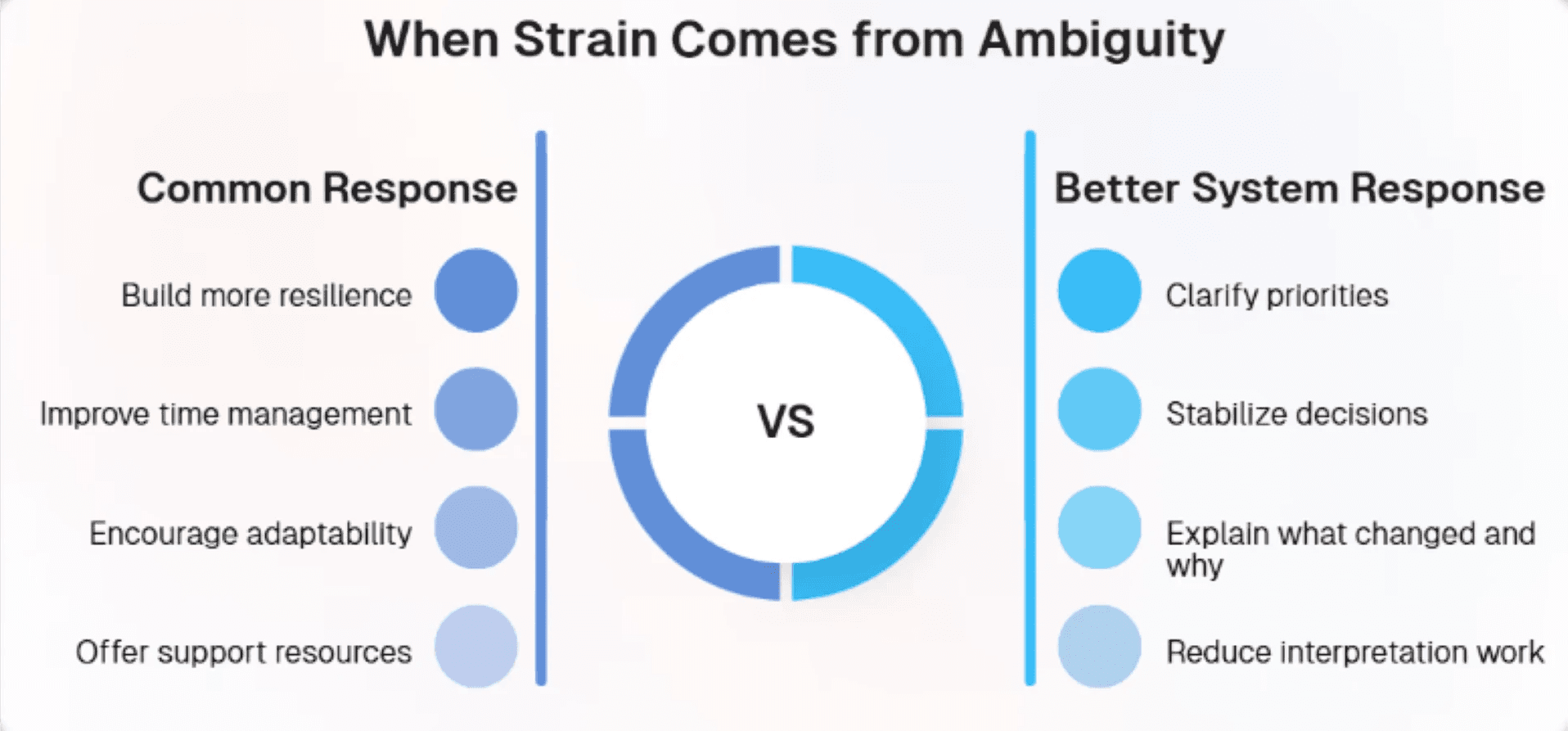
When burnout surfaces, organizations often respond by asking individuals to adapt. More resilience. Better time management. More support resources.
Those can help at the margins. But they do not address the root cause when the problem is structural ambiguity. If priorities keep shifting and decision boundaries stay unclear, no amount of individual resilience will offset the cost.
So we tend to treat burnout as a systems problem rather than an individual one. If people are consistently spending energy trying to interpret what matters, the system is manufacturing strain. Gallup's 2026 reporting adds another dimension. Declining engagement and manager strain suggest the people expected to stabilize teams are themselves under pressure. When that layer is stretched, ambiguity tends to grow rather than shrink.(Gallup engagement)
What actually reduces burnout
Reducing burnout is less about removing all pressure and more about stabilizing meaning. In practice that comes down to a few leadership moves.
Clarity of priorities matters more than volume reduction alone. When people know what matters most, they can spend effort where it counts.
Decision stability matters. Reversals without explanation erode trust faster than a heavy workload does.
Visible tradeoffs matter. When leaders say what is not being done and why, they remove a layer of hidden interpretation work.
And speed of repair matters. When something turns unclear, fixing it quickly keeps strain from compounding.
None of these are large interventions. But they change how the work is experienced.
The role of earlier signal
The hard part is that leaders rarely see ambiguity early enough to act on it. By the time it is visible, it is already affecting morale, performance, or retention.
This is the work Baryons was built for. Baryons is an Understanding Engine. It uses a low-friction, daily voice rhythm that captures how work is actually being experienced, and it does that in a way the person benefits from directly, through their own reflection and a weekly individual Resonance Insights. From those same conversations, leaders receive Group Resonance Insights that shows where clarity, alignment, confidence, and strain are moving, and where to act, watch, or amplify, while each pattern is still small.
That only works because people are honest, and people are only honest when honesty is safe. A privacy mesh sits between the individual and the organization. Leaders see patterns, not transcripts. Personal detail never crosses into group reporting. Effect without cause. That is what lets rising strain surface as signal instead of staying hidden until it shows up as a resignation. The goal is not more data. It is earlier visibility into where the system is creating effort that the work does not require.
Final thought
Burnout is often treated as a volume problem. In many organizations, it is a clarity problem.
When people have to constantly guess what matters, brace for shifting priorities, and reinterpret direction, the cost accumulates quietly until it becomes visible.
So the better question is not only "How much work are people doing?" It is "How much of their energy is going into figuring out the work itself?" If that second number is high, burnout is already forming.
If your organization is seeing early signs of that kind of strain, it is worth seeing how clearer priorities and earlier signal can change the experience of work before the cost arrives.
Curious Baryons can help decrease ambiguity and eliminate burnout ? Try it here, start free.
Learn more on how Baryons works here. Or watch this video.
See how Baryons works.
More articles

Going Deeper: The Thinking Partner and the Growth Partner
Both the Thinking Partner and the Growth Partner grow you. The difference is shape. A look at when to reach for each, and why depth is where the magic lives.

Why This Isn’t a Pulse Survey
Baryons is not another employee pulse survey. This blog explains the difference between periodic listening and longitudinal organizational signal, showing how Baryons helps CHROs and People leaders understand what changes between survey moments: clarity, momentum, alignment, strain, and emerging patterns that may matter before they become obvious symptoms.
The Privacy Mesh
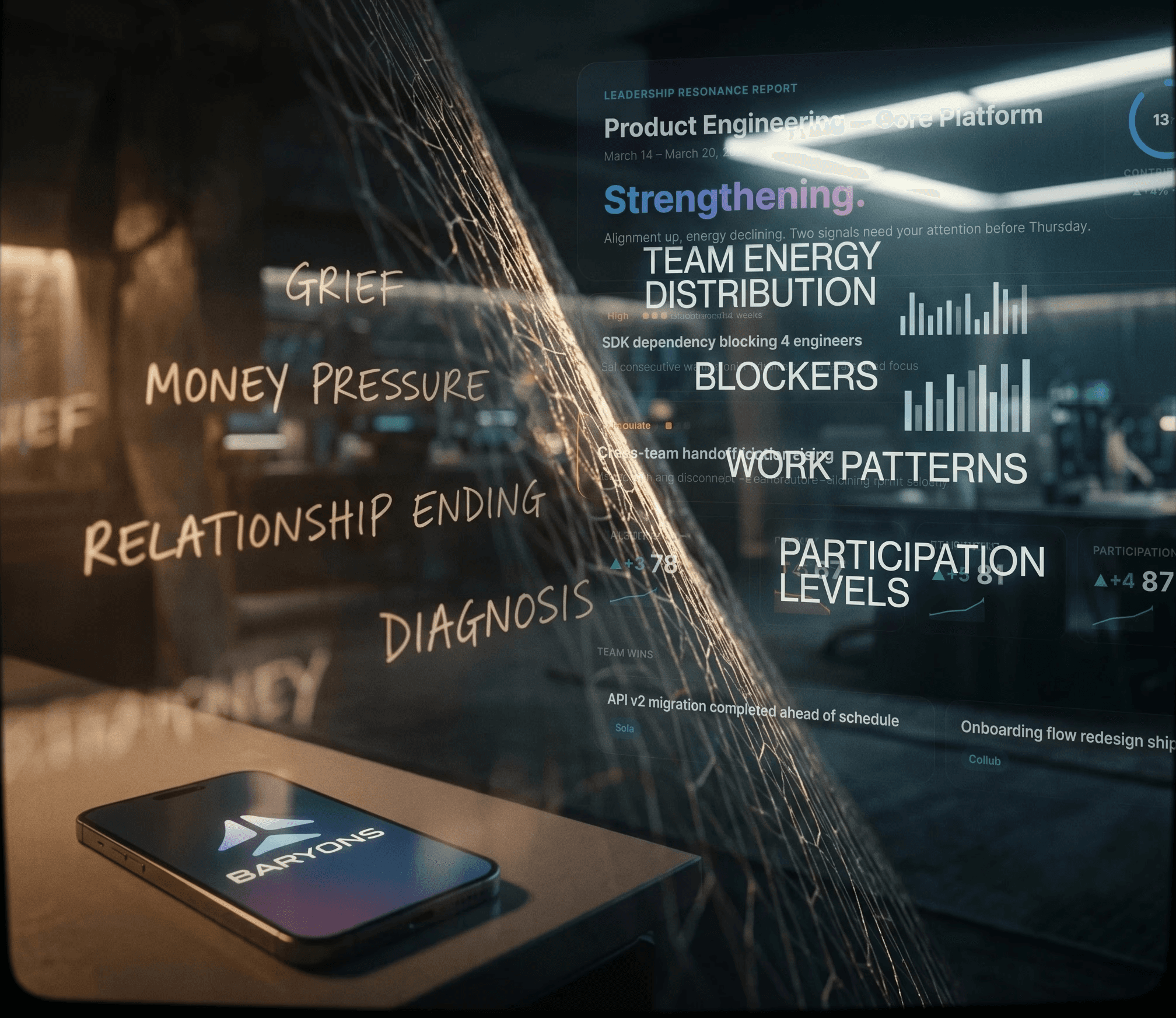
People tell their Baryon real things in an organizational context. The Privacy Mesh is how they can, while their leadership still sees a team's energy and never the contents of a life. Here is how that boundary actually holds.