The Coordination Tax: The Margin Leak Your Dashboard Cannot See

Every CFO knows how to spot the obvious threats to margin.
Rising labor costs, inflationary pressure, supply chain disruptions, shrinking demand, inventory challenges, climbing operating expenses. These risks surface quickly in financial reports, which makes them easier to identify, measure, and address.
The harder challenge is the productivity loss that never appears clearly on a dashboard. Not every threat to profitability arrives as a line item on an income statement. Some of the most significant margin erosion happens quietly, hidden inside the day-to-day dynamics of how people work.
A store manager spends half the day reconciling conflicting priorities from headquarters and regional leadership. District managers spend hours chasing updates instead of coaching teams. Employees repeat work because expectations changed midstream. Teams shift focus as priorities evolve. Approvals take longer than they should. Decisions get revisited again and again. None of these activities are usually categorized as costs, yet together they create an enormous productivity burden.
For retail organizations, and other distributed, labor-intensive businesses, this hidden coordination tax may be one of the largest sources of untapped margin opportunity. It is a symptom with a cause most reporting never reaches.
The Productivity Problem Hiding in Plain Sight
When organizations discuss productivity, the conversation usually centers on measurable outputs. Sales per labor hour, transactions per employee, revenue per store, operating expenses, headcount ratios. These metrics matter, and they rarely explain why productivity changes.
Two stores with identical staffing models and similar customer traffic can perform very differently. Two regions receiving the same corporate initiatives can execute them with dramatically different results. The difference often comes down to something traditional metrics fail to capture: how effectively people coordinate, make decisions, and execute together.
This is especially true in retail, where success depends on thousands of small decisions happening consistently across distributed teams. When those decisions get harder, productivity suffers. And when productivity suffers, margin eventually follows.
The Hidden Cost of Coordination Drag
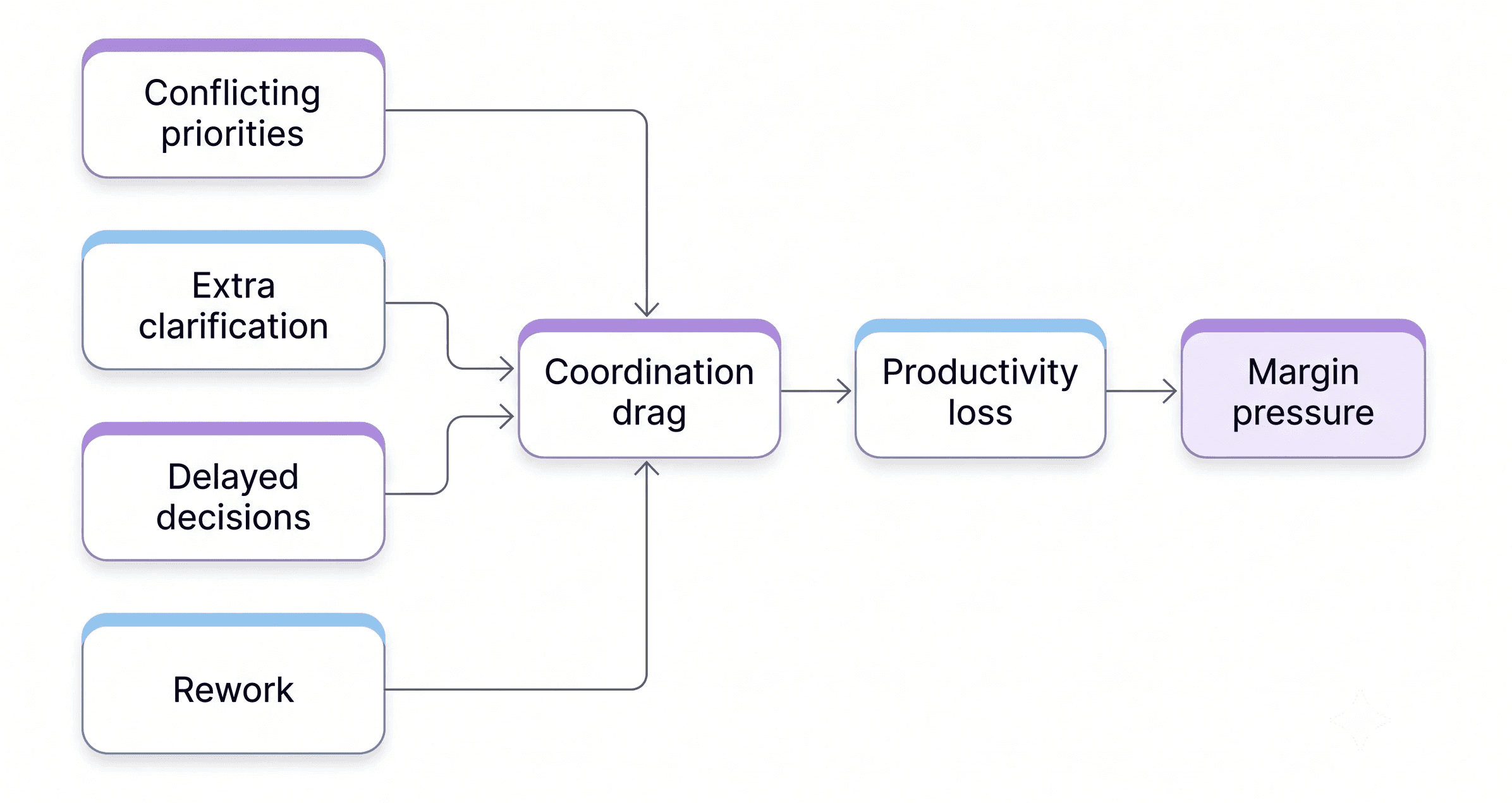
Every organization carries a certain amount of coordination work. Teams need meetings, managers need updates, leaders need visibility, and information has to flow across functions. The challenge arises when coordination itself becomes a significant portion of the work.
Consider a common retail scenario. A new promotional campaign launches. Corporate teams communicate one set of priorities. Regional leaders interpret the message differently. Store managers receive additional guidance from multiple sources. Questions pile up around execution. Employees seek clarification. The campaign launches late in some locations and inconsistently in others. No single event looks problematic, but collectively the organization has burned hundreds or thousands of productive hours managing confusion instead of serving customers.
This is coordination drag, and it is extraordinarily hard to see through traditional financial reporting, because the costs are dispersed. Five extra minutes in one store. An additional meeting in another. A delayed decision somewhere else. A little rework across multiple locations. Individually these seem insignificant. Collectively they create substantial productivity loss.
Why Retail Is Especially Vulnerable
Retail operates in one of the most complex execution environments in business. Distributed teams, multiple geographies, constant customer demand, frequent promotions and operational changes, high turnover, thin margins, and intense cost pressure. In this environment, even minor inefficiencies get expensive.
A store manager who spends excessive time clarifying priorities is spending less time coaching employees and improving the customer experience. A district manager buried in administrative coordination has less capacity to support execution. A frontline employee juggling competing priorities becomes less productive, less engaged, and more prone to mistakes.
These challenges rarely show up as direct expenses, yet they affect nearly every productivity metric the CFO ultimately cares about.
The Cost of Context Switching
One of the most overlooked sources of productivity loss is context switching. Employees constantly move between priorities. Managers shift attention across operational issues, customer demands, staffing challenges, and corporate initiatives. Store teams start one task, pause to address another, then another, then another.
Every switch carries a cost. Research has consistently shown that changing focus reduces efficiency and increases errors, and in distributed operations those costs get magnified because interruptions happen at scale. A small amount of lost productivity across hundreds of locations quickly becomes a material financial issue.
The trouble is that context switching rarely shows up in a dashboard. Financial reports capture labor expense, revenue, and operating margin. They do not capture the thousands of small interruptions that quietly consume productive capacity every day.
Rework Is More Expensive Than It Appears
Another hidden source of productivity loss is rework. Work gets repeated because priorities changed, instructions were misunderstood, communication was incomplete, decisions lacked clarity, or processes were executed inconsistently.
In retail, rework takes countless forms. Store displays are reset. Promotions are corrected. Schedules are revised. Reporting is repeated. Operational initiatives require additional follow-up. None of this directly generates value. It simply consumes time and resources that could have gone elsewhere.
Because rework is spread across teams and locations, organizations routinely underestimate its cumulative impact. The financial cost is real. It is simply hard to see..
Slow Decisions Create Invisible Costs
Speed matters, especially in customer-facing environments. Yet many organizations inadvertently create conditions that slow decision-making. Approvals move through multiple layers. Information is incomplete. Ownership becomes unclear. People hesitate to act.
The direct cost of slower decisions is rarely measured, but the indirect costs are substantial. Teams wait. Projects stall. Opportunities are delayed. Customer issues stay unresolved. Operational problems compound. In retail organizations operating at scale, even minor decision delays create ripple effects across stores, regions, and functions.
The resulting productivity loss often gets embedded in the organization and accepted as normal operating complexity. But complexity is expensive, and unnecessary complexity is more expensive still.
The Financial Dashboard Doesn't Tell the Whole Story
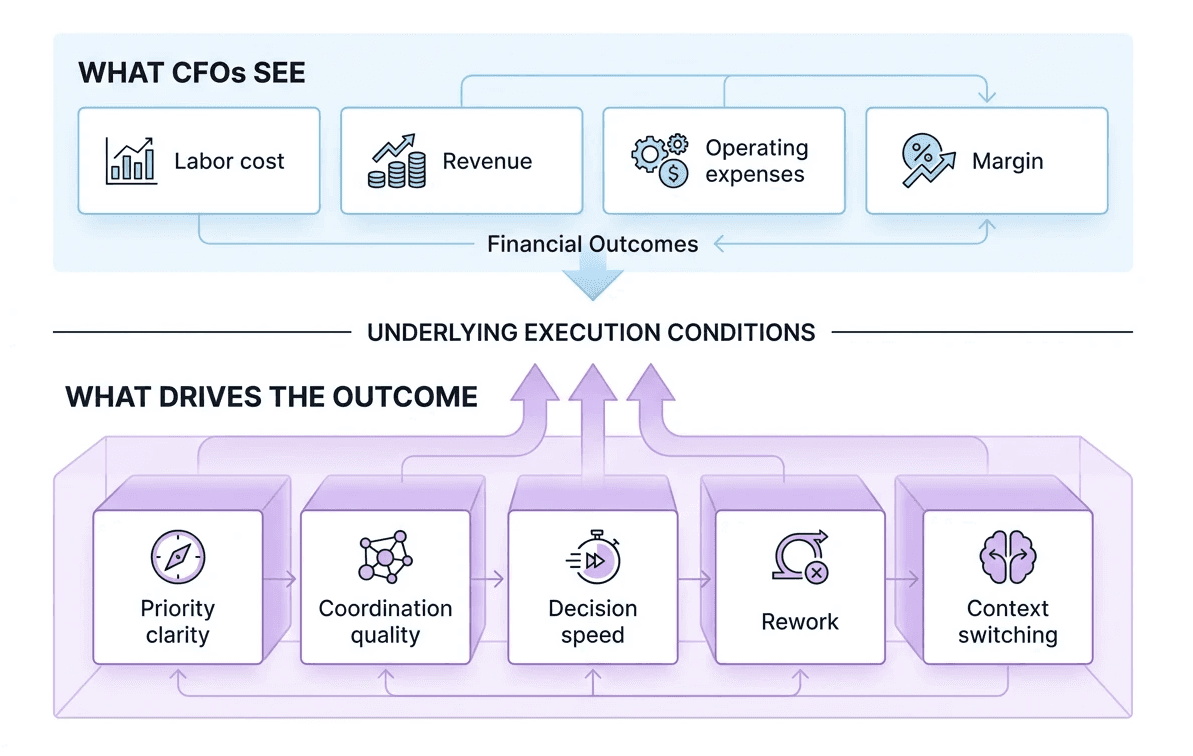
CFOs have more data than ever. Dashboards track financial performance in near real time. Operating metrics keep getting more sophisticated. Analytics capabilities keep improving. Yet many of the drivers of productivity stay invisible.
Financial outcomes are the result of countless human interactions: how clearly priorities are communicated, how effectively teams coordinate, how quickly decisions get made, how much friction exists across functions, how much time employees spend overcoming organizational obstacles rather than creating value. These factors shape productivity long before they touch financial results.
By the time margin deterioration becomes visible, the underlying causes may have existed for months. That is the challenge for finance leaders. The earlier these issues can be identified, the greater the opportunity to intervene before financial performance suffers.
The Emerging Need for Human Performance Signals
Leading CFOs are increasingly recognizing that productivity cannot be understood through financial metrics alone. To understand future performance, organizations need visibility into the human factors that shape execution.
Where is coordination becoming more difficult? Which teams are carrying more friction? Where is clarity deteriorating? How quickly are decisions being made? Which operating groups may be at risk of declining performance?
These questions are not about measuring individual productivity or scoring employees. They are about understanding the organizational conditions that influence productivity at scale. This is where Baryons fits. Baryons turns the daily conversations your people are already having into organizational signal, giving leaders a weekly read on where coordination is breaking down and where friction is building, without launching another survey.
It surfaces the human conditions behind productivity while there is still time to act, because productivity is rarely lost in dramatic moments. It is lost through small amounts of friction repeated thousands of times. A few extra minutes. A little confusion. An unnecessary meeting. A delayed decision. A preventable piece of rework. The cumulative impact can be enormous.
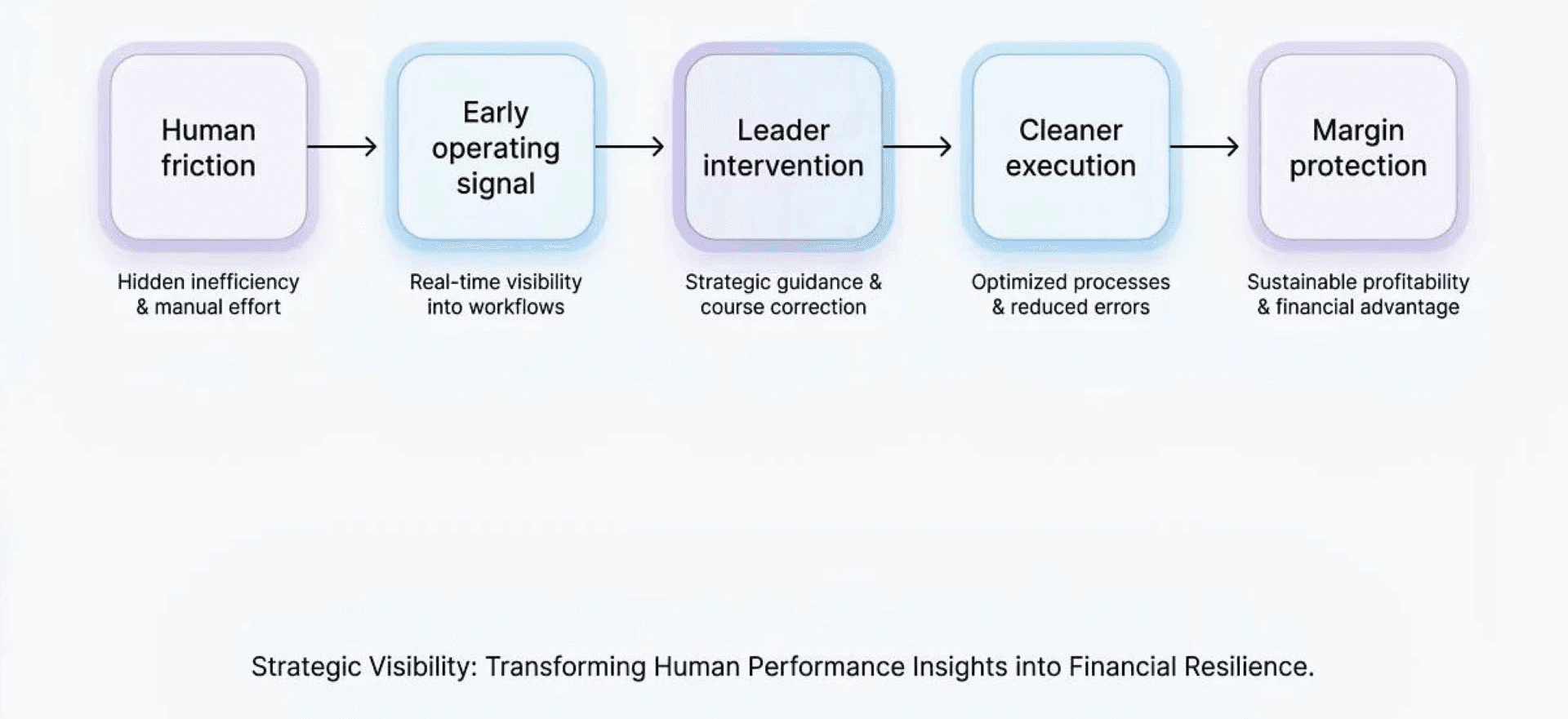
Turning Invisible Friction into Actionable Insight
The organizations that build lasting productivity advantages are often the ones that see these signals sooner. They treat human dynamics as operating issues, productivity issues, margin issues, and strategic issues.
For CFOs, the opportunity is to gain visibility into the factors that create outcomes, not only to measure the outcomes themselves. To understand where hidden productivity loss is emerging. To identify coordination drag before it becomes financial drag. To recognize when friction is starting to erode execution. To intervene before the costs reach the income statement.
At Baryons, we believe human performance is one of the most important leading indicators of business performance. As the Human Performance Layer, Baryons helps organizations translate human friction, alignment challenges, and execution risk into earlier operating signals, giving leaders visibility into what traditional dashboards miss.
Because in retail and other margin-sensitive organizations, the greatest productivity opportunities are not always hidden in the financials. Sometimes they are hidden in the way work gets done. And the organizations that see those signals first will be the ones that protect margin, sharpen execution, and outperform their competitors.
Watch : Baryons - The Overview on YouTube
Try it, its free!
Want it for your organization? Book a demo!
More articles

What Baryons Actually Does
Baryons helps leaders understand what is happening beneath business performance. This blog explains how unclear priorities, decision friction, manager strain, coordination breakdowns, and late execution risk all point to the same visibility gap and how Baryons turns individual reflection into anonymized, aggregated organizational signal.

Different Kinds of Visibility: Earlier Signal Without a Surveillance Culture
Leaders need earlier visibility into human risk, but more monitoring is not the answer. This blog explains the difference between employee surveillance and organizational insights, showing why trust is essential to signal quality and how leaders can understand patterns in clarity, alignment, momentum, and strain without reducing people to activity scores.

Dial It In: How to Talk to Your Baryon
Your Baryon is an AI you actually phone. Here's how to call it, what to say, and the small habits that make every conversation stick.