Different Kinds of Visibility: Earlier Signal Without a Surveillance Culture

Leaders need earlier visibility. Employees need reasons to trust it.
For CEOs, boards, and private equity investors, there is a difficult visibility problem inside almost every organization. By the time human risk becomes obvious, it is often already business risk. A critical team loses momentum. Managers begin compensating for unclear priorities. Confidence in a transformation weakens. Coordination gets harder. High performers start to disengage. Eventually the symptoms show up in delivery, retention, productivity, or financial performance.
It makes sense that leaders want to see these conditions earlier. How they create that visibility is what matters. The answer cannot simply be more monitoring. Tracking more individual activity produces more data, and more data is not the same as a clearer read on the organization. Done poorly, it puts at risk the one thing leaders cannot afford to lose: trust.
We believe there is a better distinction to make. Leaders need to understand the organization without turning employees into objects of observation. This is the difference between seeing the symptom and seeing the signal beneath it.
Organizational insights and employee monitoring solve different problems
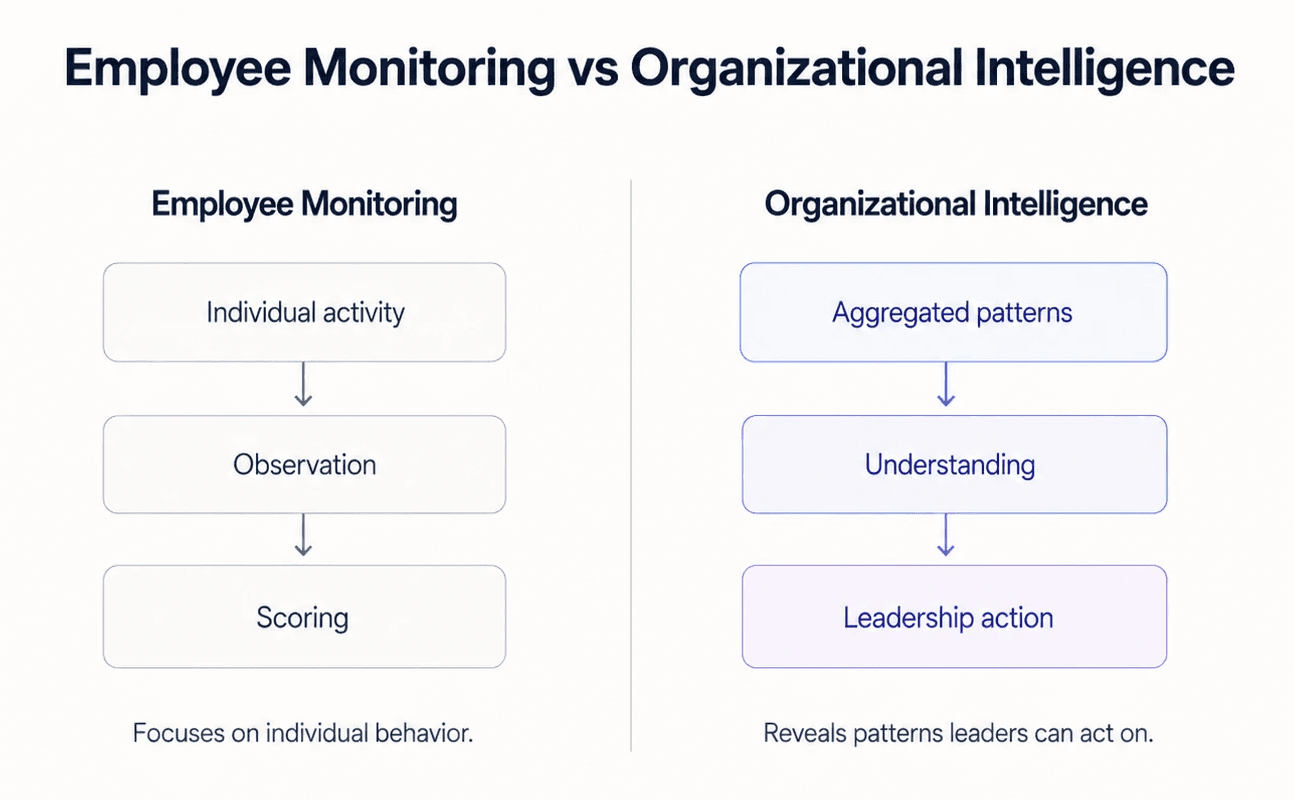
Employee monitoring generally starts with the individual. What is this person doing? How active are they? How much are they producing? Are they complying with an expected behavior?
Organizational insights start from a different question: what is happening across the system that leadership needs to understand? That means reading for patterns. Whether priorities are becoming less clear, whether alignment is weakening across teams, whether confidence is changing, or whether strain is emerging around a particular period of change.
The difference matters. One approach works to make individual behavior more observable. The other works to make organizational conditions more understandable. For a CEO, board member, or PE operating partner, the second is usually the more useful question. The goal is not to know whether an individual was active at 2:17 p.m. The goal is to understand whether the organization has the conditions it needs to execute the strategy.
Research has long raised concerns about getting this balance wrong. Deloitte’s research on workplace monitoring and organizational trust found that extensive monitoring can undermine trust and encourage “productivity theater,” where people optimize for appearing productive rather than creating value. That is the opposite of what leadership needs.
Conventional indicators arrive late
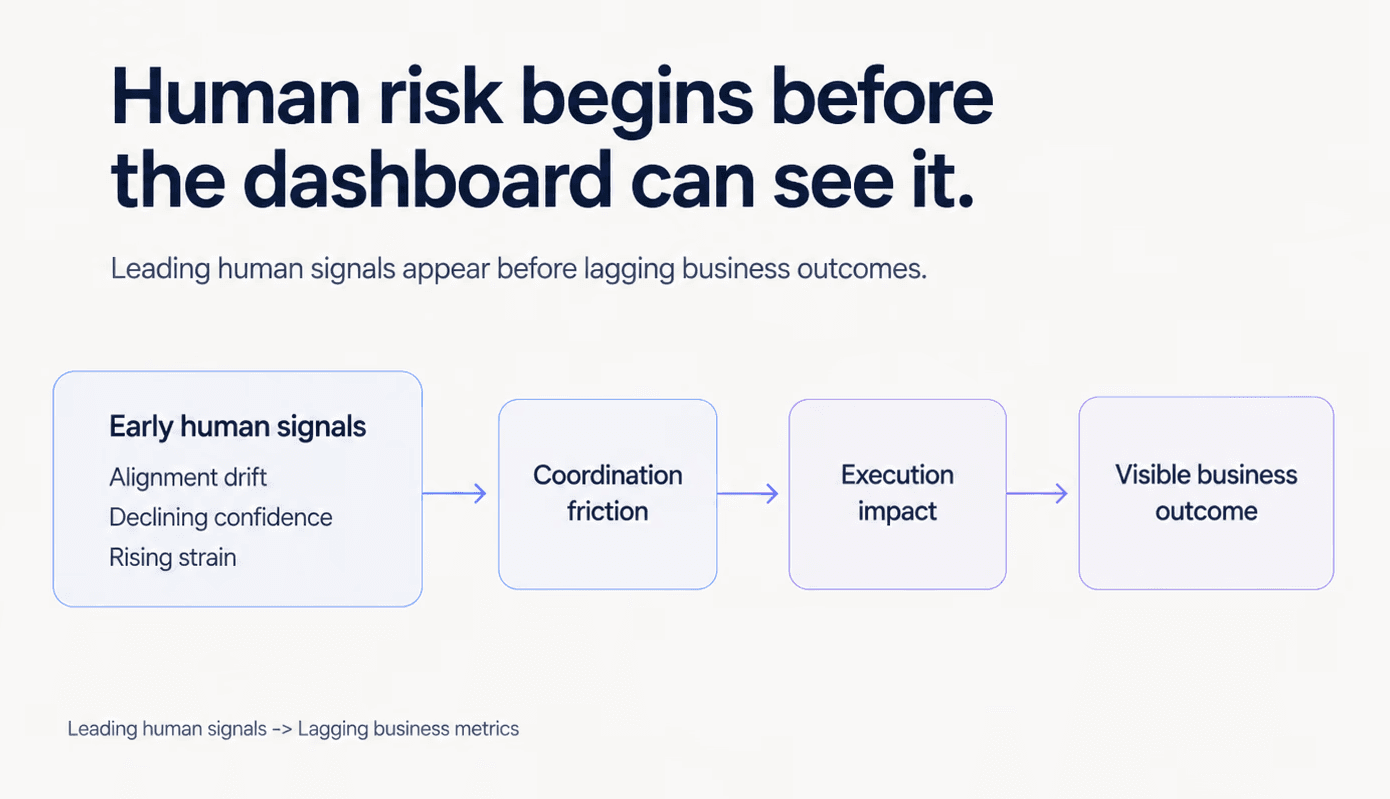
Boards and investors are used to managing risk through indicators. The difficulty with human risk is that many conventional indicators arrive late. Attrition tells you somebody left. An engagement survey tells you how people felt at a point in time. Missed targets tell you execution has already broken somewhere.
The trajectory usually starts earlier. A leadership team may notice priorities being interpreted differently across functions. Decisions that once moved quickly begin getting reopened. Managers spend more energy translating direction. Teams grow more cautious about raising concerns. Confidence in a transformation softens even while the formal milestones stay green. These signals can appear long before the eventual business outcome.
Deloitte’s 2026 Global Human Capital Trends makes the visibility challenge particularly relevant. Its research found that one-third of workers experienced 15 major changes in the previous year, while 85% of leaders said building the ability to adapt at the speed required today is critical. Deloitte also points to rising trust concerns and cultural friction as organizations accelerate AI-enabled change. When change is that frequent, waiting for lagging indicators is expensive.
More observation can actually produce worse signal
There is a paradox here that boards and executives should take seriously. The harder an organization tries to observe individuals, the less natural some employee behavior becomes. People adapt to what they believe is being measured. If activity becomes the metric, activity becomes the performance. If visibility becomes the goal, people learn to stay visible. The result can be a system that collects enormous amounts of data while understanding less about what is actually happening.
That is why we believe trust is part of signal quality. People need enough confidence in the system to surface uncertainty, friction, and concerns while those issues are still useful to leadership. If people feel individually evaluated every time they contribute a signal, they have a rational incentive to filter what they share.
Recent leadership research reinforces the importance of that environment. The Center for Creative Leadership’s 2026 research on psychological safety argues that leaders can better “read the room” when they intentionally create conversational space that allows a wider range of behavioral signals to emerge.
Better visibility, in other words, does not require making people feel more watched. It requires creating better conditions for meaningful signal.
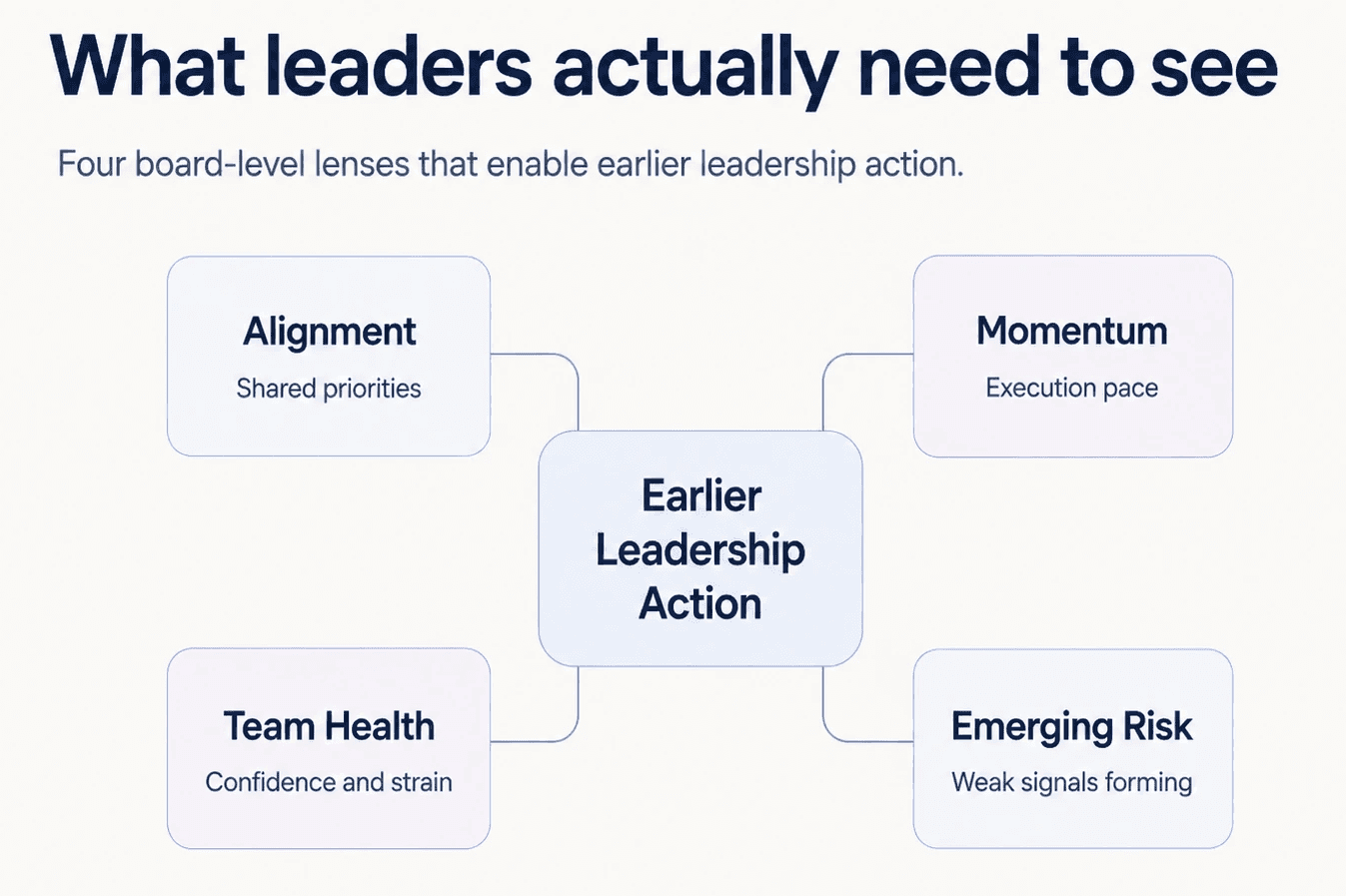
At board and investment level, human signal becomes useful when it helps answer operating questions. Is the organization aligned enough to execute the strategy? Is a major transformation gaining confidence or quietly losing it? Are teams holding momentum through change? Is strain concentrating somewhere that could create execution or retention risk? Are leadership interventions improving the trajectory?
Those are very different questions from "Who is productive?" They move the conversation from individual judgment to organizational pattern recognition.
This distinction becomes even more important as AI expands the amount of workforce data organizations can potentially collect. Gartner’s 2026 Hype Cycle for Digital Workplace Applications describes digital workplace priorities as shifting toward governing embedded AI and preparing for human-agent work models without sacrificing productivity or trust.
We think that balance, better signal while trust holds, will become a defining leadership capability.
Our approach is to understand patterns, not police activity
This is the design principle behind Baryons. We are building a Human Performance Layer because most leadership systems have a gap between what people are experiencing and what executives can see.
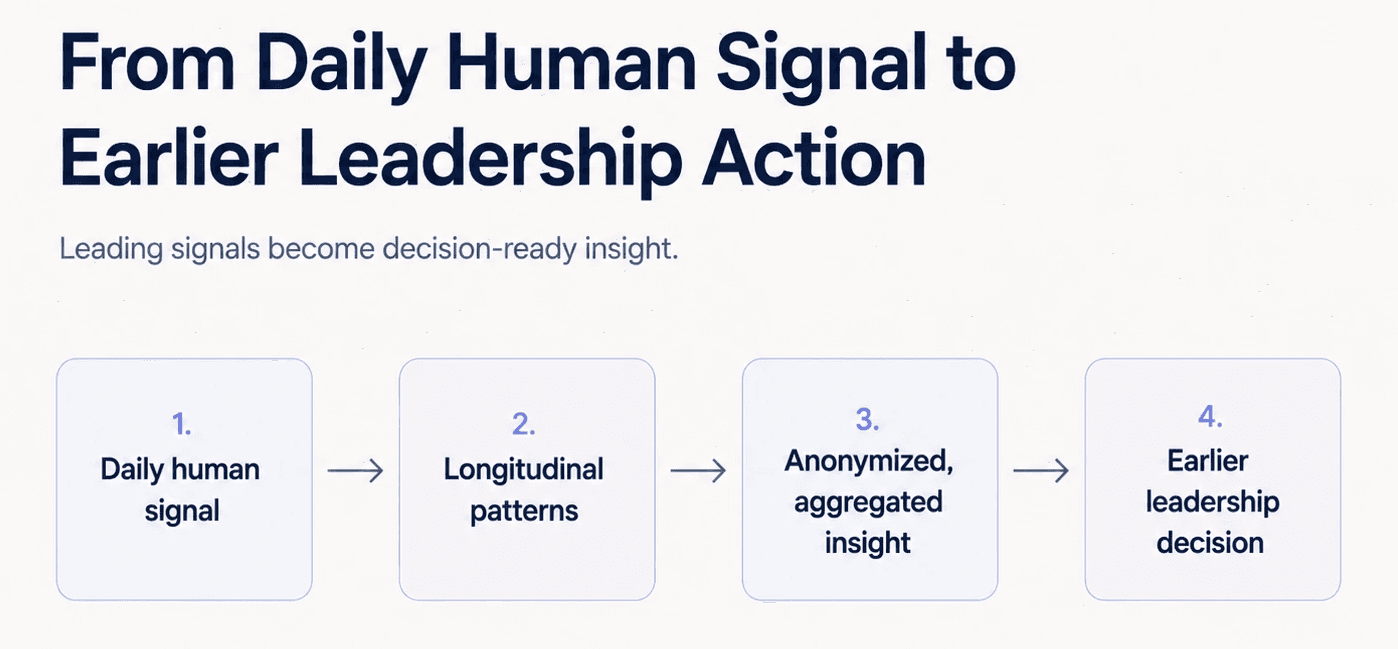
Our voice-first experience creates a low-friction daily touch point where people can prepare, reflect, and make sense of their work. Our Understanding Engine builds a longitudinal picture across those interactions rather than reducing the experience to a one-time survey score. At the organizational level, the objective changes.
Weekly Resonance Insights surface anonymized, aggregated patterns around areas such as team health, energy, momentum, engagement, relationships, flow, and purpose. Leaders see trajectories and emerging signals without the system becoming a leaderboard of individual activity. A privacy firewall keeps personal context from ever reaching a leader's view. Effects surface, causes stay private. That is the distinction we care about.
We are not trying to answer "Who worked hardest today?" We are trying to help leadership answer "What is changing inside this organization that we should understand before it affects performance?"
For PE, this is a value-creation visibility question
For private equity firms, the distinction is especially important. Human risk touches nearly every part of a value creation plan. Leadership transitions, operating model changes, AI adoption, cost transformation, integrations, and growth initiatives all depend on people interpreting priorities and executing coherently.
Yet investors typically get strong visibility into the outputs of those systems and much weaker visibility into the human conditions underneath them. That creates a blind spot.
The objective is not to create a new employee surveillance surface for the sponsor or board. It is to improve visibility into whether the organization is becoming more or less capable of delivering the plan. That can shift the board conversation from retrospective questions about what went wrong to earlier questions about what may be changing.
Trust is not separate from performance
We do not see employee trust as something leadership should protect only because it is culturally desirable. Trust affects whether leaders receive useful signal. If people believe organizational insight exists primarily to judge them, the quality of that signal deteriorates. When the purpose is clear and the system is designed around meaningful organizational patterns rather than individual activity scoring, leaders have a better foundation for understanding what is actually happening.
This is increasingly relevant as AI reshapes work. Deloitte's 2026 research found that 65% of organizations believe their culture needs to change significantly because of AI, while only 6% of leaders report making progress in designing human-AI interactions. Technology can increase what leadership is capable of seeing. The leadership question is what we choose to look for.
Final thought
The choice facing CEOs, boards, and investors is not between visibility and trust. It is between different kinds of visibility. One approach asks leaders to look harder at individuals. The other helps leaders understand the system. We believe the greater value lies in the second.
The goal is to see alignment drift, weakening momentum, emerging strain, and other human signals early enough to act, without reducing people to activity scores or treating work as something that must constantly be watched. That is the Human Performance Layer we are building at Baryons: earlier organizational insight designed to help leaders understand what is changing beneath business performance, with the focus on patterns, trajectories, and better decisions. Signal before symptom.
If your leadership team or investment committee is asking how to gain earlier visibility without creating a surveillance culture, that is a conversation we would welcome.
YouTube - Baryons - The Understanding Engine
Try it, its free!
Want it for your team? Book a demo!
More articles

Human Performance Is the Missing Layer in AI Transformation
AI transformation is not only a technology deployment challenge; it is an operating-performance challenge. This article examines how decision clarity, workflow redesign, accountability, trust-based visibility, and learning-oriented pilots help leaders convert AI capability into measurable work outcomes.

Why Employees Actually Use It
Employee participation cannot be sustained by organizational need alone. This article examines the value employees look for in a practice such as Baryons. Clarity, agency, constructive contribution, and less avoidable friction and gives sponsors a practical lens for earning trust.

How to Prove Human Performance Is Affecting Operating Results
CFOs and COOs need more than a broad engagement score to understand whether human-performance conditions are affecting execution. This article shows how to connect workforce conditions to observable operating behaviors, local process measures, and decision-ready pilot evidence over 90 days.
