Why Employees Actually Use It

TLDR
Employees do not sustain participation because an organization needs better data or a leadership initiative needs momentum. They participate when the experience gives them something immediate and credible: more clarity, a more useful way to articulate what is happening, and a meaningful sense of agency in their working life.
Introduction
For CHROs, COOs, and executive sponsors, adoption is often treated as a communications problem: explain the purpose, secure manager support, launch well, and participation should follow.
That sequence matters, but it starts in the wrong place. Employees do not experience an organizational practice as a strategy deck. They experience it in the middle of real work: competing priorities, unclear decisions, relationships that need care, and limited time. The practical question is not whether leadership has a reason to introduce Baryons. It is whether an individual sees a reason to return.
That is the employee-value test. When participation feels like another request made on behalf of management, it competes with work. When it helps someone make sense of work, express a concern constructively, or see a path toward a better conversation, it can become a credible, low-friction practice.
Adoption begins with an exchange of value
Every employee-facing practice makes an implicit trade: time and attention in exchange for something useful. The exchange does not have to be dramatic. Often, the value is practical: a moment to name a friction that has become normalized, language for an issue that is hard to raise, or a clearer view of what deserves attention.
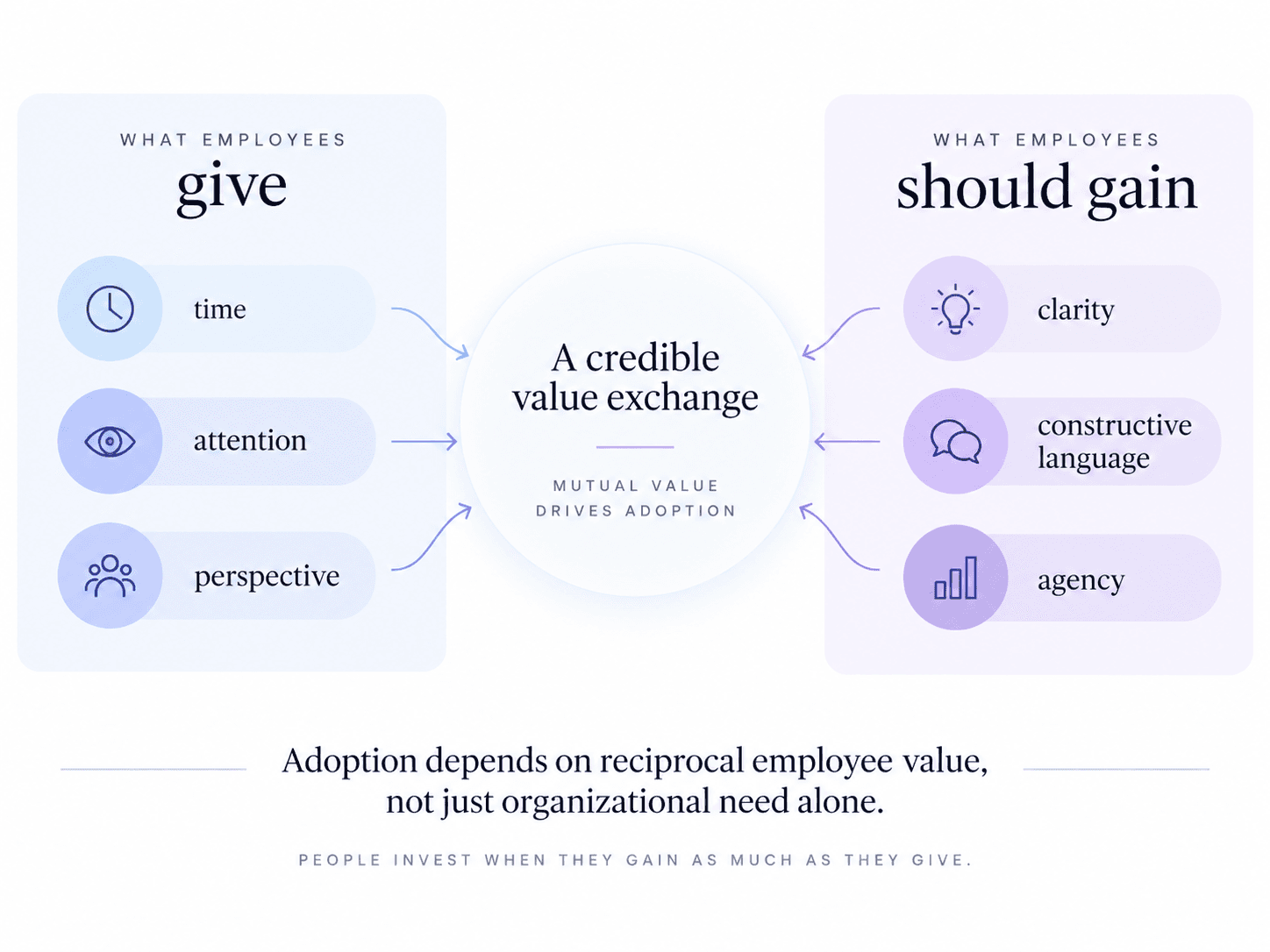
This is why participation reads as a judgment about relevance rather than mere compliance or program engagement. Employees ask, usually without saying so: Will this help me understand my situation? Can I contribute without performing for an audience? Will anything about my experience become more actionable?
The strongest answer is not, "Your feedback will help the company." That may be true, but it is incomplete. The stronger answer begins with the employee's own work and preserves their dignity as a participant, not merely a source of input.
Choice changes the quality of participation
People are more likely to engage thoughtfully when they can see a connection between the action and something they value. A 2026 workplace motivation meta-analysis, synthesizing 214 studies, found that perceived support for autonomy, competence, and relatedness was associated with need satisfaction and autonomous motivation. The results varied across contexts, so this is not a universal formula or proof of any one intervention’s effect. It is, however, a useful design principle.
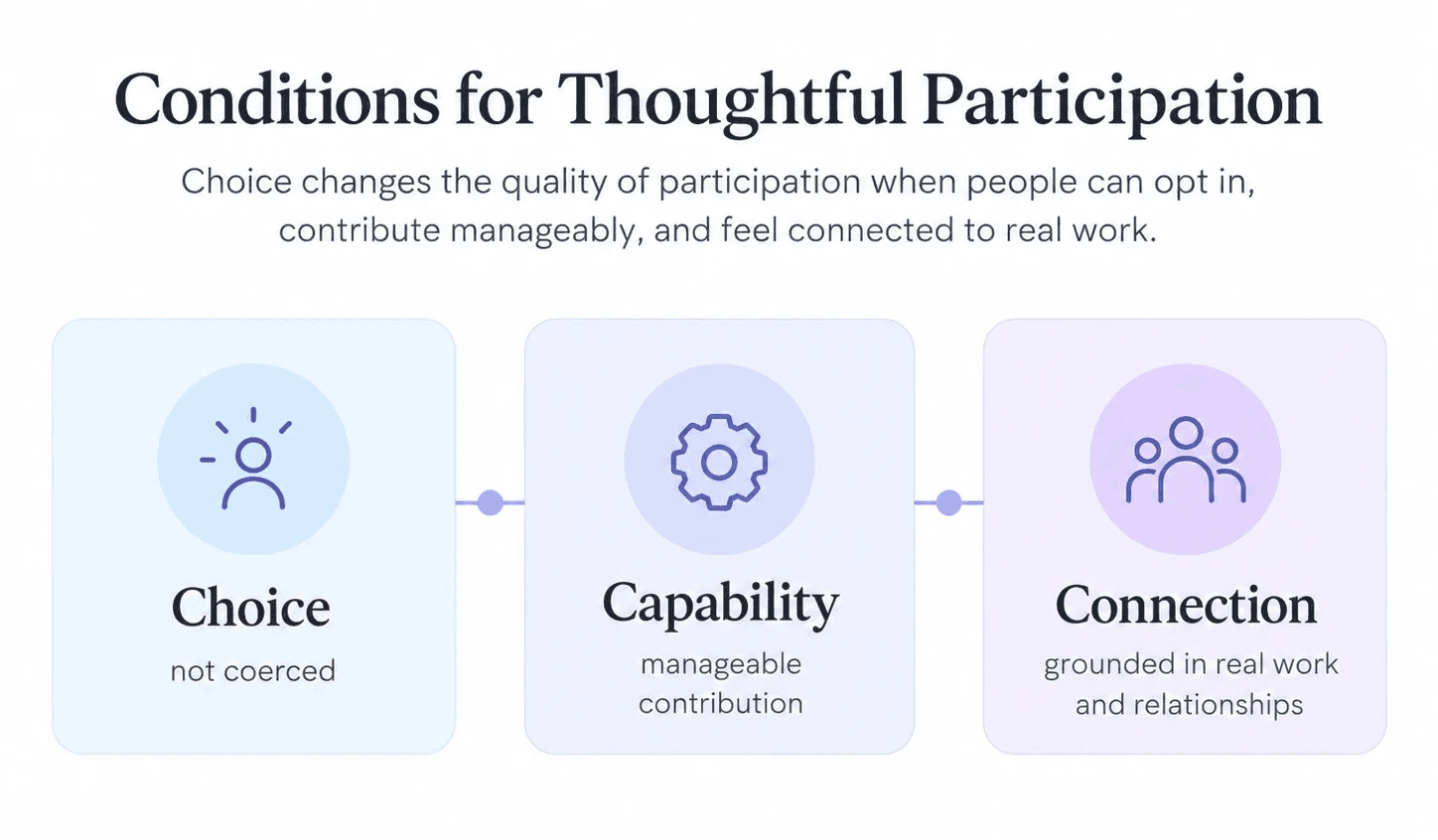
For employees, autonomy means participation does not feel coerced. Competence means they can make a contribution without needing specialist language or political confidence. Relatedness means the act of taking part is connected to real relationships and shared work rather than disappearing into an abstract system.
Baryons should earn use on those terms. The experience must respect people's judgment, make contribution feel manageable, and connect reflection to the work they are already trying to do.
The personal gain is often clarity before change
Leaders may look for visible organizational outcomes first. Employees often look for a more immediate gain: clarity. Before a team can address a recurring tension, people need a way to distinguish a one-off frustration from a pattern worth discussing.
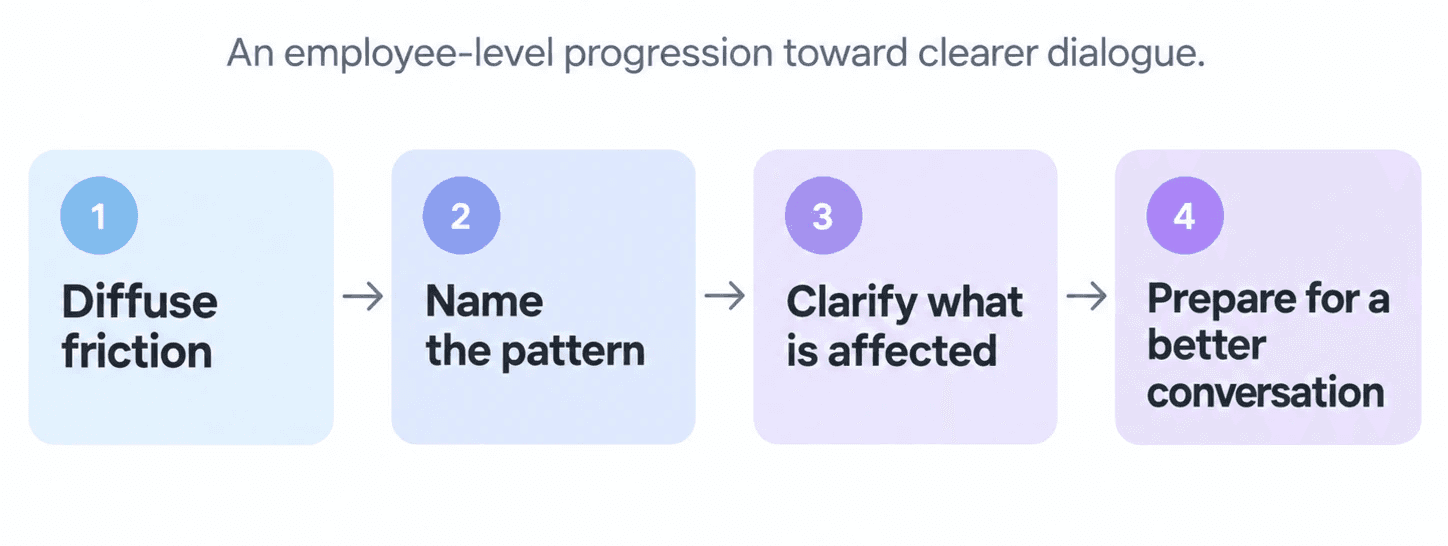
That distinction matters because vague dissatisfaction is hard to act on. A person may know that work feels harder than it should, yet struggle to identify whether the issue is priorities, coordination, decision rights, workload, or a relationship. A useful practice helps turn that diffuse experience into something more specific and discussable.
This is not a promise that every issue will be resolved. It is a more credible proposition: taking part can help an employee locate what is affecting their work and prepare for a better next conversation. That is personal value even before a broader operating response occurs.
Voice is not just information for leaders
Employee contribution has its own consequences for the person who contributes. A 2025 review of employee voice consequences examines how constructive voice can shape affective, cognitive, and behavioral responses among employees, coworkers, and managers. It does not suggest that every invitation to speak produces a positive outcome. It does reinforce a crucial point: voice is relational, not transactional.
Employees are therefore deciding whether it is safe and worthwhile to make their perspective visible, rather than simply completing an input field for management. They may be weighing exposure, effort, hope, and past experience. An employee-value approach recognizes those stakes.
The leadership obligation is to make participation proportionate, intelligible, and respectfully handled. If contribution is invited, employees need to be able to understand what happens next, even when the answer is that a concern cannot be solved immediately.
Low friction means fewer demands, not lower standards
"Easy to use" is often described as a design feature. In an employee-value context, it is broader than that. Low friction means the practice does not require people to decode an initiative, repeat context they have already supplied, or spend more energy navigating the process than reflecting on the issue.
The standard is usefulness in the flow of work. In a 2025 U.S. worker technology survey, 69% of respondents said workplace technology makes their job easier; faster access to information, quicker task completion, and better work quality were among the leading reported benefits. Those are self-reported perceptions of technology generally, not evidence about Baryons. Still, they clarify the employee benchmark: a new practice must feel like it reduces avoidable effort or improves the quality of work.
For sponsors, the implication is direct. Do not measure adoption only by whether people showed up. Ask whether the experience helped them do something they already needed to do.
Sponsor the conditions, not the participation target
Executive sponsorship remains important, but its job is often misunderstood. Sponsorship should protect the conditions for honest, useful participation: clear purpose, time to engage, local respect for the process, and disciplined follow-through. It should not turn participation into a public loyalty test.
A practical sponsor review can focus on five questions:
What immediate value can an employee reasonably expect?
Where does this fit naturally within real work?
What makes contribution feel safe enough and simple enough?
How will managers respond without overpromising?
What will employees be able to see, learn, or discuss after participating?
These questions shift the launch conversation from "How do we drive uptake?" to "What are we asking people to trust us with, and what do they receive in return?" That is a more durable basis for adoption.
Final Thought
Employees actually use a practice when it recognizes that their time, perspective, and working relationships have value. The organizational benefit may be better visibility into conditions that affect execution. But it cannot be the only benefit on offer.
For executive sponsors, the test is simple: if an employee explained the experience to a colleague, would they describe it as something that helps them work through what matters, or as another request from the organization? The answer will shape participation long before a launch plan does.
If you are evaluating whether an employee-facing practice has a credible value exchange, start by examining the experience from the employee's point of view. Explore Baryons with that question in mind.
The fastest way to judge an employee-facing practice is to try it as an employee. Bring a real friction to your Baryon, name the thing that has quietly become normal, and see whether you come away with something more discussable than when you started. Call 231-BARYONS or begin at app.baryons.com.
Signal before symptom.
No Baryon yet? Creating one takes a few minutes and costs nothing, for anyone: get yours here.
Curious whether your people would find it worth their time? Book a demo and we'll show you the employee's view first.
Want the quick tour? Watch the Baryon Overview on YouTube.
More articles

How to Prove Human Performance Is Affecting Operating Results
CFOs and COOs need more than a broad engagement score to understand whether human-performance conditions are affecting execution. This article shows how to connect workforce conditions to observable operating behaviors, local process measures, and decision-ready pilot evidence over 90 days.

Going Deeper: The Thinking Partner and the Growth Partner
Both the Thinking Partner and the Growth Partner grow you. The difference is shape. A look at when to reach for each, and why depth is where the magic lives.

Why This Isn’t a Pulse Survey
Baryons is not another employee pulse survey. This blog explains the difference between periodic listening and longitudinal organizational signal, showing how Baryons helps CHROs and People leaders understand what changes between survey moments: clarity, momentum, alignment, strain, and emerging patterns that may matter before they become obvious symptoms.
