Human Performance Is the Missing Layer in AI Transformation

TLDR
AI transformation does not stall only because models, data, or funding are inadequate. It stalls when organizations add powerful tools without redesigning how people decide, coordinate, learn, and take accountability for the capacity AI creates. Human performance is the operating layer that turns AI activity into durable business value.
Introduction
Most AI programs begin with a technology question: Which tools should we deploy, where can we automate, and how quickly can we scale? Those are necessary questions, but they are incomplete. The harder question is whether the organization can convert new capability into better operating performance.
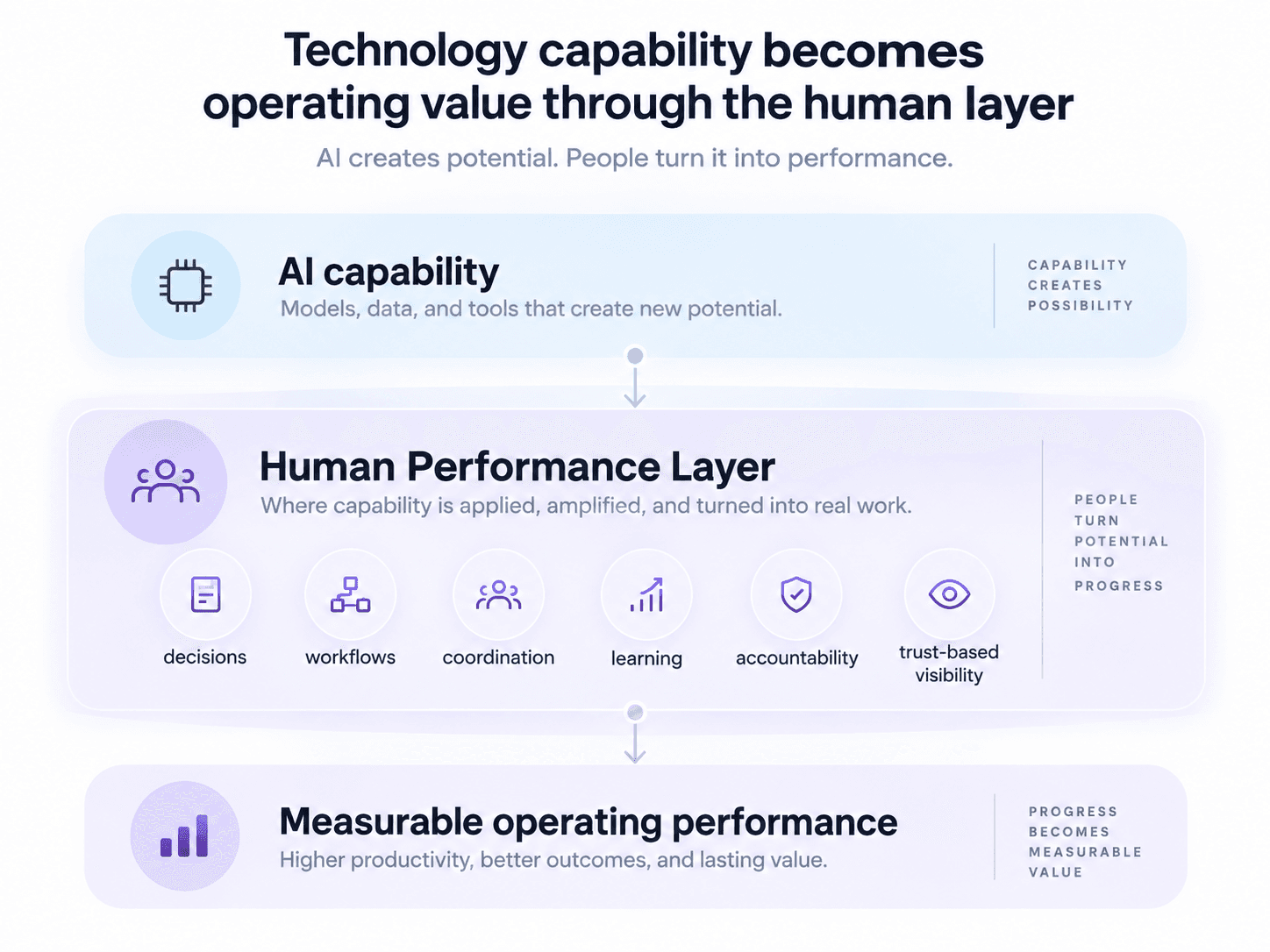
That conversion happens through people and systems: clearer decisions, redesigned work, trusted visibility, shared expectations, practical learning, and leaders who can direct newly available capacity toward priorities that matter. Without those conditions, an organization can show adoption, enthusiasm, and even time savings while struggling to show meaningful operational improvement.
For executives, human performance is not a soft complement to AI transformation. It is the missing layer between technical possibility and repeatable value.
Tool deployment is not operating-model change
Deploying an AI tool changes what is possible. It does not automatically change how work moves through the enterprise. Existing approval paths, ambiguous decision rights, overloaded managers, fragmented handoffs, and conflicting incentives can remain intact, now operating faster.
This distinction matters because AI can magnify the strengths and weaknesses already embedded in a system. If a team has clear priorities and disciplined workflows, faster drafting, analysis, or retrieval may create useful capacity. If the team is unclear about ownership or what a good outcome requires, speed can simply create more output, more review, and more noise.
The executive task is therefore not to ask whether a tool is being used. It is to identify the operating work that must change around it: the workflow, decision, handoff, control point, and measure of success.
Saved time becomes value only when it has a destination
Productivity claims often stop at time saved. But time is an input rather than an outcome. Capacity creates value only when leaders decide where it goes and make that choice operationally real.
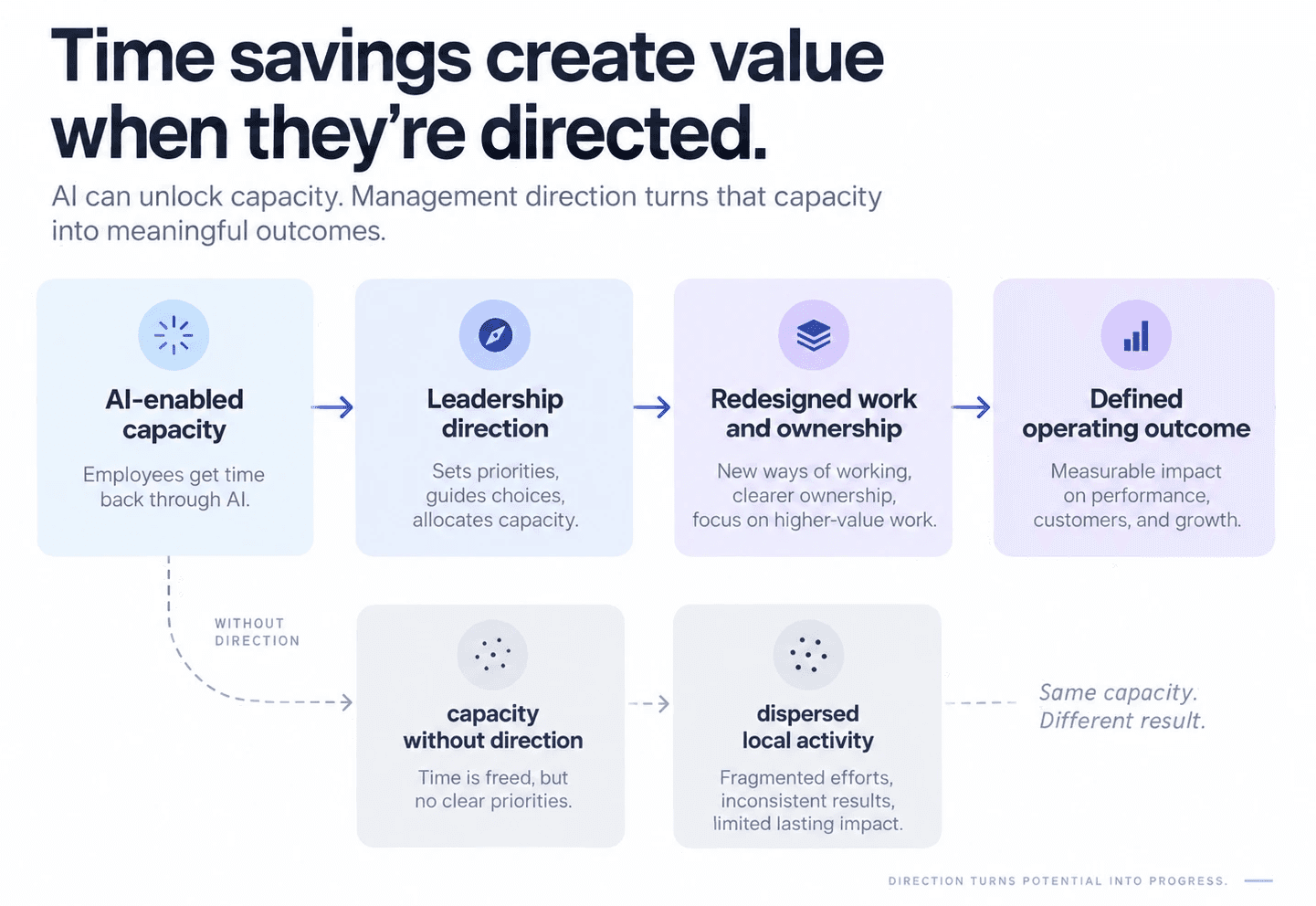
In BCG's 2026 AI at Work survey, 42% of regular frontline AI users reported saving at least eight hours a week, while 66% said they received limited or no guidance on how to use time saved. These are reported survey findings, not independently measured productivity gains, but they highlight a familiar management problem: capacity without direction can dissipate.
A better question is: what should the organization do differently with the capacity AI may release? The answer might be faster customer resolution, more rigorous forecasting, reduced rework, stronger quality control, or more time for high-consequence decisions. The destination should be explicit, owned, and observable. Otherwise, AI can become a local efficiency gain with no enterprise-level consequence.
Early warning signals sit in the human system
Lagging financial measures remain essential, but they arrive after operating conditions have already taken hold. AI transformation needs earlier signals that reveal whether the organization is becoming more capable or merely more active.
Useful signals include recurring decision delays, uneven adoption across connected teams, rising rework, unclear escalation paths, weak confidence in new ways of working, and managers carrying unresolved coordination burden. None is a standalone verdict. Together, they indicate whether technology is being integrated into work or placed on top of it.
Adoption patterns deserve particular attention. Gartner's 2025 employee AI survey found that 65% of surveyed employees were excited to use AI at work, yet 37% said they did not use available AI because their coworkers were not using it. That result does not prove a business effect, but it shows why access and individual attitude are insufficient measures. Adoption is also social: people need shared norms, credible examples, and workflows in which use makes sense.
Accountability must connect workflow, behavior, and measures
AI governance often concentrates on risk, procurement, and technical controls. Those responsibilities matter. Yet value governance is different: it asks who owns the operating outcome, which workflow is changing, what behavior must change, and how leaders will know whether the change is working.
This requires measures that are close enough to the work to guide action and meaningful enough to matter to the business. A team might track cycle time, quality, customer response, forecast accuracy, exception volume, or decision latency, depending on the workflow. The point is to establish a credible link between a defined intervention and a defined operating result rather than a universal AI score.
That discipline aligns with McKinsey's survey on AI workflow redesign, where workflow redesign had the strongest association, among 25 attributes tested, with reported gen-AI EBIT (Earnings Before Interest and Taxes) impact. Because this is observational survey evidence, it does not establish causation. It does reinforce the practical lesson: value is more likely to be found in changing work than in adding tools to unchanged work.
Trust-based visibility is a management capability
Executives need visibility into whether transformation is progressing, but visibility should not become surveillance. Counting prompts, logins, or individual activity may show tool interaction; it rarely explains whether work is improving, where teams are blocked, or what leaders should change.
Trust-based visibility focuses on conditions and patterns: where a redesigned workflow is being adopted, where handoffs are breaking down, where guidance is unclear, and whether teams can translate experimentation into reliable practice. It combines operational measures with direct understanding of the work, rather than treating people as telemetry.
This distinction protects candor. When employees believe signals will be used to punish rather than improve the system, they have reason to conceal workarounds and risks. When leaders use visibility to remove friction, clarify priorities, and support learning, the organization has a better chance of seeing problems early enough to act.
Start with a bounded pilot built for learning
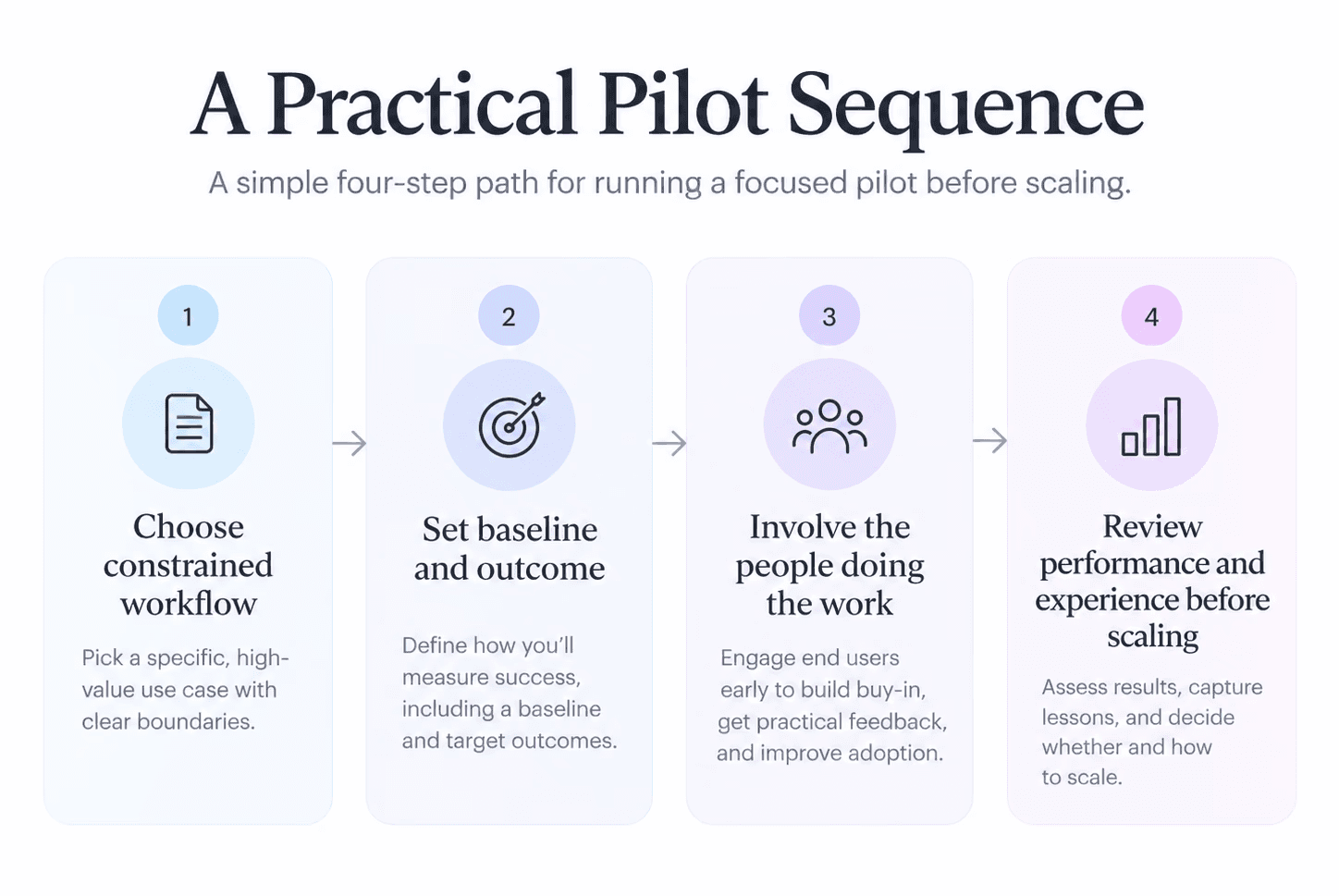
A credible pilot is a test of a meaningful operating hypothesis rather than a small-scale launch: if we redesign this workflow, equip this group, clarify these decisions, and direct capacity toward this outcome, what changes?
Choose a workflow with a real performance constraint, a committed business owner, and a measurable outcome. Establish a baseline. Involve the people who do the work in shaping the change. Define what will be learned, not only whether the technology functions but whether roles, handoffs, controls, and incentives support adoption.
Then review both performance and experience. Where did the work improve? Where did burden move rather than disappear? What conditions distinguished teams that integrated the change from those that did not? A pilot designed this way gives leaders evidence for a scaling decision, not simply a demonstration of technical feasibility.
Final Thought
The next phase of AI transformation will not be won by the organization with the longest list of tools. It will be won by the organization that can repeatedly turn capability into coordinated, accountable, measurable work.
That is why human performance belongs in the transformation agenda alongside architecture, data, risk, and investment. It is the layer that makes strategy executable when work itself is changing.
As your organization moves from AI experimentation to operating change, use the human performance layer as a leadership lens: identify the workflow, clarify the decision, define the early signals, and make the intended performance outcome visible. Baryons works from this premise: transformation becomes durable when the human system is designed to carry it.
Tools move fast. Whether the work around them actually changes is a human question, and it is the one Baryons is built to help you answer. Bring a real transformation constraint to your Baryon, name the workflow that has quietly stopped keeping up, and see what surfaces. Start at app.baryons.com or call 231-BARYONS.
Signal before symptom.
Not set up yet? Getting your own Baryon is quick, and free for anyone who wants one: claim yours here.
Want to see how this lands with your leadership team? Book a demo and we'll map it to a real workflow.
Prefer the short version first? Watch the Baryon Overview on YouTube.
More articles

Why Employees Actually Use It
Employee participation cannot be sustained by organizational need alone. This article examines the value employees look for in a practice such as Baryons. Clarity, agency, constructive contribution, and less avoidable friction and gives sponsors a practical lens for earning trust.

How to Prove Human Performance Is Affecting Operating Results
CFOs and COOs need more than a broad engagement score to understand whether human-performance conditions are affecting execution. This article shows how to connect workforce conditions to observable operating behaviors, local process measures, and decision-ready pilot evidence over 90 days.

Going Deeper: The Thinking Partner and the Growth Partner
Both the Thinking Partner and the Growth Partner grow you. The difference is shape. A look at when to reach for each, and why depth is where the magic lives.
