How to Prove Human Performance Is Affecting Operating Results

TLDR
Human performance should not be treated as a soft explanation for hard operating problems. CFOs and COOs can test its relevance by defining a specific operating constraint, measuring the behaviors and workflow conditions around it, and tracking whether leading indicators move before the business outcome does.
Introduction
When delivery slips, rework rises, retention deteriorates, or a frontline process becomes inconsistent, the usual response is to search for a technical, structural, or financial cause. Those causes matter. But they can obscure a more immediate operating condition: whether people have the clarity, capacity, coordination, and management support required to execute the work as designed.
The challenge for a CFO or COO is not to prove that people "matter." It is to establish whether a defined human-performance condition is plausibly contributing to a specific operating result, and whether changing that condition is associated with measurable improvement. That requires a measurement discipline stronger than an engagement score and more practical than a broad transformation program.
Start with an operating problem, not a people metric
The most credible starting point is a business problem with a clear owner, boundary, and consequence. Examples include avoidable attrition in a critical role group, missed handoffs between sales and delivery, inconsistent shift-start routines, delayed close activities, or escalating exception volume in a core workflow.
Then ask: what must people reliably do for this result to improve? The answer may involve role clarity, decision rights, skill coverage, manager follow-through, escalation quality, or cross-functional coordination. These read as observable operating conditions rather than abstract cultural themes.
This distinction matters because a broad score can describe sentiment without explaining a workflow failure. A focused operating problem gives leaders a basis for selecting the few human signals that may be relevant to execution.
Build a measurement chain rather than a direct-causation claim
Human signals rarely provide a clean, standalone explanation for a financial result. A better logic is a chain: workforce condition → operating behavior → process result → business consequence.
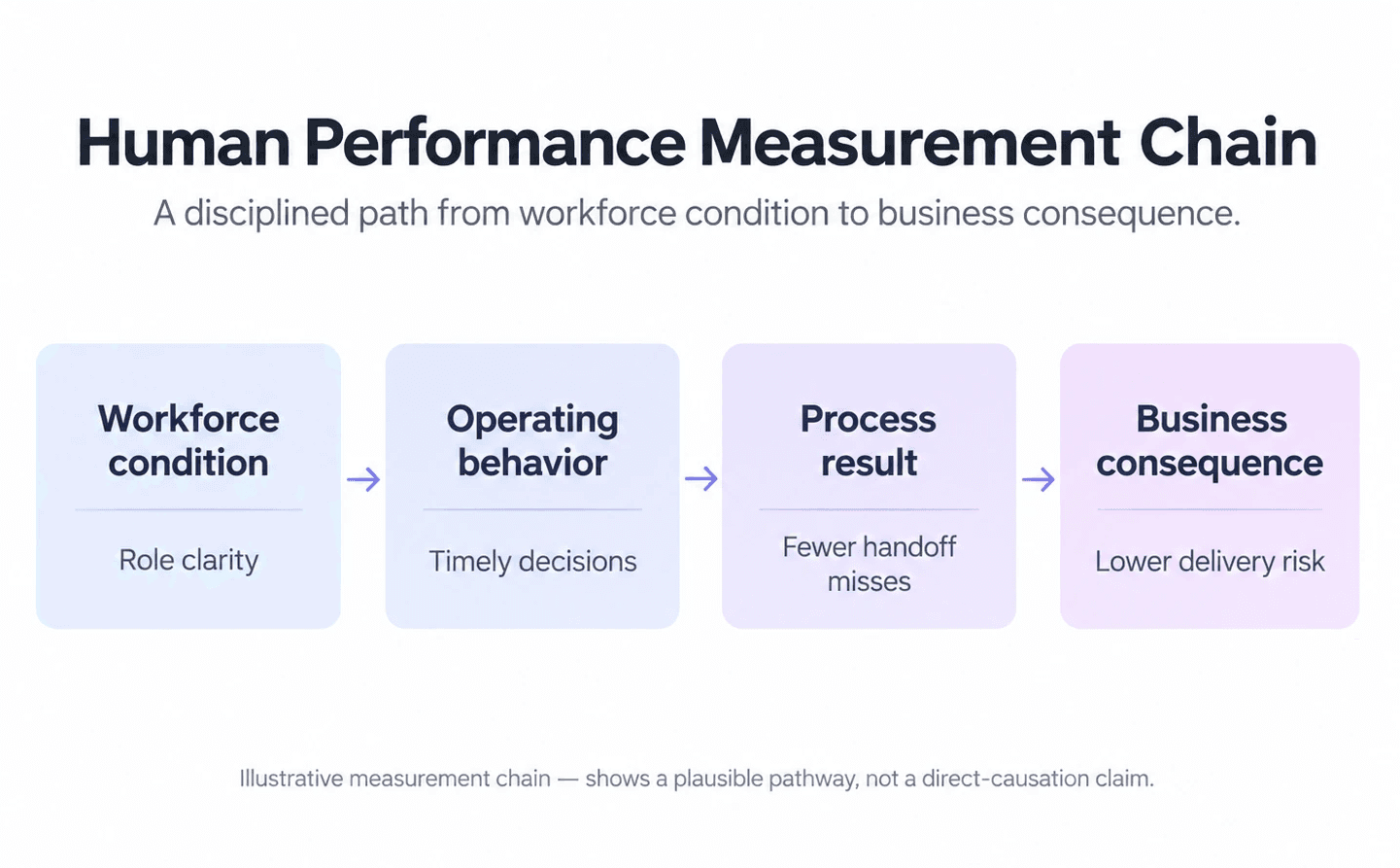
For example, unclear ownership may show up first in delayed decisions; delayed decisions may create handoff misses; handoff misses may increase rework or delivery risk. The financial effect, if there is one, is downstream and shaped by many other variables.
That framing is consistent with Gallup’s 2024 work-unit performance meta-analysis, which reports relationships between engagement and outcomes including productivity, turnover, quality, safety, absenteeism, customer loyalty, and profitability. Gallup also cautions that profitability is likely influenced through nearer operating outcomes. The practical implication is clear: do not claim that a human signal caused margin movement. Test whether it is connected to the operational pathway that could affect margin.
Use leading indicators that fit the workflow
A pilot should pair human signals with evidence from the work itself. If the operating problem is poor handoff quality, useful measures might include completeness of handoff, unresolved items at transfer, time to clarification, rework volume, and the experience of people responsible for the transition.
The point is to establish a baseline and choose a small set of indicators that can show whether the targeted behavior is becoming more reliable, without standing up a large measurement program. A mixed-method handoff baseline assessment in a pediatric critical-care setting used direct audits alongside staff surveys before designing improvement work. Its setting is specialized, not a general business benchmark, but its measurement logic is useful: combine observed workflow evidence with the perspective of the people doing the work.
That combination helps distinguish a perception problem from an execution problem, and it reveals when both are present.
Make the baseline local and the comparison fair
Enterprise averages often dilute the signal leaders need. Measure the affected team, site, role group, workflow, or manager population. Define the time window. Capture relevant context such as demand volume, staffing changes, system releases, or policy shifts that could influence results.

A practical baseline answers four questions:
• What outcome is currently under pressure?
• Which operating behavior is expected to influence it?
• What human or management condition may be disrupting that behavior?
• What evidence would count as meaningful improvement over the pilot period?
This creates a disciplined comparison, short of experimental certainty. If the targeted condition and operating behavior improve while the process outcome stabilizes or improves, leaders have a stronger basis for action than they would from anecdote alone. If they do not move, the hypothesis should be revised rather than defended.
Treat retention and capacity as operating variables
For operations leaders, talent risk is often an execution constraint rather than a separate HR issue. In PwC’s May 2025 COO Pulse Survey, 46% of the 82 COO respondents placed talent retention and skill shortages among their top three barriers to delivering operations strategy. The survey also identifies cross-functional collaboration, fragmented systems, and constrained visibility as reported execution barriers.
CFOs face a related concern inside finance. Deloitte’s 2025 CFO Signals workforce survey found that 50% of surveyed CFOs identified employee engagement and 45% identified skilled-talent shortages as major workforce challenges in meeting C-suite expectations for finance. These are perceptions from particular executive samples, not proof of productivity loss. Still, they justify testing whether workload, capability coverage, and manager conditions are affecting a defined service, control, or throughput measure.
Use 90 days to scope, launch, and measure
A 90-day pilot is long enough to test a focused operating hypothesis without waiting for an enterprise-wide change program. The structure should be simple.
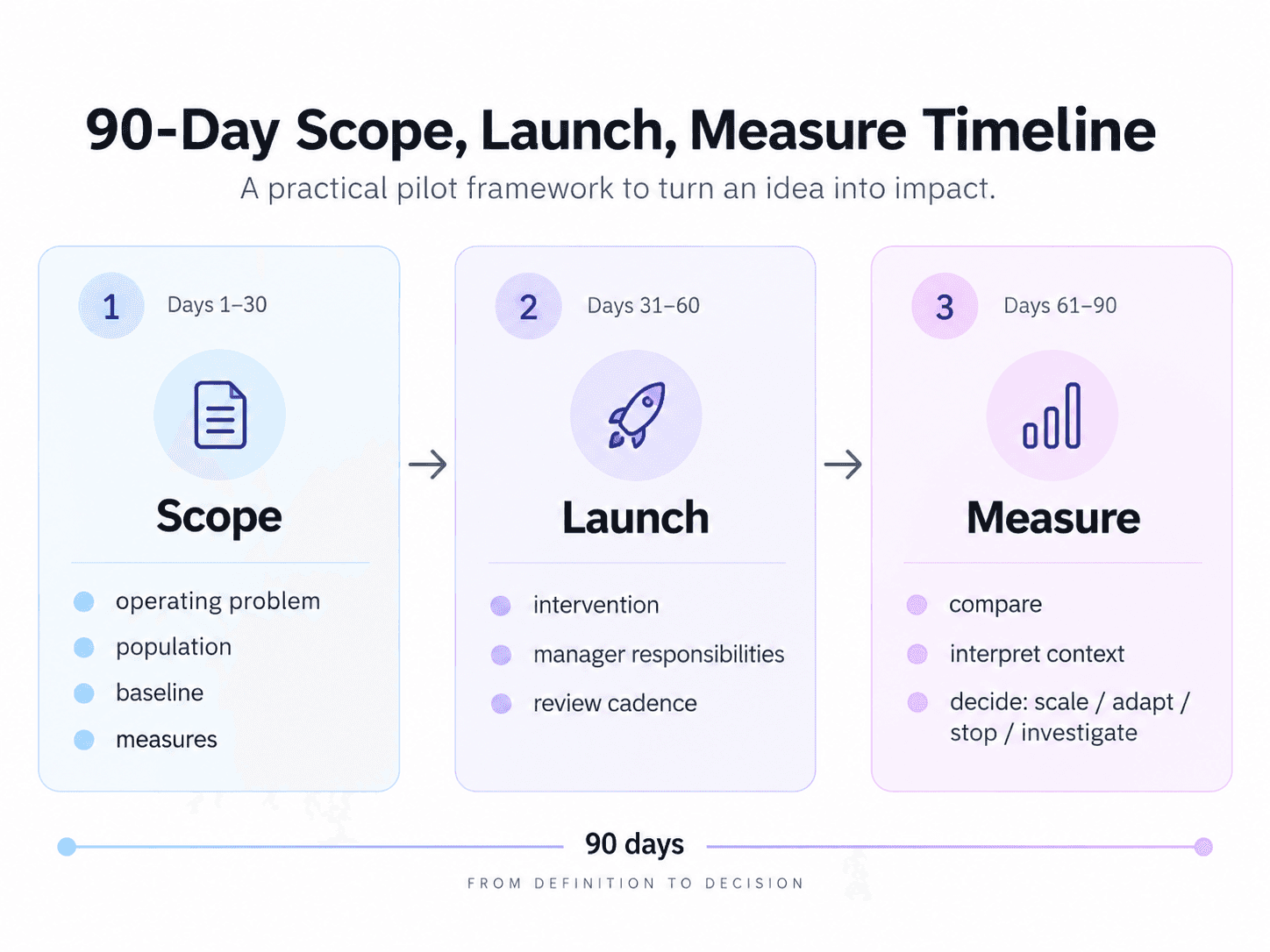
Scope: Select one material operating problem, a contained population, a baseline, and no more than a handful of leading and outcome measures. Agree in advance on the decision the evidence will inform.
Launch: Introduce the intervention or operating change, clarify manager responsibilities, and establish a regular cadence for reviewing both human and workflow signals. Keep the intervention visible enough that execution can be assessed.
Measure: Compare the defined indicators with the baseline, interpret results alongside operating context, and decide whether to scale, adapt, stop, or investigate further. The objective is to reduce uncertainty about which conditions are affecting execution and what deserves further investment, well short of manufacturing a return-on-investment number in 90 days.
Baryons' 90-day pilot structure is designed around this scope, launch, and measure discipline: make the operating question explicit before asking the organization to generate more data.
Final Thought
The strongest case for investing in human performance is not a promise that better sentiment automatically produces better financial results. It is a transparent operating hypothesis, tested close to the work. When leaders can see the chain from condition to behavior to process result, they can make better decisions about where management attention, process redesign, and investment will have the greatest value.
If you are deciding which operating constraint is suitable for a focused pilot, start by framing the question, baseline, and decision rule before launch. Baryons can provide the context for that conversation.
Every useful operating hypothesis starts with one honest question asked close to the work. That is the kind of thinking a Baryon is built for. Start the conversation at app.baryons.com, or call 231-BARYONS. Bring something real.
Signal before symptom.
Don't have a Baryon yet? Set one up in a few minutes. It's free for everyone: get yours here.
Wondering whether your leadership team would get value from this? Book a demo and we'll walk you through it.
Prefer to see it first? Watch the Baryon Overview on YouTube.
More articles

Why Employees Actually Use It
Employee participation cannot be sustained by organizational need alone. This article examines the value employees look for in a practice such as Baryons. Clarity, agency, constructive contribution, and less avoidable friction and gives sponsors a practical lens for earning trust.

Going Deeper: The Thinking Partner and the Growth Partner
Both the Thinking Partner and the Growth Partner grow you. The difference is shape. A look at when to reach for each, and why depth is where the magic lives.

Why This Isn’t a Pulse Survey
Baryons is not another employee pulse survey. This blog explains the difference between periodic listening and longitudinal organizational signal, showing how Baryons helps CHROs and People leaders understand what changes between survey moments: clarity, momentum, alignment, strain, and emerging patterns that may matter before they become obvious symptoms.
