Why This Isn’t a Pulse Survey

It is a reasonable assumption AND an important distinction
When CHROs and People leaders first encounter Baryons, one of the most natural questions is whether this is another employee pulse survey. It isn't.
That does not mean surveys have no place in an employee-listening strategy. Annual engagement surveys, targeted pulse surveys, lifecycle surveys, and event-based listening all answer valuable questions. They establish benchmarks, measure sentiment around defined topics, and help leaders understand how employees responded at a particular point in time.
Baryons is designed for a different problem. We are trying to understand what changes between those listening moments: whether clarity is strengthening or weakening, whether momentum is building or fading, where alignment may be drifting, and what emerging patterns leaders should understand before they become obvious organizational symptoms. The distinction is not simply that Baryons operates more frequently. It is that we are building a different kind of signal.
Surveys are designed to ask. Baryons is designed to understand.
A traditional survey starts with questions the organization wants answered. Do you understand our strategy? Do you feel supported by your manager? How engaged are you? How likely are you to recommend the organization as a place to work?
Those can be important questions. Gallup's current guidance on employee surveys reflects the different jobs surveys can perform: semiannual engagement surveys for deeper assessment, monthly or quarterly pulse surveys for targeted issues or changes, and event-based surveys around moments like onboarding or organizational change. Gallup also makes an important point, that cadence should reflect leaders' capacity to review the feedback and act on it. We agree.
Consider a different People leadership question: what is changing inside our organization right now that we did not know to ask about? That is harder for a questionnaire to answer. Baryons starts with the individual experience and builds understanding longitudinally. Each conversation contributes to a living picture rather than becoming an isolated response to a predetermined question. As our website puts it: "Not a transcript. Not a survey score. A real picture." That difference is fundamental.
A daily practice is not a daily survey
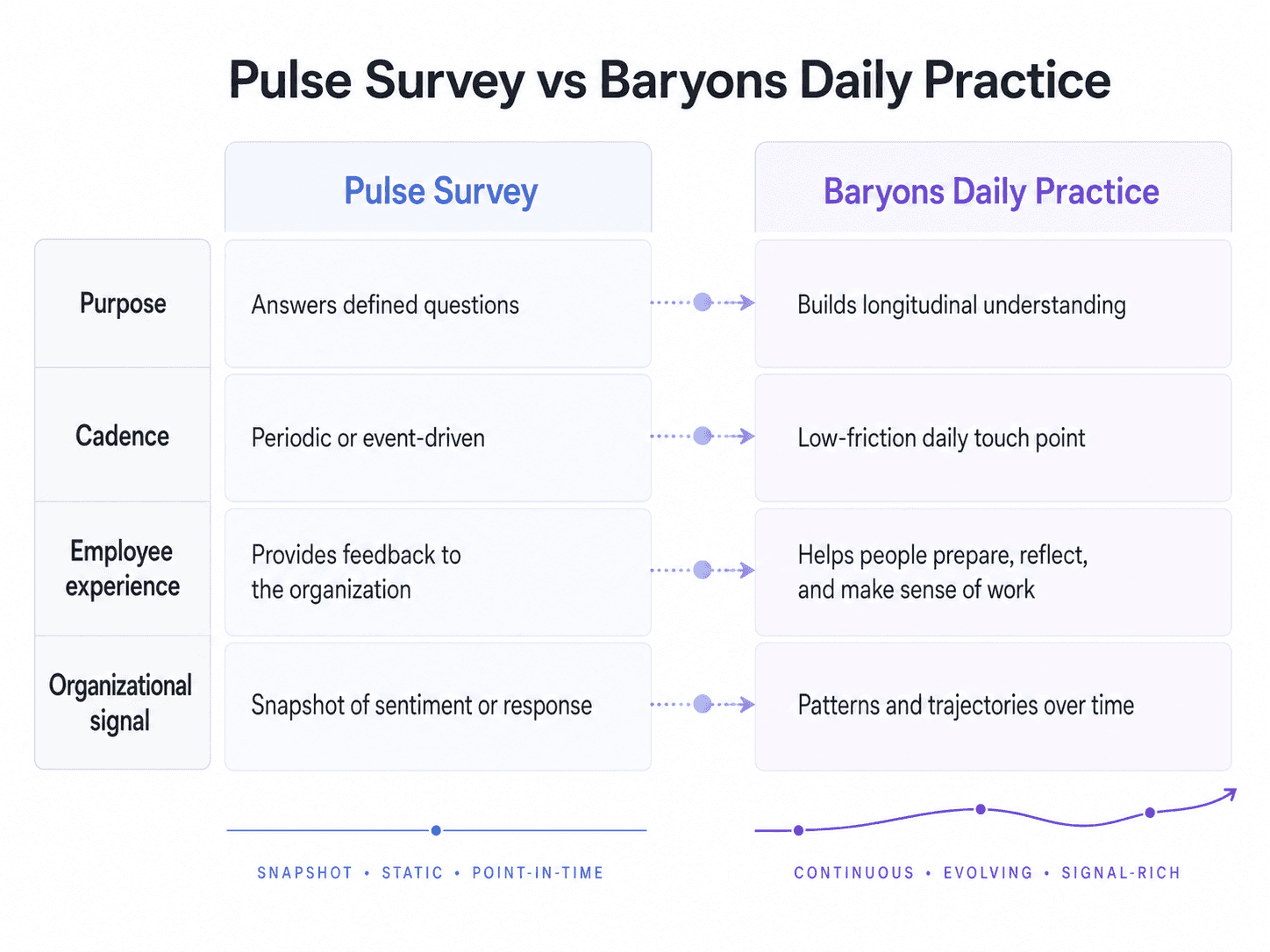
It would be easy to hear "daily" and imagine employees getting another questionnaire every morning. That is not the Baryons experience. Baryons is voice-first. The individual experience includes a morning intention, evening reflection, and on-demand conversations. The purpose is a useful touch point for the person to prepare, reflect, think through what is happening, and build understanding over time.
That employee experience matters because traditional listening can become transactional when every interaction begins with the organization asking for data. We wanted to approach the problem differently.
The individual should get value from the interaction itself, and organizational insight is then created from the patterns that emerge across those experiences. So a survey asks employees to periodically describe the organization. A daily practice helps people make sense of their work while creating longitudinal signal about how organizational conditions are changing. Those are very different experiences.
Frequency alone does not close the gap. A monthly survey is still a survey. A weekly survey is still asking predefined questions at predefined intervals. Push that frequency far enough and another problem appears: employees are repeatedly asked for feedback while leaders accumulate more data to interpret and act on.
Gallup explicitly cautions against surveying so often that results go unused or employees experience survey fatigue. The goal is not maximum listening frequency. It is better understanding with minimal unnecessary friction. That is why we describe Baryons as a low-friction daily practice rather than a continuous survey. The cadence lets patterns develop over time, and the purpose of each interaction is not to repeatedly extract answers from employees.
The problem with snapshots is what happens between them
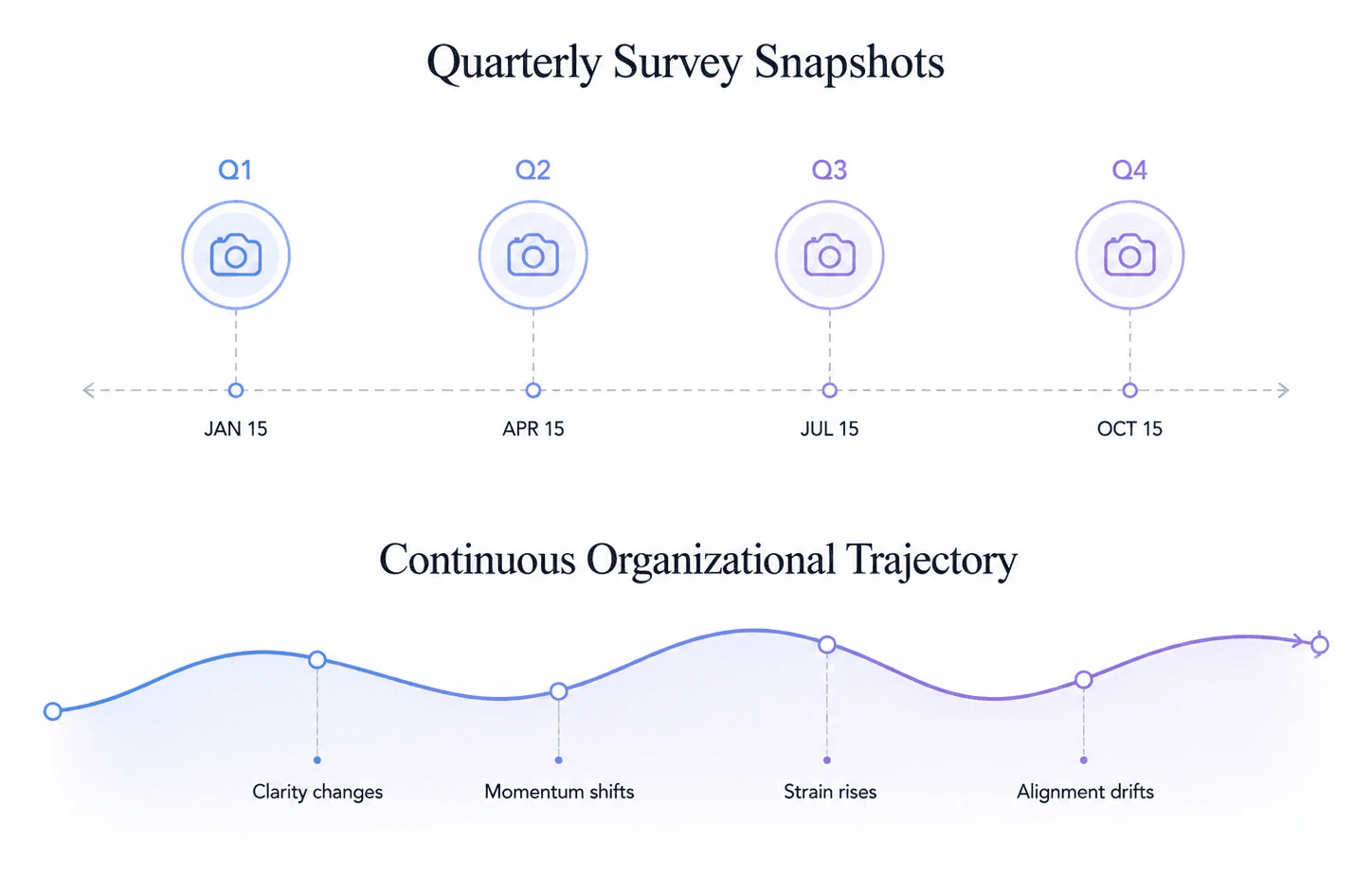
A snapshot is not inherently bad. Sometimes it is exactly what leadership needs. The problem comes when we ask a snapshot to explain a trajectory. Imagine a transformation begins in September.
Leadership communicates the strategy clearly. Initial sentiment is positive. Over the following weeks, implementation decisions start changing. Different teams interpret the new priorities differently. Managers spend more time translating direction. Confidence gradually softens. A quarterly pulse might eventually capture some of that change, but the organization has been living through the trajectory for weeks.
This matters because the pace of work is accelerating. Deloitte's 2026 Global Human Capital Trends found that one-third of workers experienced 15 major changes during the previous year. Only 27% of leaders said their organizations manage change effectively, while 85% said developing the ability to adapt at today's required speed is critical.
Deloitte's recommendation is especially relevant for People leaders: leading organizations are moving toward feedback and support embedded in the flow of work rather than relying solely on episodic change programs. Employee listening needs to evolve in a similar direction.
The leadership output is different too
The clearest difference appears at the other end of the system. Traditional surveys commonly give People teams scores, response distributions, comments, benchmarks, and changes between survey periods. Those outputs are useful when leadership wants to understand engagement or sentiment around defined topics.
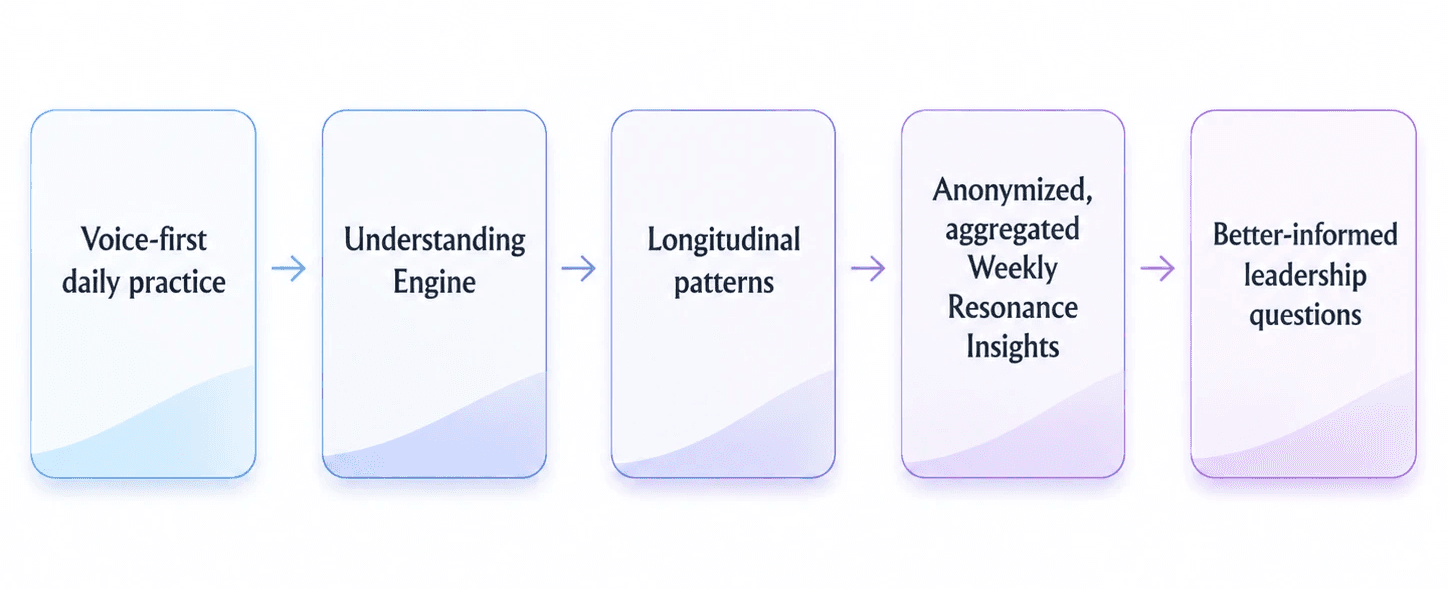
Baryons is designed to surface longitudinal organizational signal. Our Understanding Engine builds understanding across conversations rather than treating each interaction as new. At the organizational level, Weekly Resonance Insights surface anonymized, aggregated patterns around areas including team health, energy, momentum, engagement, relationships, flow, and purpose.
The leadership conversation therefore moves beyond "What was our score?" toward "What is changing? Where is a pattern developing? What might deserve attention? Where is positive momentum emerging that we should understand or reinforce?" That is what we mean by moving from periodic listening toward continuous organizational insight.
From sentiment to signal
For a CHRO, this distinction becomes especially valuable when conditions are changing quickly. Suppose confidence begins weakening around a transformation. A traditional pulse can help establish that confidence is lower than it was during the previous measurement period. A longitudinal view creates a different set of questions. Is the change persistent? Is the trajectory stabilizing or continuing? What other patterns are appearing alongside it? Is there emerging strain? Has momentum shifted?
We are not suggesting those signals automatically explain causation or tell leadership what decision to make. Leadership judgment still matters. The organization now has a richer basis for asking the right questions earlier. This is increasingly important because work itself is becoming less episodic.
Deloitte's June 2026 analysis describes the boundary between planning and execution collapsing while cost pressure and questions of trust and clarity intensify. If work changes continuously, our understanding of work needs to become more continuous too.
Four practical differences for People leaders
For CHROs evaluating Baryons alongside an existing listening program, four distinctions matter most:
Purpose: A survey gathers structured feedback against defined questions. Baryons builds longitudinal understanding from an ongoing individual practice.
Cadence: Surveys are generally periodic or event-driven. Baryons creates a daily touch point from which patterns can be understood across time.
Employee experience: A survey primarily asks the employee to provide information. Baryons' voice-first experience is designed to help the individual prepare, reflect, and make sense of their own work.
Leadership output: Surveys commonly produce scores, benchmarks, comments, and periodic comparisons. Baryons surfaces anonymized, aggregated organizational patterns and trajectories through Resonance Insights.
These differences are why we do not see Baryons as simply a more frequent pulse. It is solving for another layer of understanding.
This does not mean every survey should disappear
We want to be precise here.
There are good reasons an organization may keep using established surveys. A validated engagement instrument may provide an important benchmark. A lifecycle survey may answer a specific question around onboarding or exit. A targeted pulse may help during a particular initiative. An annual listening program may create a consistent enterprise-wide reference point. Baryons does not need to replace all of those to be valuable.
The better question is: what do our current listening systems tell us well, and what are we still learning too late? A CHRO may already have excellent visibility into annual engagement. What they may lack is a more continuous understanding of how organizational conditions are moving between survey cycles.
That is where Baryons fits.
People leaders need signal they can bring into the business conversation
The opportunity extends beyond making employee listening more current. CHROs increasingly need to connect human conditions to operating conversations. If alignment is weakening during a strategic shift, that matters to execution. If manager strain is rising, that can matter to leadership capacity. If momentum is deteriorating across a critical team, that may deserve attention before a performance metric moves. If a positive pattern is strengthening, leaders may want to understand what is working and reinforce it.
These are not merely engagement questions. They are organizational questions. Baryons gives People leaders another way to bring human signal into those conversations as longitudinal patterns that help leadership see what may be changing beneath the business.
Final thought
So why isn't Baryons a pulse survey? Because the fundamental job is different. Surveys are valuable when an organization needs to ask employees specific questions and measure their responses. We are focused on what happens between those questions: the changing patterns in team health, momentum, engagement, relationships, flow, purpose, and other human dynamics that become important to leadership over time.
Our low-friction daily practice creates value for the individual first. The Understanding Engine builds context longitudinally. And Weekly Resonance Insights turn anonymized, aggregated patterns into a more timely view for leadership.
For CHROs, the opportunity is not necessarily to replace the listening architecture they already have. It is to close the visibility gaps inside it. If your People team already knows how to measure employee sentiment but still finds itself learning about important organizational changes too late, that is exactly the gap we built Baryons to help address.
Learn more about Baryons here- Watch on YouTube - Baryons - The Understanding Engine
Try it, its free for everyone!
Bring Baryons to your team. Book a demo!
More articles
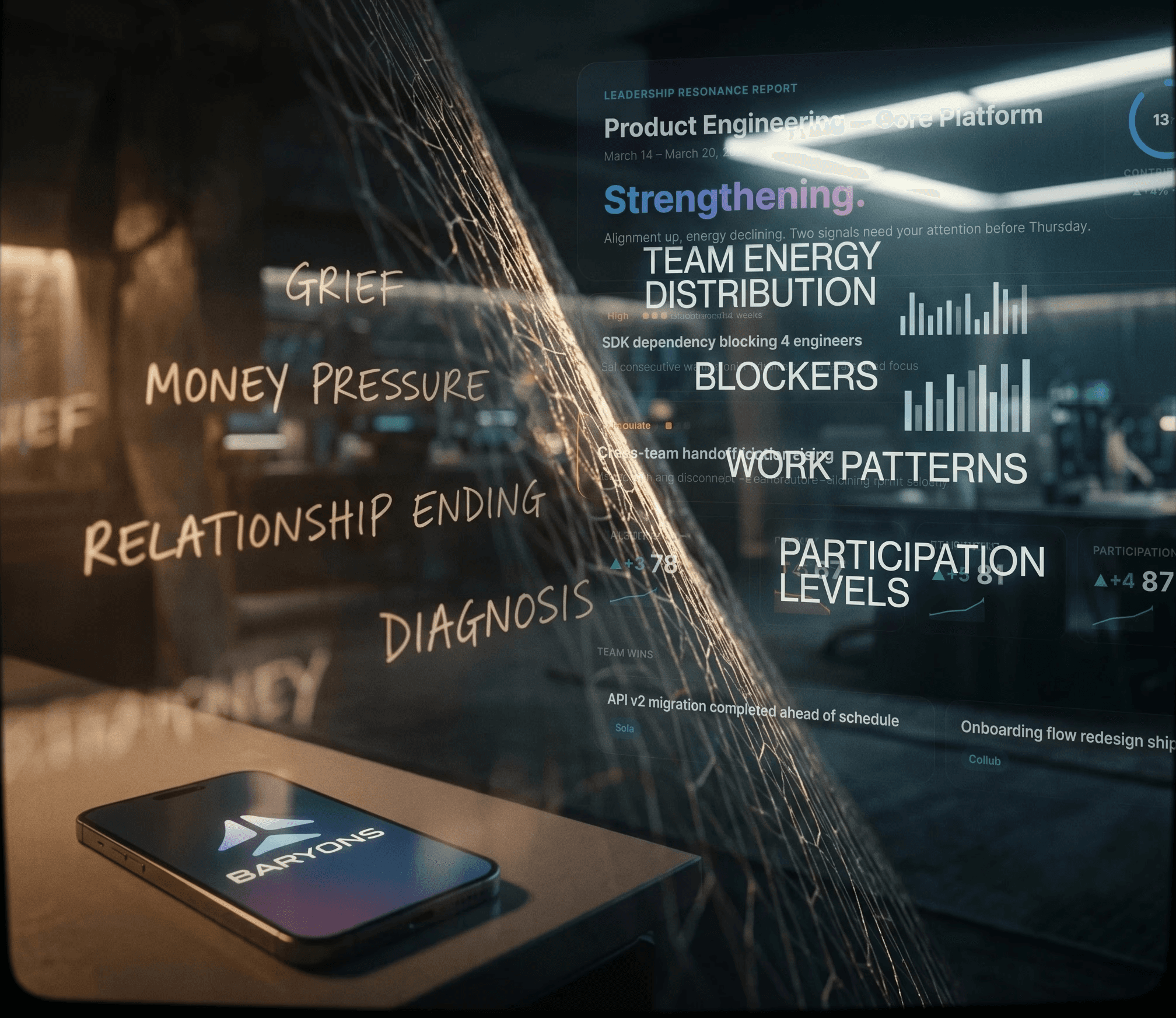
The Privacy Mesh
People tell their Baryon real things in an organizational context. The Privacy Mesh is how they can, while their leadership still sees a team's energy and never the contents of a life. Here is how that boundary actually holds.

Why Accountability Fails When Teams Don’t Have Clear Ownership Signals
Accountability often breaks before a missed commitment. This blog explains why unclear ownership, competing priorities, ambiguous decision authority, and different definitions of “done” turn accountability into blame and how stronger ownership signals help teams follow through with more trust, clarity, and consistency.

The Private Equity Operating Partner
The first 100 days are not just about finding value creation levers, they are about understanding whether the organization can execute the plan. This blog gives PE operating partners a practical lens for assessing decision clarity, ownership, leadership strain, coordination friction, operating discipline, and execution risk before those issues show up in missed targets or delayed value creation.