The Private Equity Operating Partner

The first 100 days are not just about finding the levers
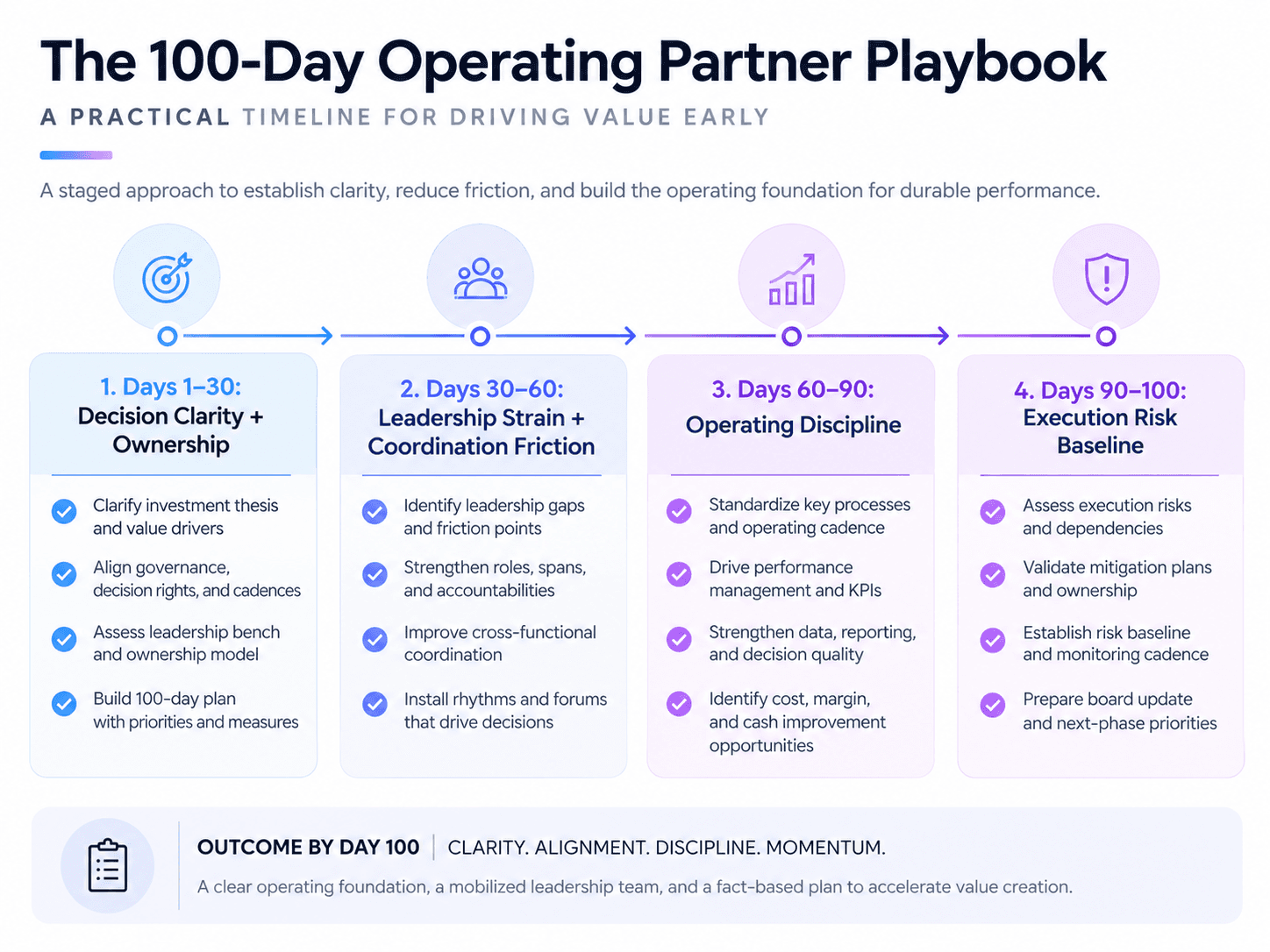
For a private equity (PE) operating partner, the first 100 days create a particular kind of pressure. The investment thesis is already on the table. The value creation plan is taking shape. There are targets to establish, initiatives to sequence, leadership capabilities to assess, and an operating cadence to build with the management team.
The temptation is to move straight to the levers: pricing, procurement, working capital, sales effectiveness, organizational design, technology, productivity. Those levers matter. There is another question operating partners should answer early: is this organization actually capable of executing the plan the way we currently expect it to?
That is different from whether the strategy is sound. It asks whether decisions are clear, ownership holds, leaders have enough bandwidth, teams can coordinate across boundaries, and operating discipline is strong enough to turn the investment thesis into repeatable execution. That is where the first 90 to 100 days can tell you far more than the numbers alone.
Days 1–30: Find the gap between the plan and how decisions really happen
Start with decision clarity. The org chart tells you who owns a function. The operating model tells you how decisions are supposed to happen. Neither tells you how decisions actually happen under pressure. Early in an engagement, listen for the patterns around real decisions. Does ownership stay clear when functions disagree? Do routine decisions move at the appropriate level, or get escalated unnecessarily? Once a decision is made, does it hold? Do leaders leave the same meeting with the same understanding of what was decided?
Repeated reversals and unclear decision rights are not minor management quirks. They create execution drag. This matters even more in the current environment. Bain’s 2026 Global Private Equity Report argues that today’s deals require substantially faster EBITDA (Earnings Before Interest, Taxes, Depreciation, and Amortization) growth and that firms need to move from full-potential diligence to execution on Day 1.
Speed only creates value when the organization can make and hold decisions. So the first month should establish a baseline not only for financial and operating KPIs, but for the quality of the decision environment.
Ownership is closely related, and it deserves its own examination. Most organizations can produce a RACI (Responsible, Accountable, Consulted, Informed) chart. The more useful question is whether people behave as if ownership is clear. Look at what happens when an initiative meets resistance. Does the owner have authority to resolve it? Do multiple executives believe they own the same outcome? Does accountability move sideways when performance slips? Does the CEO become the default decision-maker for issues that should be resolved elsewhere?
These patterns reveal how much coordination labor the organization needs simply to keep moving. A value creation plan can contain perfectly sensible initiatives and still stall if ownership stays ambiguous, so the first 30 days should test the difference between formal ownership and operating ownership. That difference tells you a great deal about how difficult the next 70 days may become.
Days 30–60: Look for leadership strain before it becomes a constraint
Once the initial cadence is underway, leadership strain becomes easier to see. This is not a question of whether the management team is working hard. In a PE-backed environment, that is a given. The more useful question is where leadership capacity is being consumed. A CFO who spends too much time reconciling conflicting operating narratives has less capacity for transformation. A COO who becomes the clearinghouse for every cross-functional decision eventually becomes a bottleneck. A CEO who repeatedly has to translate priorities that should already be understood is absorbing ambiguity the system failed to resolve.
Strong executives can compensate for these weaknesses for a while, which is exactly what makes the risk hard to see. The company may keep hitting milestones while a few leaders carry an unsustainable share of the coordination load. By the time that strain shows up in missed execution, turnover, or declining decision quality, the operating problem is already mature. Use the middle of the window to separate where leadership is creating leverage from where leadership is compensating for system weakness.
Days 30–60: Follow coordination friction across functions
Coordination friction deserves the same explicit attention, because value creation initiatives rarely stay inside one function. Pricing may require sales, finance, and commercial operations. Procurement touches operations and finance. AI transformation crosses technology, functions, workflows, and leadership decisions. Working-capital initiatives depend on coordination stretching from commercial teams to supply chain.
Look for repeated handoff failures, meetings that revisit the same questions, inconsistent interpretations of priorities, work being redone, or managers building informal workarounds. None of this automatically means the management team is weak. It tells you where the operating system is expensive. That distinction matters because operating partners are increasingly central to value realization. EY’s Private Equity Value Creation Benchmark research notes the operating partner role has grown more important amid higher financing costs and reduced reliance on multiple expansion, and reports that firms with more operating partners relative to deal professionals hit target ROI more than 75% of the time with fewer unforeseen risks.
The mandate is not simply to identify initiatives. It is to understand what may prevent them from moving cleanly through the organization.
Days 60–90: Determine whether the new operating discipline is actually taking hold
By this point, most portfolio companies have no shortage of plans. The more important question is whether new behaviors are becoming repeatable. Operating discipline shows up in ordinary places. Decisions close instead of cycling. Owners follow through without repeated escalation. Leadership conversations distinguish between information, discussion, and decision. Priorities stay stable enough for teams to execute, and when they change, people understand why.
This is where the operating partner should compare intent with trajectory. Is decision velocity improving? Is ownership becoming clearer? Is coordination friction decreasing as the organization learns the new cadence? Are leaders spending more time driving the plan and less time resolving avoidable ambiguity? The first 100 days should not simply produce a plan. They should create evidence the organization can execute it.
Do not confuse compliance with operating discipline
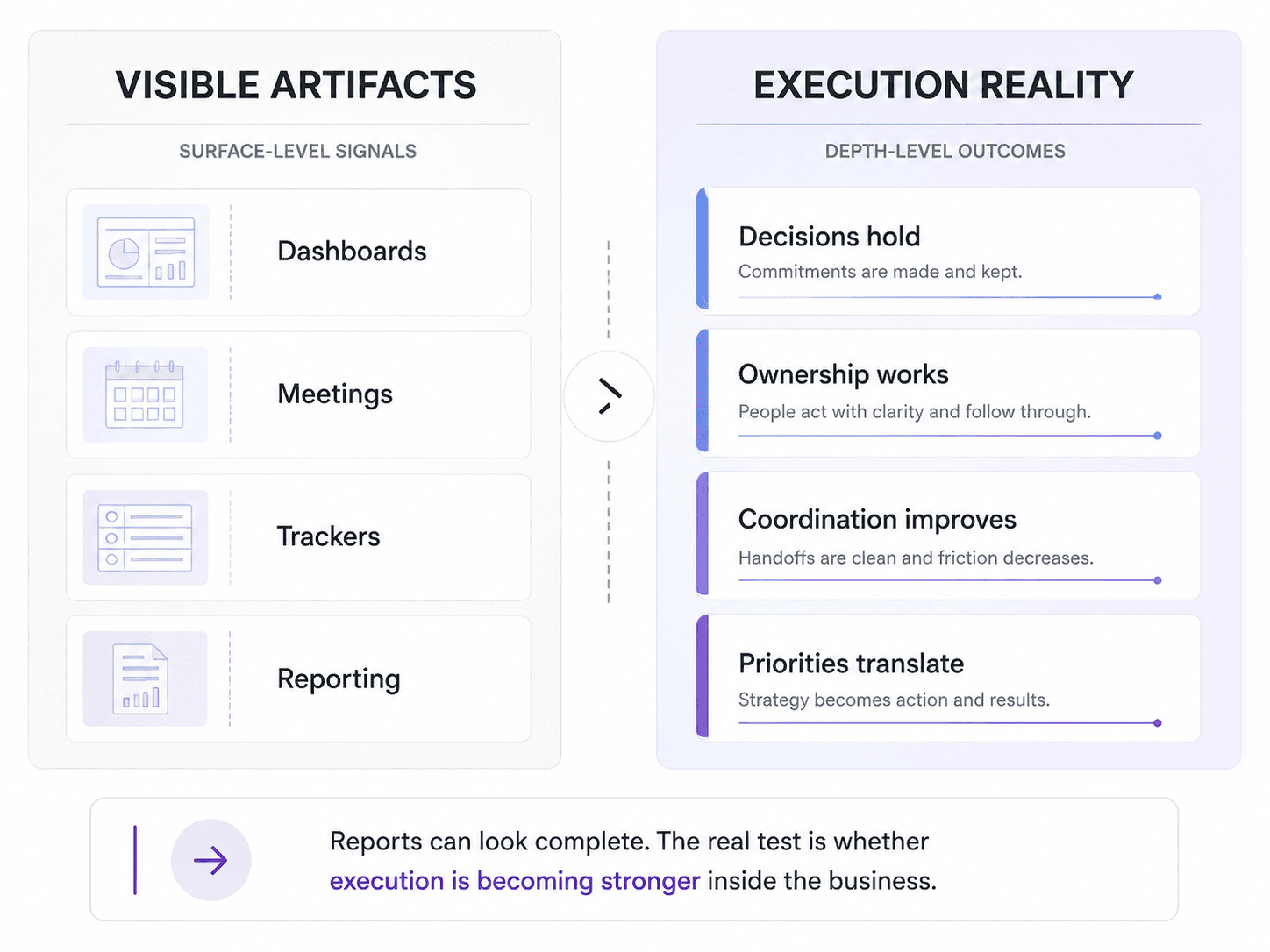
There is a trap in this phase. A company can quickly get very good at producing the artifacts the sponsor expects. Dashboards appear. Weekly meetings happen. Initiative trackers turn green. Management learns the vocabulary of the value creation plan. None of that necessarily means execution improved.
Operating discipline should be measured by what becomes easier and more reliable inside the business, not by whether the reporting machinery looks complete. A team that updates its tracker every Friday but repeatedly reopens decisions still has a decision problem.
A workstream with a named owner who lacks real authority still has an ownership problem. A leadership team that reports green while managers quietly compensate for coordination failures still carries execution risk. The operating partner's advantage is the ability to see past the artifacts and ask whether the underlying system is getting stronger.
Days 90–100: Identify the execution risks that deserve continued attention
The end of the 100-day period should not create the illusion that uncertainty has disappeared. It should create a clearer map of where execution risk lives. By this point, you want to know which parts of the organization can absorb change cleanly and which need continued leadership attention. Where is alignment holding? Where does decision-making remain fragile? Which leaders are carrying disproportionate coordination load? Which initiatives depend on cross-functional relationships that are still unstable?
That makes for a more useful handoff from the 100-day plan into the broader hold period. And there is a long-term reason to establish this discipline early. EY’s 2026 Global Private Equity Exit Readiness Study says evidencing value creation in exit EBITDA remains PE firms' top exit challenge, and emphasizes management alignment and early, systematic preparation in demonstrating sustainable improvements at exit. What happens at exit is connected to what gets established at the beginning.
A value creation story is much easier to defend when operating improvements were visible, measurable, and embedded throughout the hold, rather than reconstructed retrospectively.
The missing piece is often signal between the milestones
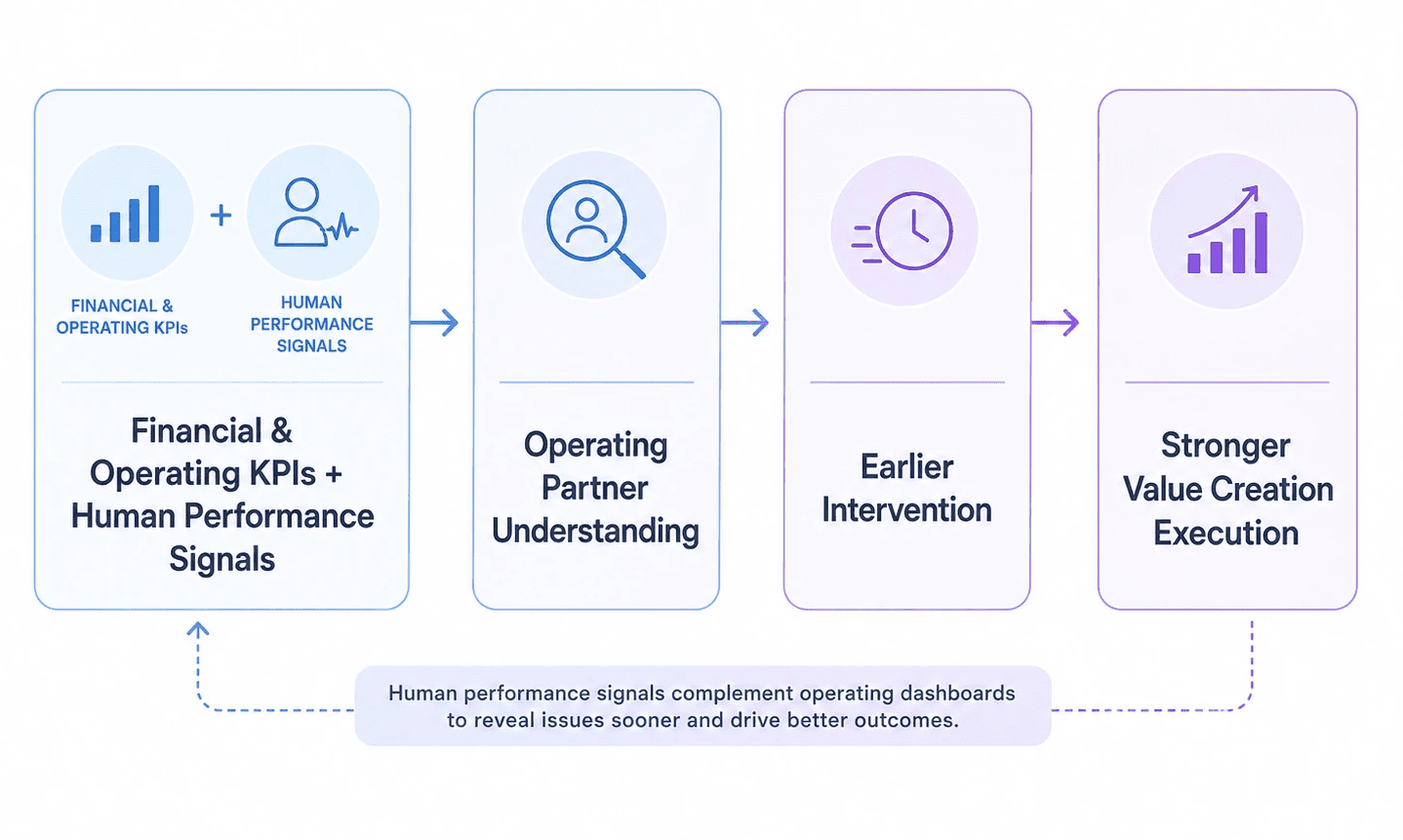
Traditional 100-day plans provide substantial visibility into initiatives, financial performance, and operating KPIs. What they often provide less visibility into is the human layer connecting those things. That is where we built Baryons to help.
Our Human Performance Layer surfaces organizational patterns around alignment, clarity, confidence, energy, and strain while the work is happening. Through a low-friction, voice-first individual experience, people can prepare, reflect, and make sense of their work. At the organizational level, anonymized and aggregated patterns give leaders a way to understand what is changing across teams without turning the system into employee productivity scoring.
For an operating partner, the value is practical. It creates an additional line of sight into whether decision clarity is strengthening, whether alignment is holding as priorities change, where leadership or team strain may be emerging, and where patterns warrant attention before they become visible execution problems.
Human signal works alongside the operating plan, KPIs, and management judgment, it does not replace them. The operating dashboard tells you what the company is producing. The Human Performance Layer helps illuminate the conditions affecting its ability to keep producing it.
The 100-day questions we would keep asking
A good 100-day plan should leave an operating partner with more than a list of initiatives. It should create a sharper understanding of the company's execution system.
Six questions are worth returning to throughout the hold:
Decision clarity: Are important decisions being made at the right level, and do they hold?
Ownership: Do accountable leaders have enough authority to deliver what they own?
Leadership strain: Where are executives or managers compensating for weaknesses in the system?
Coordination friction: Which cross-functional dependencies repeatedly create delay or rework?
Operating discipline: Are new cadences producing better execution or simply more reporting?
Execution risk: What is beginning to drift now that could threaten the value creation plan later?
Those questions turn the first 100 days from an onboarding exercise into an execution baseline. They are an opportunity to understand not only what needs to change, but whether the organization can make the change happen, which requires seeing beyond the initiatives themselves to the conditions underneath them: decisions, ownership, leadership capacity, coordination, and operating discipline.
Final thought
EY notes that operating partners are the people most deeply connected to the portfolio company's value creation journey during the hold, while Bain's 2026 outlook calls for sharper, data-backed value creation and execution beginning on Day 1.
We believe organizational signal belongs in that Day 1 toolkit. If you are entering a new portfolio company and building the first 100-day agenda, Baryons can add another layer of visibility to the operating picture, helping you understand not just whether the plan is moving, but whether the organization underneath it is becoming more capable of delivering the investment thesis.
Learn more about Baryons and how it works - Watch on YouTube - Baryons - The Overview
Try it, its free for everyone!
Want to add another layer of visibility? Book a demo!
More articles

The Handoff Problem: Why Execution Loses Context Between Teams
Execution friction is often blamed on effort, but it frequently begins when context, priorities, and decision boundaries weaken as work moves between teams. This article gives COOs and cross-functional leaders a practical way to improve translation quality and preserve strategic intent through the handoff.

Why Strategy Breaks as It Is Retold Across the Organization
Strategy often changes shape as leaders interpret and communicate it through multiple layers and functions. This article explains translation drift as a source of execution friction and offers a practical way for CEOs and COOs to surface divergence before it becomes a lagging business symptom.

The Manager Dependency Trap
Manager overload is not always a workload problem. This article examines how unclear priorities, decision boundaries, and trade-offs turn managers into a routing layer for routine ambiguity, and how COOs and CHROs can restore team agency without sacrificing coordination.
