The Manager Dependency Trap

When Every Clarification Flows Upward
TLDR
Manager overload is often diagnosed as a capacity problem. More fundamentally, it can be a decision-and-interpretation problem. When teams lack enough shared context and clear boundaries to act, managers become the routing layer for every ambiguity. The answer lies in designing conditions where judgment can move closer to the work without losing coordination, while managers stay in the decisions that truly need them.
Introduction
A manager’s calendar can look busy for perfectly reasonable reasons: customer issues, changing priorities, cross-functional dependencies, difficult people decisions. But one particular kind of busyness deserves closer attention. It is the steady stream of questions that should not require a managerial answer: “What does this priority mean for us?” “Which trade-off should we make?” “Can I tell the customer this?” “Who decides?”
Each question may be sensible on its own. Together, they reveal an operating design in which the manager has become the interpreter, approver, and resolver of routine uncertainty. That design slows decisions, narrows team agency, and leaves leaders with less attention for the work only they can do.
Manager dependency is a flow problem, not a character flaw
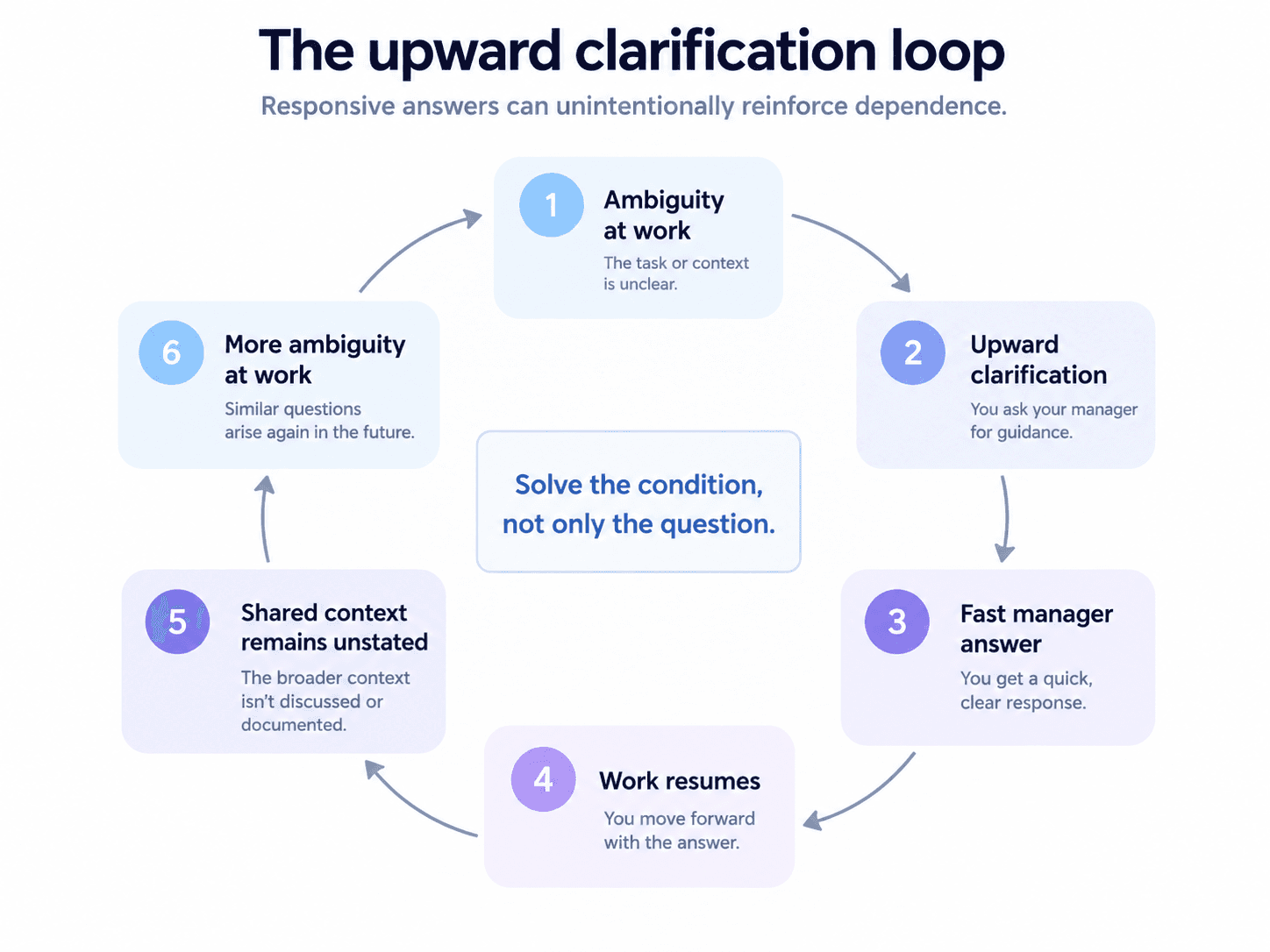
It is tempting to describe dependency as a confidence problem in the team or a delegation problem in the manager. Either may contribute, but the recurring pattern is usually structural.
People escalate when the cost of acting incorrectly feels higher than the cost of waiting. That happens when priorities have not been translated into local implications, when decision rights are vague, or when prior decisions are not visible enough to guide the next one. The manager becomes a human interface between strategy and execution..
This creates a self-reinforcing loop. A manager answers quickly to keep work moving. The team learns that escalation is the safest route. More questions travel upward. The manager has less time to clarify the underlying context, so the next question is just as likely to escalate. What looks like responsiveness can quietly become a bottleneck.
The hidden cost is interpretation capacity
Workload is finite, but interpretation capacity is often the scarcer resource. A manager must continually convert broad direction into choices that make sense for a specific customer, project, team, or moment. When that conversion happens one question at a time, the organization pays again and again for the same translation.
The visible cost is meeting time, messages, and approval queues. The less visible cost is delayed judgment. Team members defer decisions they could make with clearer guardrails. Managers spend their attention adjudicating exceptions instead of improving the conditions that create them. Senior leaders receive escalations stripped of local context, then issue answers that must be translated back down again.
For a COO, this is decision latency hidden inside ordinary coordination. For a CHRO, it is a leadership-capacity issue that resilience training or time-management advice alone cannot solve.
Overload is a signal, not a complete diagnosis
The pressure on managers is real. Gartner's 2025 CHRO manager-capacity benchmark reports that 75% of surveyed CHROs believe managers are overwhelmed by increased job responsibilities. That finding does not identify where every added responsibility comes from, though. Treating overload alone as the diagnosis risks wrapping more support around a flawed flow of decisions.
The same caution applies to autonomy. Giving teams permission to act without supplying context, boundaries, and coordination can simply push uncertainty downward. A 2026 study of autonomy and manager effectiveness in distributed teams found that autonomy’s relationships with perceived manager effectiveness and team coordination were curvilinear, and that role clarity and daily communication shaped those relationships. Its scope is specific, but the operating implication is useful: autonomy works best when it is calibrated.
Find the questions that should have been answered once
A more useful diagnostic than “Are managers busy?” is this: “What kinds of questions keep returning, and what condition makes them recurring?”

Look at repeated escalation patterns across a week:
• Interpretation questions: What does the priority mean here?
• Boundary questions: What can we decide without approval?
• Trade-off questions: Which objective wins when they conflict?
• Ownership questions: Who carries the next move?
• Risk questions: What is safe to communicate or change?
Then separate one-off judgment calls from repeatable ambiguity. A consequential exception may rightly need a manager. A recurring question about priorities, ownership, or thresholds points to context that has not traveled far enough. The intervention is to make the answer reusable, so the manager stops answering the same question faster each time.
This makes a natural mission for a Baryon. A manager can bring the question their team asks most often and privately work out what context would let the team answer it without them.
Replace approval chains with decision conditions

Reducing unnecessary escalation does not mean telling people to “be more empowered.” It means making the conditions for sound judgment explicit.
Start with four practical moves. First, translate each major priority into the handful of local decisions teams will face. Second, state decision boundaries: what a team owns, what it should consult on, and what must escalate. Third, document the trade-offs that matter when priorities collide. Fourth, create a short cadence for revisiting assumptions as conditions change.
Treat this as a living decision-rights practice, because direction degrades as it moves through changing work. Managers still play a critical role, but their role shifts from answering every question to strengthening the shared context that lets the next decision happen closer to the work.
Make manager capacity an organizational design conversation
Managers can become reactive when unclear expectations and time pressure accumulate. In McKinsey's 2026 survey of senior executives, 47% of respondents cited time pressure and 38% cited unclear expectations as leading challenges to creating psychological safety. Those self-reported results do not prove why any one team escalates. They do reinforce the need to examine the operating conditions around leaders as well as their individual habits.
This is where operations and people leadership should work together. Operations can identify where decisions stall, rework repeats, and handoffs multiply. People leaders can help managers build the communication, judgment, and role clarity needed to create agency without confusion. The shared goal is fewer avoidable clarification loops, with conversation saved for what deserves it.
Want to see how this plays out when operations and people leaders work it together? Book a Baryons demo and we’ll trace one of your recurring escalation loops with you.
Final Thought
The manager dependency trap is costly because it feels helpful in the moment. A quick answer releases one blocked task, while the structural cause stays in place. Over time, the organization teaches people that progress requires permission rather than judgment.
A stronger question for leaders than whether managers can absorb more is whether intent, decision boundaries, and trade-offs are clear enough for capable people to carry the work forward. When they are, managers regain room for coaching judgment, resolving genuine exceptions, and keeping the system aligned as conditions change.
If recurring escalation is consuming leadership attention, Baryons can help leaders examine how shared context, private guidance, and privacy-protected aggregate signal can keep intent connected to execution before clarification loops become the operating model.
Every question that climbs the ladder is a small clue about where context stopped short. Working out why is human work, and Baryons exists to support exactly that kind of work. Bring your Baryon the question your team asks you most often, describe what makes it hard to hand off, and notice what comes back. Head to app.baryons.com or dial 231-BARYONS to begin.
First time here? Getting your own Baryon is fast and free: sign up here.
Prefer to watch before you dive in? The Baryon Overview on YouTube gives you the full picture.
Signal before symptom.
More articles

Why Strategy Breaks as It Is Retold Across the Organization
Strategy often changes shape as leaders interpret and communicate it through multiple layers and functions. This article explains translation drift as a source of execution friction and offers a practical way for CEOs and COOs to surface divergence before it becomes a lagging business symptom.

Decision Debt: What Happens When Leadership Intent Stays Unresolved
Unresolved executive decisions do not stay in the executive room. This article examines how ambiguity travels through leadership layers as conflicting priorities, hesitation, and rework, and outlines a practical discipline for making intent usable at every handoff.

See strategy drift while it is still a conversation | The Leadership Enablement Lab
A 90-day program that shows leadership teams where understanding of strategy is diverging, early enough to act. Private by design.
