What Baryons Actually Does

Start with the problems leaders already recognize
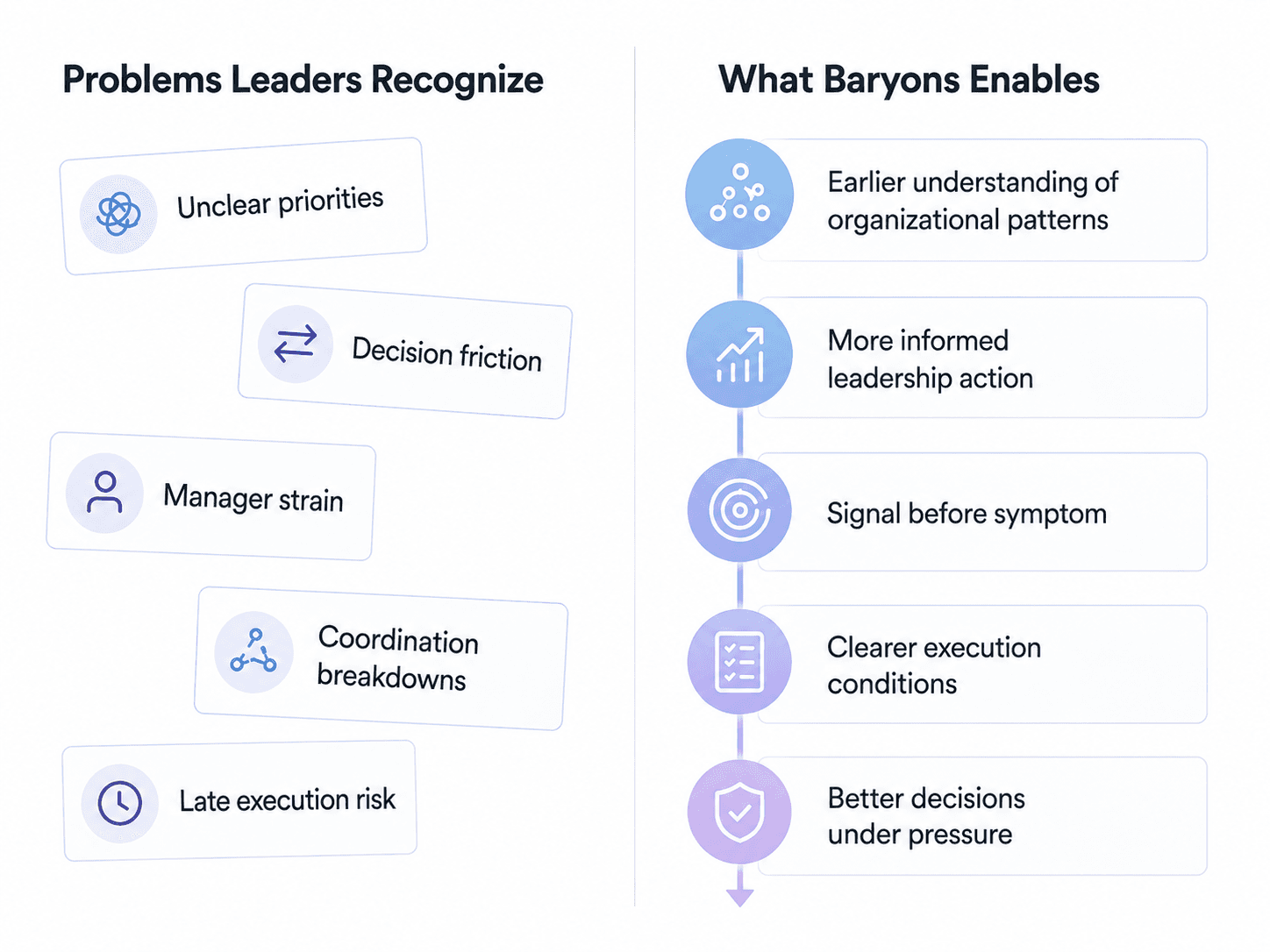
The simplest way to explain Baryons is to start with problems most executive teams already know, rather than with a new category of software.
A strategy is clear in the leadership meeting, but teams interpret it differently three layers down. A decision gets made, then quietly reopened. Managers spend more time translating priorities and resolving ambiguity than leading. Teams are working hard, but handoffs, rework, and coordination friction keep slowing execution. Leadership senses something is changing inside the organization, but the dashboard does not show it yet.
These are not separate problems. They are different expressions of the same visibility gap: leaders can usually see business outcomes and activity, but they have much less visibility into the human dynamics producing them. That is the gap we built Baryons to address.
We are building an Understanding Engine for organizations in the age of AI, a way to help leaders see where alignment is breaking, where decisions are degrading, where energy is draining, and where friction may be slowing execution before those conditions become obvious in business results.
Problem: priorities are clear at the top but blur through the organization
Executives spend significant time setting priorities. That does not mean those priorities arrive intact where work actually happens. A leadership team can leave a strategy session feeling completely aligned while different functions, managers, and teams walk away with different interpretations of what matters most. As those interpretations move through the organization, small differences become execution differences.
Alignment needs a more practical definition. Alignment is people having enough shared clarity to make coherent decisions as circumstances change. When that starts breaking, leaders need to know before the quarterly result tells them.
This challenge is becoming more acute. Deloitte’s 2026 Global Human Capital Trends found that 85% of leaders consider building the ability to adapt at today’s required speed critical, yet only 7% say they are leading in helping their workforce continuously grow and adapt. One-third of workers surveyed had experienced 15 major changes in the prior year.
When change becomes continuous, alignment cannot be something leadership checks episodically.
Problem: decisions are being made, but decision friction is growing
A second problem is harder to see. The organization appears to be making decisions, but the cost of making and implementing them keeps rising. Decisions take longer. More people get pulled into the process. Teams hesitate because ownership is unclear. A call gets made and then revisited. People spend more and more time interpreting what leadership intended.
That friction matters because decisions are where strategy becomes execution.
Deloitte’s 2026 research on AI and decision-making argues that organizations need to treat decision-making as a strategic discipline, particularly as AI becomes involved in more choices. The research notes that 60% of executives now regularly use AI to support decisions, while also warning that unclear decision rights can become even more problematic as human and AI roles converge.
AI can accelerate analysis. It cannot resolve an organization that is unclear about who decides, what matters, or how a choice should translate into action. We want leaders to be able to see when that decision environment is strengthening or weakening.
Problem: managers are absorbing the ambiguity
When priorities and decision rights are unclear, somebody has to compensate. Usually it is the manager. Managers become the translation layer between executive intent and everyday execution. They clarify competing messages, resolve uncertainty, absorb frustration, coordinate dependencies, and keep work moving even when the operating system around them is creating friction.
That can hide organizational problems for a surprisingly long time, because good managers compensate. Until they cannot.
Gallup’s March 2026 leadership research emphasizes how directly employees experience the organization through managers and local leaders. When those leaders become strained, the effects appear in slower decisions, less coaching, and less consistent communication.
The answer is not to ask managers to get better at absorbing ambiguity. Leaders need visibility into where the system is creating that ambiguity in the first place.
Problem: teams are busy, but coordination is breaking down
Another recognizable pattern is the team that never stops working but does not seem to move proportionally faster. Meetings multiply. Messages increase. People spend more time checking what others are doing. Handoffs need follow-up. Work gets redone because two teams interpreted the same priority differently. Everyone is busy, and the organization is still losing momentum.
This distinction matters because activity metrics can make coordination problems hard to see. A full calendar, high message volume, or a busy project board tells leadership that work is happening. It does not tell leadership whether the work is coherent.
Most organizations can see the surface, financial results, activity metrics, engagement surveys, project status, but have much less visibility into the conditions underneath those outcomes. That is where Baryons sits.
So, what actually happens when someone uses Baryons?
For the individual, the experience starts simply. Baryons is voice-first. A person can use a morning Check-in to set intention and an evening Check-out to reflect on the day, with on-demand conversations available whenever they help. The experience fits into the rhythm of work instead of requiring another lengthy survey or formal assessment.
Behind those conversations is our Understanding Engine. Instead of treating every interaction as isolated, Baryons builds understanding longitudinally. It looks across conversations and analyzes dimensions of meaning so the experience can carry forward relevant themes, goals, values, patterns, and emotional trajectory over time.
The individual experience is meant to be useful in its own right: a place to prepare, reflect, think through challenges, and grow. That is only one side of the system.
Individual reflection becomes organizational signal
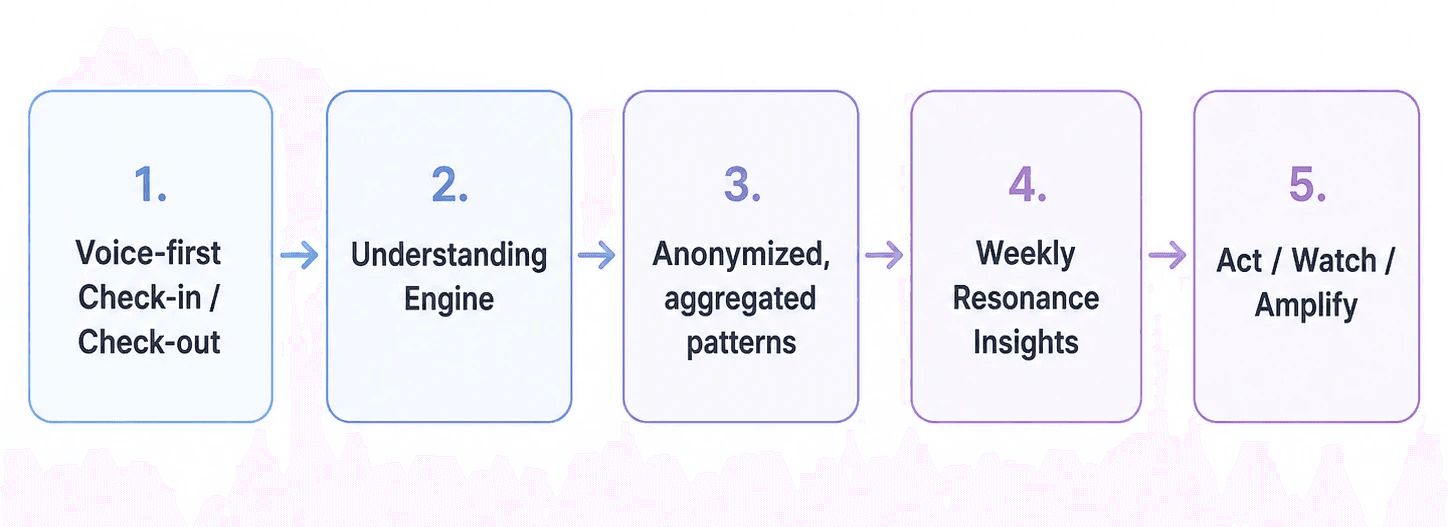
The organizational value comes from turning those individual interactions into a different level of understanding. Baryons surfaces anonymized, aggregated patterns rather than handing individual conversations to leadership. Weekly Resonance Insights can surface patterns around team health, energy, momentum, engagement, relationships, flow, and purpose. A privacy mesh keeps personal context from ever reaching a leader's view. Effects surface, causes stay private.
This connects two things organizations have historically struggled to hold together: a genuinely useful individual experience and decision-ready organizational insights. For leaders, the conversation can shift from "Something feels off" to "Here is a pattern we should understand," and ultimately to "What should we act on, what should we keep watching, and what is working well enough to reinforce?"
Our Resonance Insights organize that leadership view around Act, Watch, and Amplify, helping distinguish signals that may warrant attention, patterns worth watching, and areas where positive momentum is emerging. The point is not to generate another dashboard full of numbers. It is to make the signal usable.
Problem: execution risk becomes visible too late
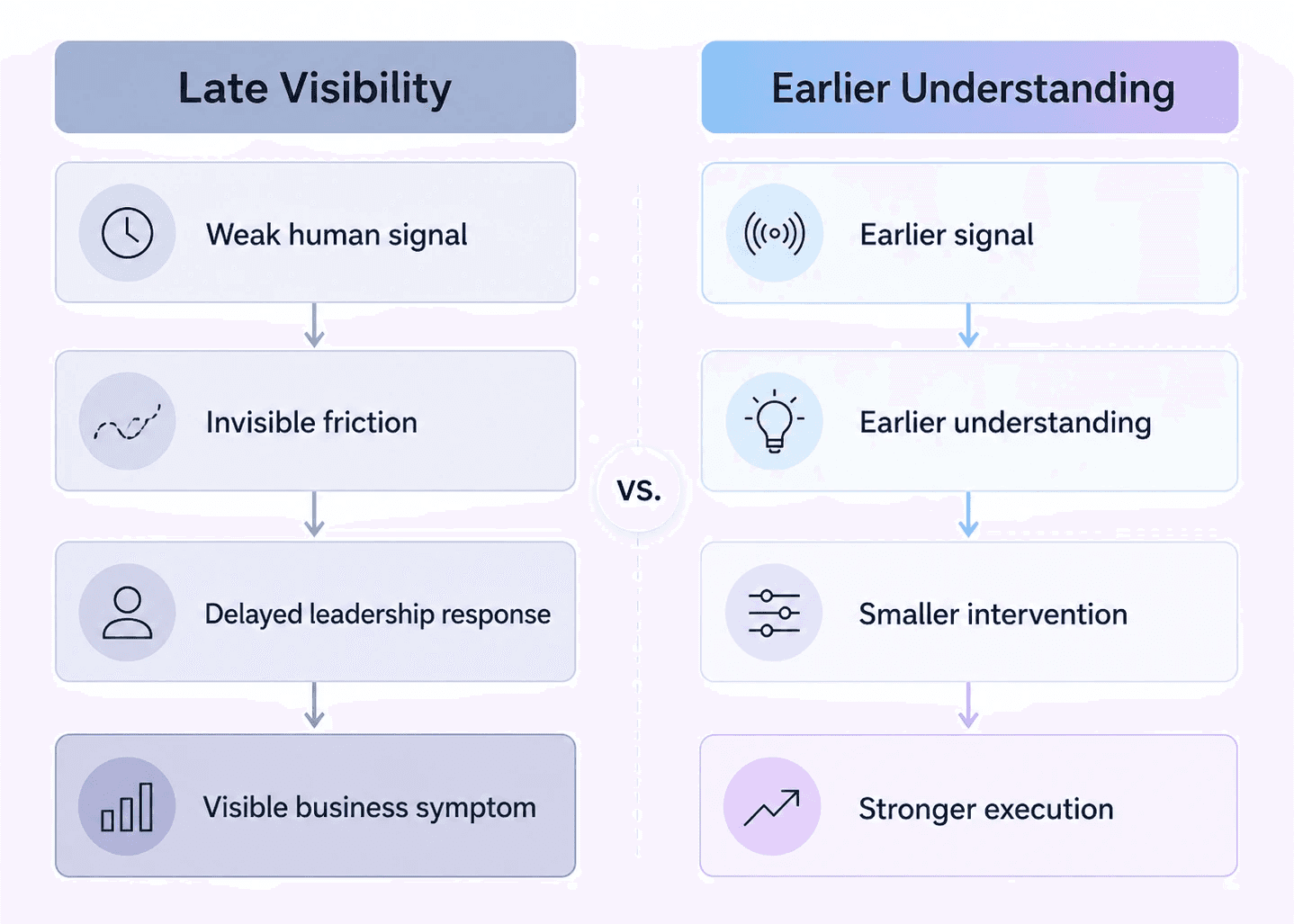
This is where the pieces come together. A missed target is visible. Attrition is visible. A delayed transformation is visible. Margin pressure is visible. None of those begin on the day they appear in the dashboard.
Before the missed milestone, there may have been declining confidence, repeated decision reversals, or coordination friction. Before a critical manager leaves, strain may have been building. Before execution becomes inconsistent, priorities may have started drifting across teams. We want leadership to have a better chance of seeing those trajectories while there is still room for a smaller intervention. That is why we talk about signal before symptom.
Baryons works alongside financial reporting, operating dashboards, engagement tools, and leadership judgment. It adds visibility into a layer those systems often do not capture continuously: the human dynamics underneath execution.
Our goal is to help organizations see where alignment is breaking, decisions are degrading, energy is draining, or friction is increasing before the business result makes the issue undeniable.
Where Baryons fits for the executive team
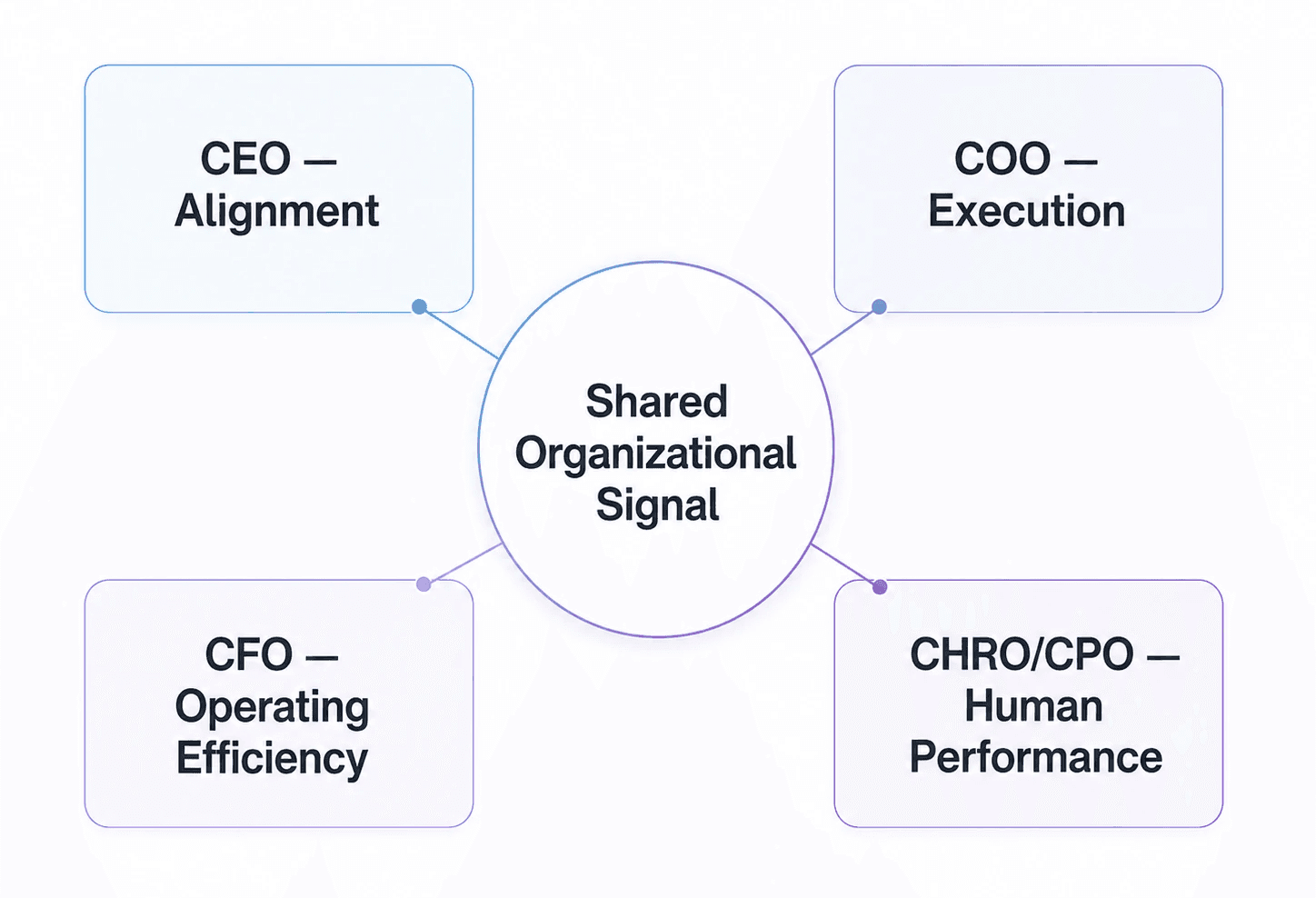
The same organizational signal matters differently depending on the executive looking at it.
For a CEO, the question may be whether the organization is aligned enough to execute the strategy as conditions change.
For a COO, it may be where coordination friction or weakening decision clarity could become execution risk.
For a CFO, it may be whether hidden friction is creating rework, inefficient resource use, or operating drag that financial reporting will reveal only later.
For a CHRO or CPO, it may be where team health, energy, engagement, or alignment is changing and where leadership attention may be needed.
Those are different executive lenses on the same underlying problem: what is happening inside the organization that we cannot see clearly enough today?
That question is becoming more consequential as work changes. Deloitte’s 2026 Chief Strategy Officer Survey found that more than half of strategy leaders report too many priorities and too little time, while only 35% say they co-lead or fully own strategic decision-making for top priorities. The problem is not simply generating more strategy or information. It is creating enough clarity and operating capacity to turn priorities into execution.
What Baryons is AND what it is not
If there is one thing we want executives to take away, it is this. Baryons is designed to create understanding, not to give leadership more activity data. We add a layer that helps explain what may be forming underneath your outcomes, working with the systems that already tell you what happened. And we are not asking leaders to become amateur psychologists. We make organizational patterns more legible so leaders can apply the judgment they already bring to the business.
That is why our mission is straightforward: improve how organizations think, align, and execute by giving them genuine understanding of the human dynamics that drive performance.
Final thought
What Baryons does is easier to understand when we start with the problems. Unclear priorities. Decision friction. Leadership strain. Coordination breakdowns. Execution risk that becomes visible too late.
Those conditions already exist inside organizations. The challenge is that leaders often have to infer them from anecdotes, periodic snapshots, or business outcomes that arrive after the cost has landed.
We built Baryons to make that layer easier to understand. The individual gets a voice-first experience for preparing, reflecting, and growing. The organization gets anonymized, aggregated, longitudinal signal that helps leadership see patterns earlier and make better-informed decisions.
That is the connection.
And if your executive team is asking what is happening between strategy and results that your existing systems cannot quite show you, that is a practical place to start a conversation with us.
Watch on YouTube - Baryons - The Understanding Engine
Try it, its free!
Want to bring organizational insights to your team? Book a demo!
More articles

Human Performance Is the Missing Layer in AI Transformation
AI transformation is not only a technology deployment challenge; it is an operating-performance challenge. This article examines how decision clarity, workflow redesign, accountability, trust-based visibility, and learning-oriented pilots help leaders convert AI capability into measurable work outcomes.

Why Employees Actually Use It
Employee participation cannot be sustained by organizational need alone. This article examines the value employees look for in a practice such as Baryons. Clarity, agency, constructive contribution, and less avoidable friction and gives sponsors a practical lens for earning trust.

How to Prove Human Performance Is Affecting Operating Results
CFOs and COOs need more than a broad engagement score to understand whether human-performance conditions are affecting execution. This article shows how to connect workforce conditions to observable operating behaviors, local process measures, and decision-ready pilot evidence over 90 days.
