The Early Warning Signals COOs Need Before Delivery Starts Slipping

Every operations leader has experienced the same frustrating scenario.
A critical delivery misses its target. Customer complaints climb. Projects that looked on track suddenly need rework. Teams point to unexpected delays, communication breakdowns, and resource constraints. By the time these problems surface in performance reports, the damage is already done.
In transportation and logistics, the consequences land fast and expensive. A delayed shipment ripples downstream. A missed handoff creates bottlenecks across the supply chain. A small coordination issue between two teams cascades into service disruptions, financial penalties, and strained customer relationships.
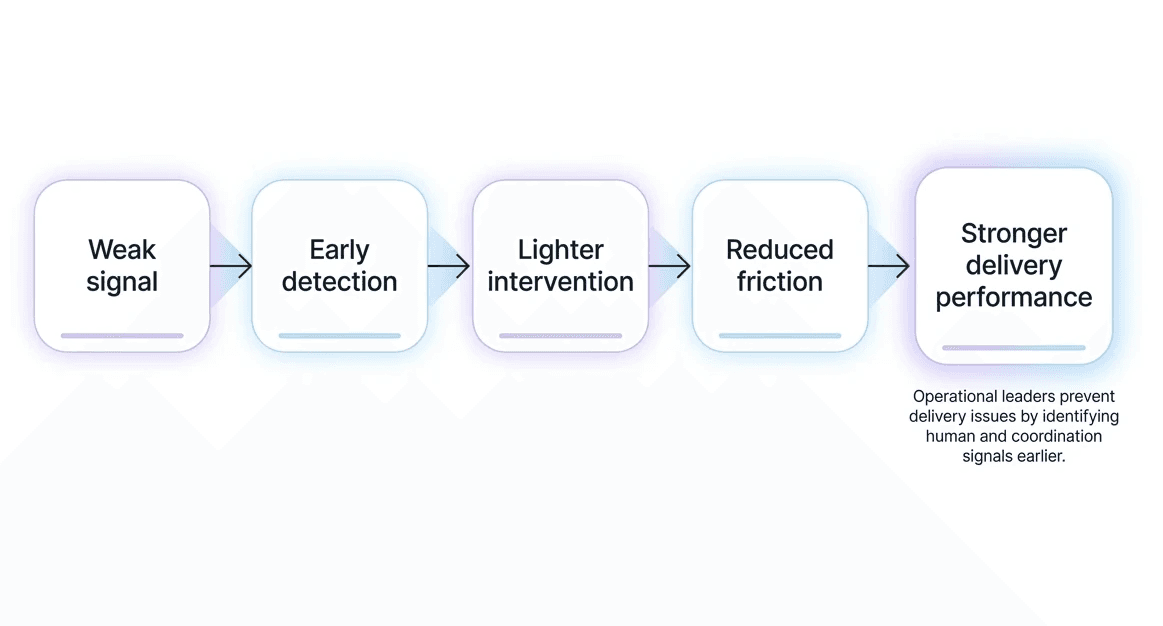
Operational failures rarely arrive without warning. The signals are almost always there. The problem is that most organizations do not see them until delivery performance starts to deteriorate. For today's COO, the most important capability is no longer responding quickly to operational issues. It is reading the early indicators that a problem is developing, weeks before it shows up in a dashboard, a KPI, or a customer escalation. The organizations that consistently outperform are the ones that catch the signal before it becomes a symptom.
Operational Failure Is Usually a Human Problem Before It Becomes a Process Problem
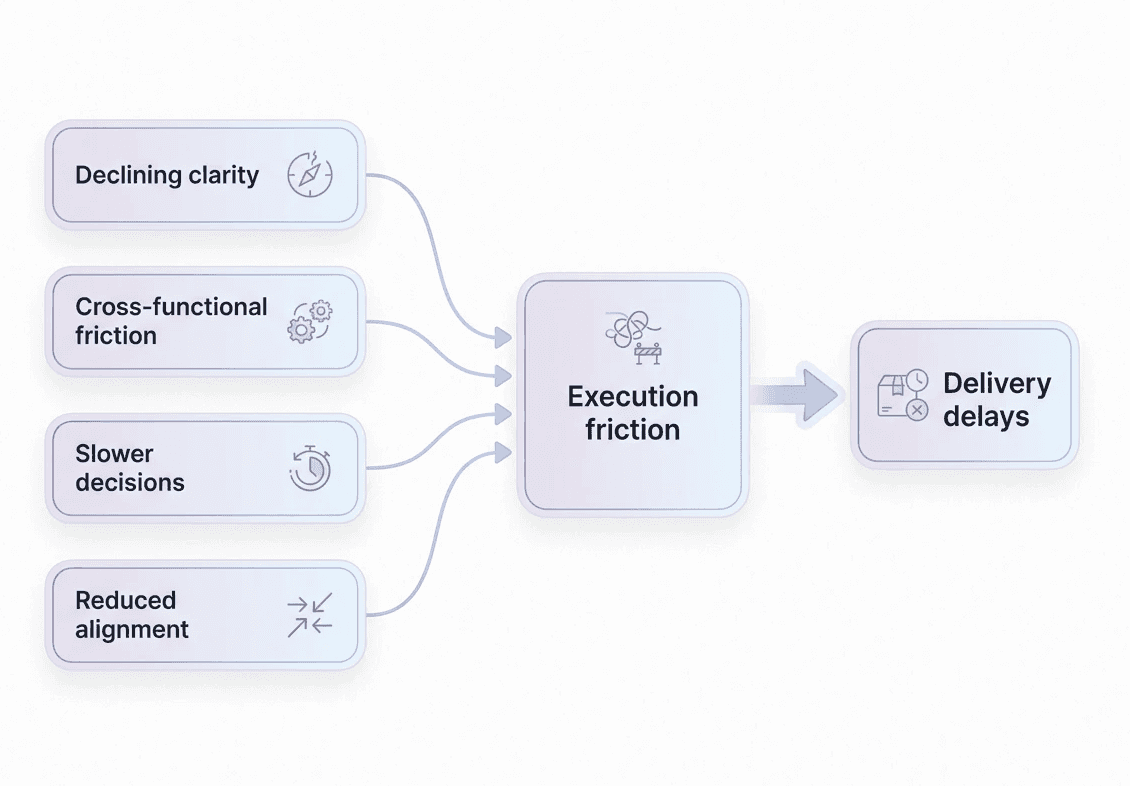
When delivery performance slips, organizations investigate the obvious causes first. Was there a system failure? Did demand exceed capacity? Was there a supplier issue? Did external conditions create disruption? These factors matter, but many operational failures begin somewhere else entirely: in the human system.
People lose clarity on priorities. Teams stop communicating well. Decision-making slows. Managers miss emerging risks. Employees start operating on different assumptions. Cross-functional handoffs get inconsistent, and accountability blurs. None of this shows up on an operational dashboard, but all of it creates friction. And friction eventually becomes delay.
In transportation and logistics, where precision and coordination are everything, even small friction produces real consequences. A warehouse team and a transportation team slightly out of sync create shipment delays. A distribution center with communication gaps quietly raises the order-error rate. A dispatcher working with incomplete information generates downstream scheduling problems that touch dozens of customers. The operational symptoms eventually become obvious. The human signals underneath them stay invisible.
The Cost of Waiting for Lagging Indicators
Most organizations are exceptionally good at measuring outcomes.
They track on-time delivery.
They monitor productivity.
They measure service levels and customer satisfaction.
They review financial performance and operational KPIs.
These metrics are essential.
The problem is that they are lagging indicators.
They tell leaders what has already happened.
They do not reveal what is beginning to happen.
Picture a logistics network reporting a decline in on-time delivery. By the time that metric moves, several things have usually already occurred. Teams have been wrestling with coordination issues for weeks. Managers have noticed rising confusion around priorities. Communication breakdowns have created operational inconsistencies. Decision bottlenecks have slowed responses to emerging issues. Employees have started to disengage or become overloaded. The performance metric is simply the final expression of signals that appeared much earlier.
For COOs, this is the core challenge. If the organization can only react after performance drops, leaders spend their time managing consequences instead of preventing them. Operational excellence asks for something different: visibility into the conditions that shape performance before the performance itself changes.
The Weak Signals That Often Predict Delivery Problems
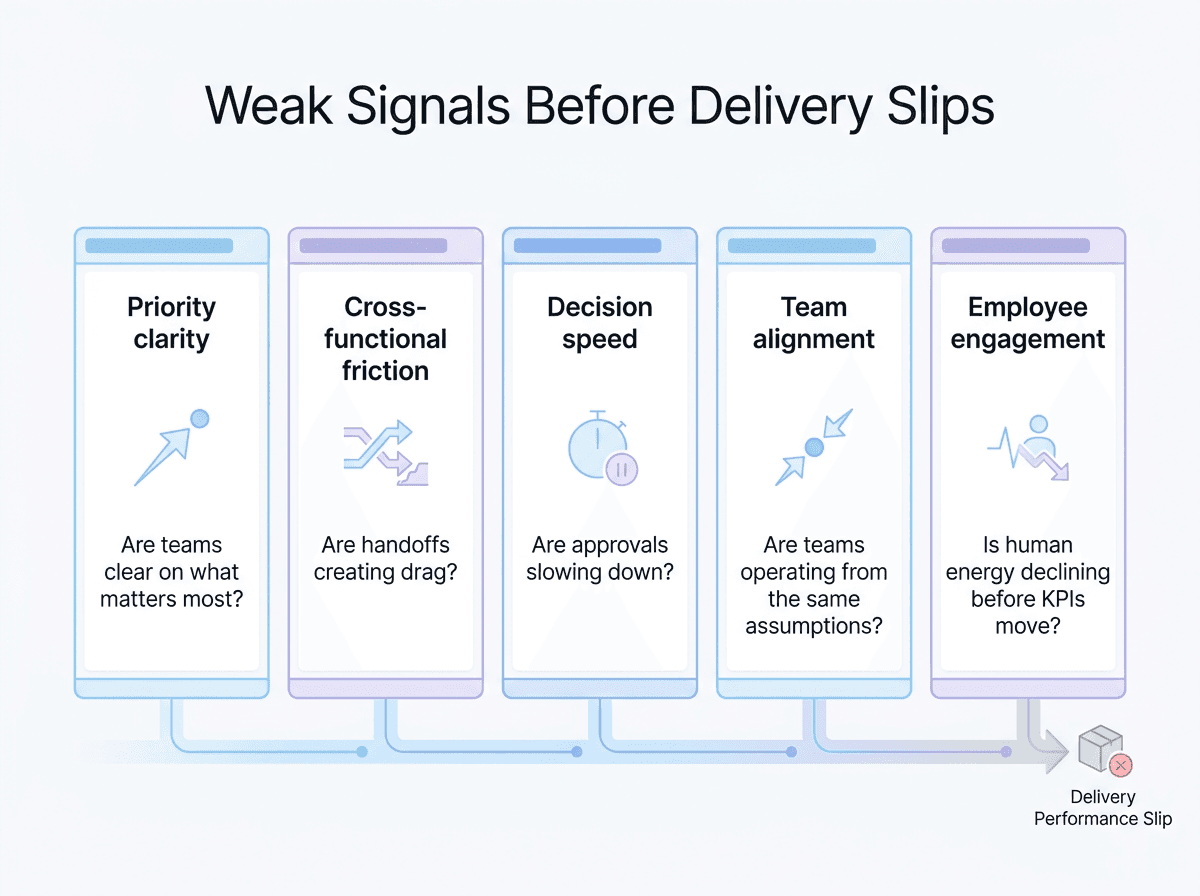
Operational breakdowns rarely happen without indicators. Some of the most important ones are subtle and easy to overlook.
Declining Clarity Around Priorities
When teams get uncertain about what matters most, execution slows. People spend more time seeking clarification, decisions get delayed, and resources fragment. In environments built on speed and coordination, even minor ambiguity creates delays throughout the system.
Increasing Cross-Functional Friction
Every delivery depends on handoffs. Operations hands work to transportation. Transportation coordinates with customers. Customer service interacts with field teams. Warehousing depends on procurement and inventory.
When communication between these groups turns inconsistent, performance risk rises fast. The first signals are small: extra follow-up, duplicate work, minor misunderstandings. Over time they become missed deadlines and service failures.
Slower Decision-Making
Organizations under pressure often turn more cautious. Approvals take longer, managers hesitate, escalations rise, and information circulates through more layers. These behaviors point to declining organizational confidence and rising complexity. By the time metrics deteriorate, decision friction may already be deeply embedded.
Reduced Team Alignment
Different teams begin working from different assumptions. Priorities fragment, success metrics vary by department, and employees get conflicting direction. In distributed operations, small inconsistencies multiply as work moves across functions and locations.
Early Signs of Employee Disengagement
Operational performance is tied to human performance. When employees feel disconnected from priorities, buried in complexity, or worn down by friction, execution quality drops. The impact is not immediately visible, but over time engagement challenges become delivery challenges.
Transportation and Logistics Makes the Risks Impossible to Ignore
Transportation and logistics offers one of the clearest cases for why early signals matter. These environments run on timing, coordination, and precision. A single delay affects multiple downstream activities. A warehouse delay hits transportation schedules. Transportation delays affect customer commitments. Customer issues create escalations. Escalations consume management attention and operational resources.
Because these organizations run on interconnected processes, a small human issue becomes an enterprise-wide problem quickly. That is why so many operational leaders invest heavily in visibility into assets, shipments, and inventory. Increasingly, the leading ones are recognizing they need visibility into something else: the health of the human operating system that makes delivery possible. Trucks, warehouses, and technology platforms do not execute strategy.
People do.
The Shift from Performance Monitoring to Performance Prediction
The next generation of operational leadership will be defined by who can anticipate issues before they become visible. That means moving past traditional reporting toward a deeper read on the factors that drive execution. The most effective COOs are already asking different questions. Where is alignment weakening? Which teams are carrying more friction? Where are decision bottlenecks forming? Which operating groups are at risk before the KPIs move? How do we surface execution risk earlier?
These questions focus on the drivers of performance rather than the outcomes alone. This is where Baryons fits. Baryons turns the daily conversations your people are already having into organizational signal, giving leaders a weekly read on where to act, where to watch, and where to amplify.
It gives operational leaders a way to understand the human and team dynamics behind execution without launching another survey, so alignment gaps and rising friction become visible while there is still time to respond.
Why Human Signals Matter More Than Ever
Modern operations keep getting more complex. Teams are more distributed, supply chains more interconnected, and customer expectations higher. Organizations are adopting new technology and automation at unprecedented speed. As complexity grows, the human factors behind performance carry more weight. Small misunderstandings create larger consequences. Communication gaps become operational failures. Weak alignment produces real execution risk.
The organizations that thrive will be the ones that spot emerging problems early enough to intervene before performance suffers. They understand that operational performance is a reflection of how people work together, not only a function of processes and systems.
Seeing the Signal Before the Symptom
For COOs, one of the greatest opportunities today is developing visibility into the early indicators that precede operational disruption.
Because by the time delivery metrics decline, customer complaints increase, or rework becomes visible, the organization is already paying the price.
The better approach is to identify the weak signals sooner.
To understand where friction is developing.
To detect when alignment is slipping.
To recognize when decision effectiveness is weakening.
To see emerging risks before they become operational realities.
At Baryons, we believe these signals are among the most important indicators of future performance. As the Human Performance Layer, Baryons helps organizations understand the human and team dynamics that influence execution, enabling leaders to identify risk earlier and act before delivery performance suffers.
In transportation, logistics and increasingly in every industry where execution depends on coordination, timing, and follow-through, the organizations that win will be those that can see the signal before the symptom.
Baryons - The Understanding Engine on YouTube
Try it for yourself, its free!
Want it for your team, book a demo!
More articles

Human Performance Is the Missing Layer in AI Transformation
AI transformation is not only a technology deployment challenge; it is an operating-performance challenge. This article examines how decision clarity, workflow redesign, accountability, trust-based visibility, and learning-oriented pilots help leaders convert AI capability into measurable work outcomes.

Why Employees Actually Use It
Employee participation cannot be sustained by organizational need alone. This article examines the value employees look for in a practice such as Baryons. Clarity, agency, constructive contribution, and less avoidable friction and gives sponsors a practical lens for earning trust.

How to Prove Human Performance Is Affecting Operating Results
CFOs and COOs need more than a broad engagement score to understand whether human-performance conditions are affecting execution. This article shows how to connect workforce conditions to observable operating behaviors, local process measures, and decision-ready pilot evidence over 90 days.
