Data Without Trust & the Psychology of Signal

More measurement can produce less truth
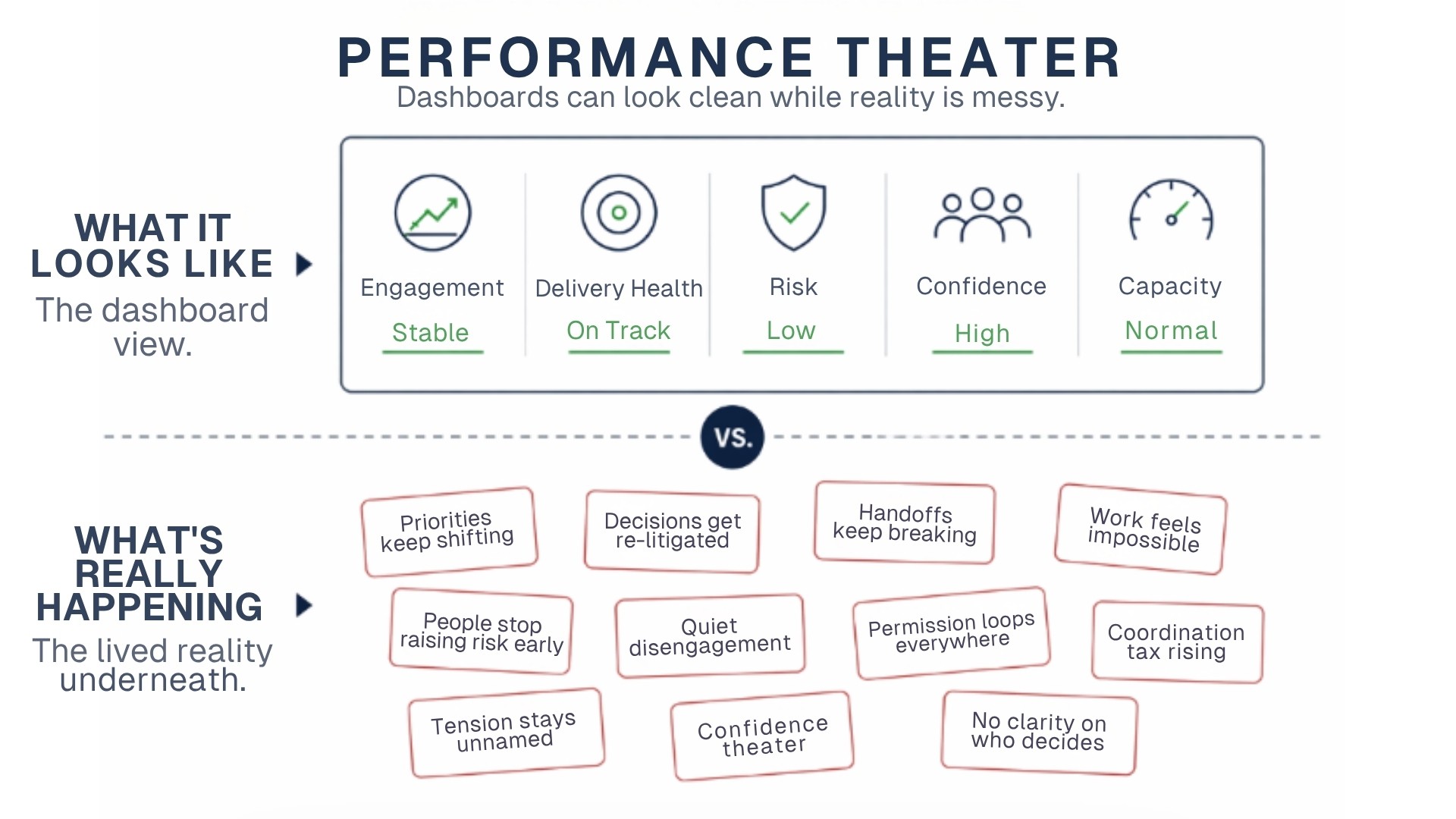
The modern organization is over-instrumented and under-informed.
We have dashboards for everything. Pulse surveys, engagement platforms, productivity tooling, sentiment analysis, performance metrics, operational KPIs. Yet leaders still say the same thing in executive rooms:
“We have data, but we don’t trust it.”
or
“I can’t tell what’s really happening until it’s already a problem.”
This is the central paradox of people and performance measurement:
Signal is not what you collect. Signal is what people will tell the truth into.
And trust is the gating factor.
Why signal collapses: the psychology is predictable
When leaders don’t trust the data, they often blame methodology:
sample size
bias
timing
question quality
Those matter, but the deeper issue is psychological.
People don’t distort signal because they’re dishonest. They distort signal because they’re adaptive.
If telling the truth creates exposure, people protect themselves.
If measurement is used for evaluation, people game it.
If nothing changes after feedback, people stop contributing.
If leaders reward optimism theater, reality goes underground.
This is why measurement becomes performance theater: not because people are immature, but because the system teaches them that optics are safer than accuracy.
Trust breaks in three common ways
Across organizations, signal trust tends to collapse through a few repeatable failure modes.
Politicization
When metrics become ammunition, they stop being information.
If teams believe data will be used to punish, compare, or embarrass, they will either withhold or reshape responses. This is why “the numbers look fine” often correlates with “the floor feels tense.”
People can sense whether a system is for learning or for judgment.
Inconsistency & fatigue
If measurement arrives episodically, it’s forced to carry too much weight.
Quarterly engagement surveys ask people to compress months of experience into a few clicks. The result is either noise or resentment. Even worse: leaders treat the results as a strategic event, not a continuous operating input, so action is delayed and trust erodes.
Episodic listening doesn’t feel like listening. It feels like extraction.
No visible repair loops
If people give feedback and nothing changes, they stop believing.
The fastest way to destroy signal quality is to invite truth and then ignore it. Not because leaders are malicious, because the organization lacks a path from insight → decision → intervention.
Without repair loops, measurement becomes ritual. Ritual becomes cynicism.
The difference between listening & instrumentation
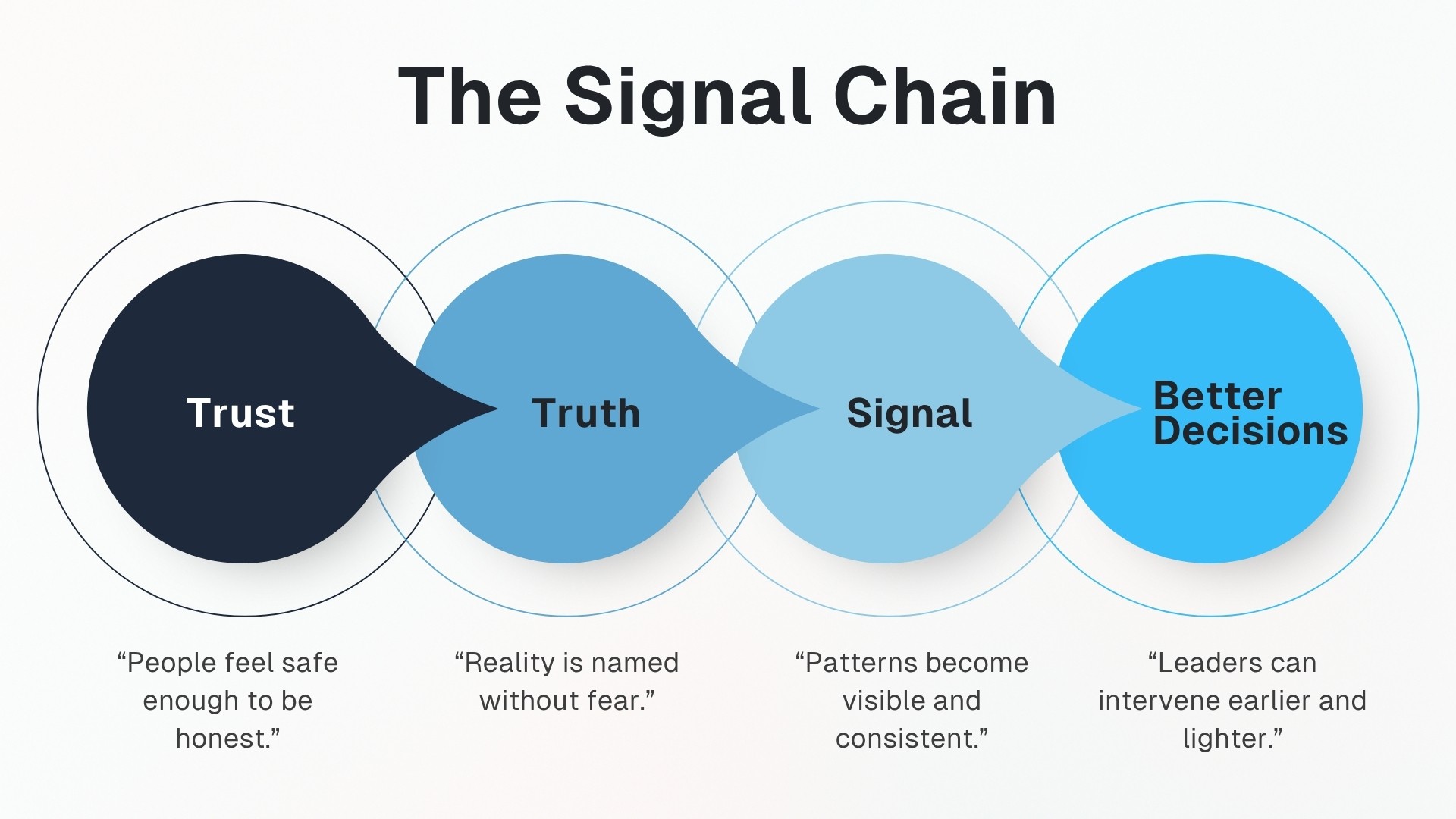
Listening is a relationship. Instrumentation is a system.
Most companies do instrumentation without relationship. They collect data. They publish dashboards. They hold readouts. They assume truth will keep flowing.
But human signal doesn’t behave like machine telemetry. Humans interpret risk. They assess incentives. They evaluate safety.
So the real question isn’t, “How do we measure more?”
It’s, “How do we design measurement people will trust and leaders can act on?”
The executive requirement: decision-ready signal, not more reporting
Executives are time-fragmented. They scan before they read. They reject anything that feels like marketing or bureaucracy.
So signal has to be low-friction, high-trust, and compressed into meaning.
This is why the best visibility systems:
reduce cognitive effort while increasing insight density,
avoid noise and overproduction,
and deliver clarity that supports action.
Principles for building signal people will tell the truth into
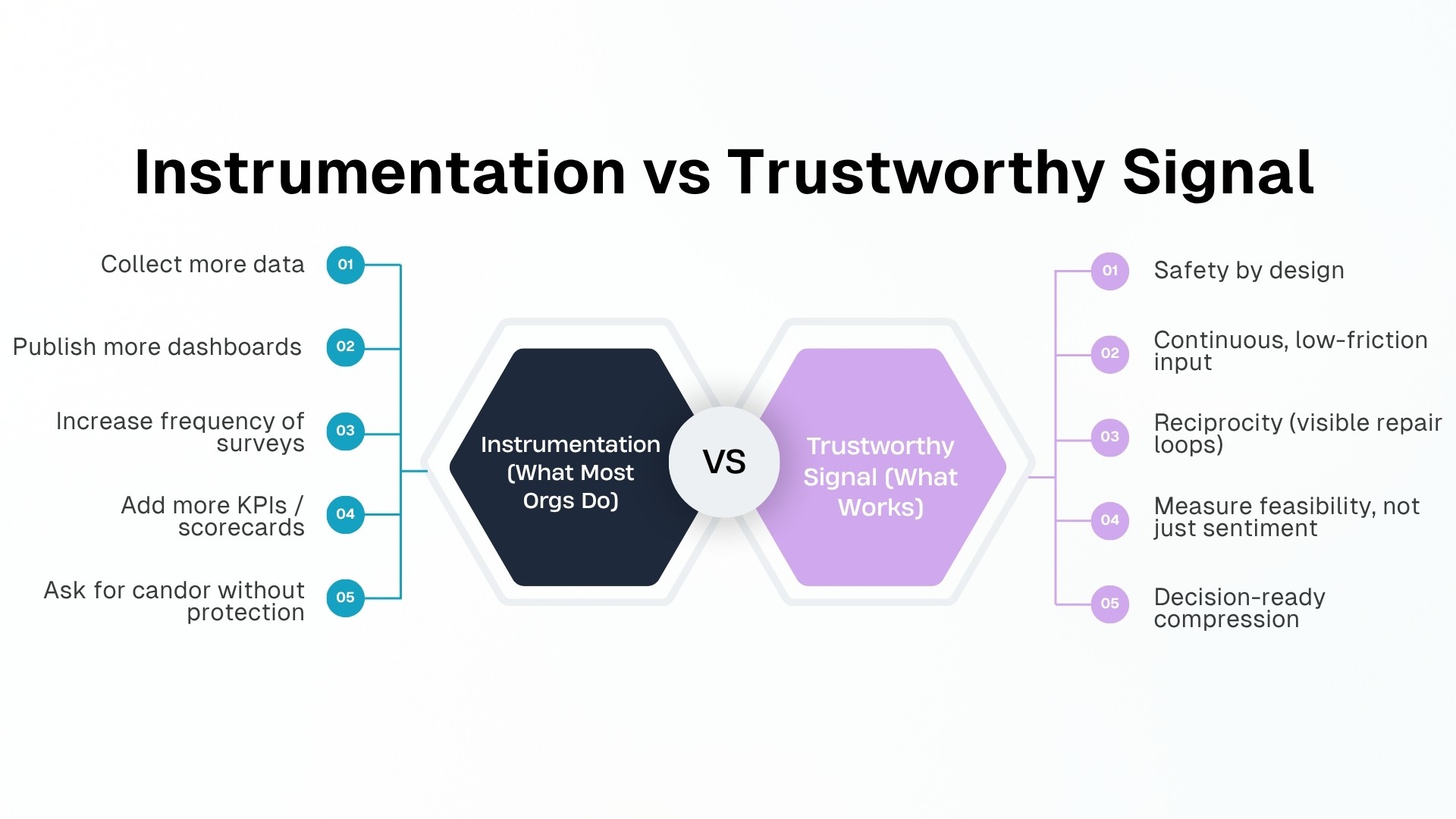
If you want trustworthy data, you need a trustworthy system. Here are the design principles that consistently work.
Safety by design, not by promise
You can’t ask people to “feel safe.” You have to architect safety:
anonymized rollups
protections against individual attribution
clarity that it’s not a disciplinary tool
governance that prevents misuse
If people can’t predict how data will be used, they assume the worst.
Signal systems must explicitly avoid surveillance framing.
Continuous, small, in-the-flow collection
Truth is easier to tell in small moments than in big surveys.
Continuous check-ins and check-outs create a living feedback layer that captures patterns as they form, not after memory and emotion have rewritten the story.
Reciprocity: feedback must produce visible action
People keep contributing when they see cause → effect.
Even small “repairs” matter:
a clarified priority,
a removed blocker,
a named tradeoff,
a changed workflow.
The goal isn’t to satisfy everyone. It’s to prove the system is real: signal creates decisions; decisions create interventions.
Measure feasibility, not just sentiment
Dashboards can’t tell you if work feels possible.
Feasibility is a leading indicator:
Do people understand what matters?
Do they have the capacity to deliver?
Is coordination clean or chaotic?
Are decisions stable or constantly reversed?
When feasibility collapses, performance collapse follows.
Sentiment without feasibility is just mood tracking.
Closing
Data without trust creates theater.
If leaders want earlier warning signals, they need to stop treating measurement as extraction and start treating it as infrastructure: a continuous, safe, decision-ready signal of how work is actually being experienced and coordinated.
That is the north star Baryons is built around, Human Performance AI that turns invisible dynamics into trustworthy signal so leaders can make better decisions, earlier, with less disruption.
More articles

Going Deeper: The Thinking Partner and the Growth Partner
Both the Thinking Partner and the Growth Partner grow you. The difference is shape. A look at when to reach for each, and why depth is where the magic lives.

Why This Isn’t a Pulse Survey
Baryons is not another employee pulse survey. This blog explains the difference between periodic listening and longitudinal organizational signal, showing how Baryons helps CHROs and People leaders understand what changes between survey moments: clarity, momentum, alignment, strain, and emerging patterns that may matter before they become obvious symptoms.
The Privacy Mesh
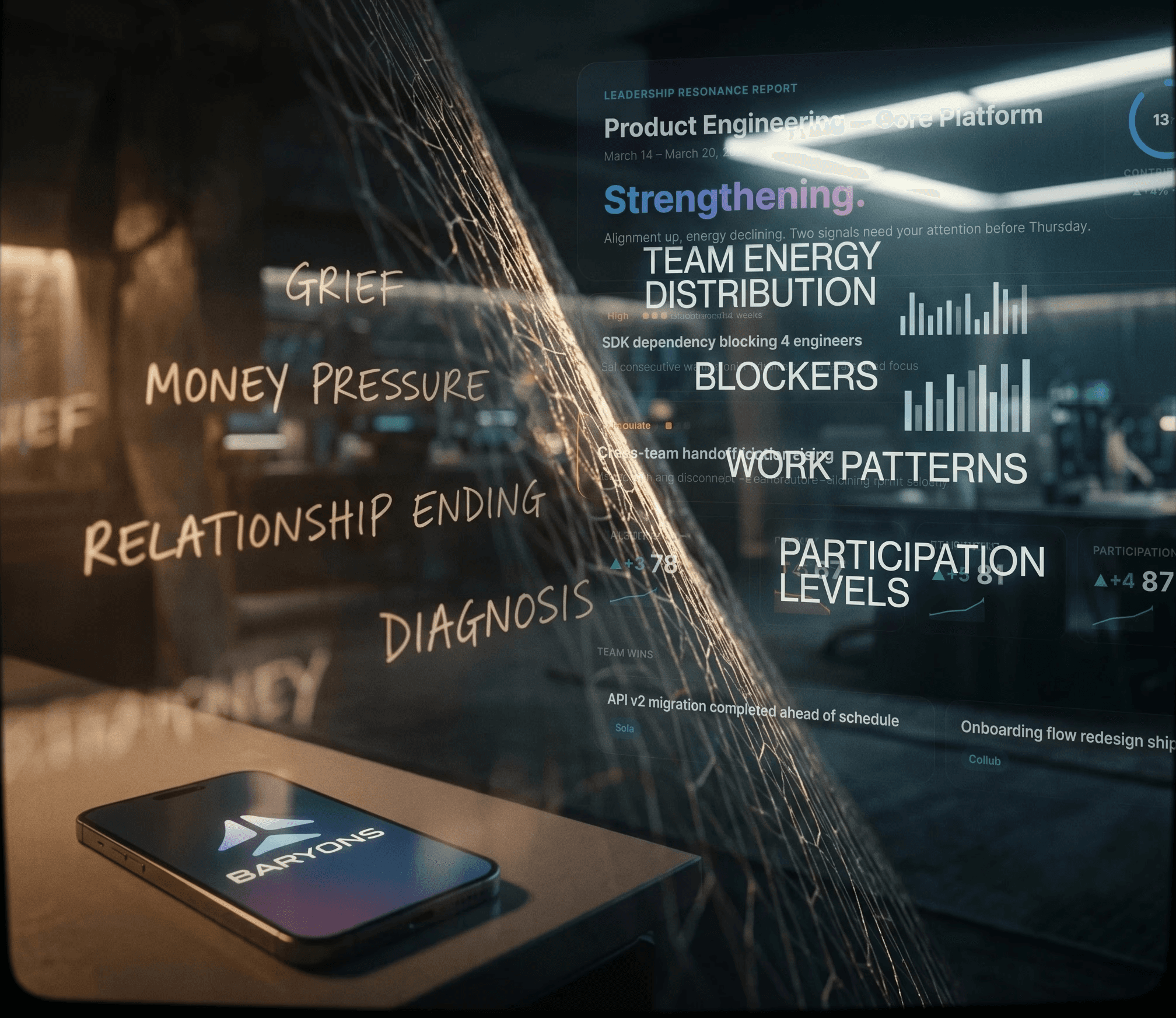
People tell their Baryon real things in an organizational context. The Privacy Mesh is how they can, while their leadership still sees a team's energy and never the contents of a life. Here is how that boundary actually holds.
