Cognitive Overload Is the New Coordination Tax

Cognitive Overload Is the New Coordination Tax
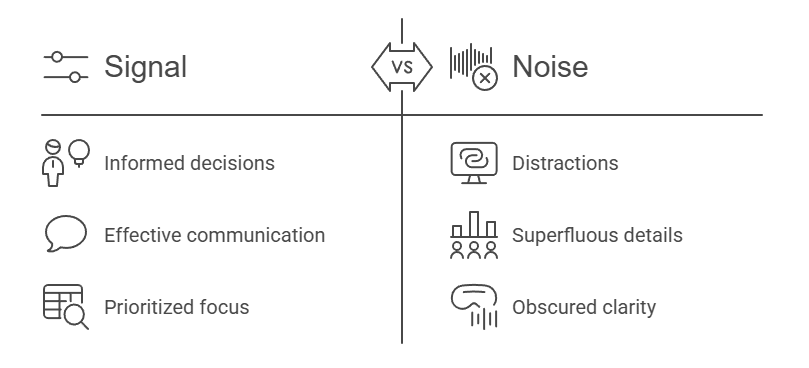
The modern organization is drowning in “almost-communication”
Most teams don’t suffer from a lack of tools. They suffer from an excess of partially processed information.
Messages arrive faster than meaning. Updates are frequent but incomplete. Context lives in threads, documents, meetings, and memory. Everyone is “in the loop,” but few people feel truly clear.
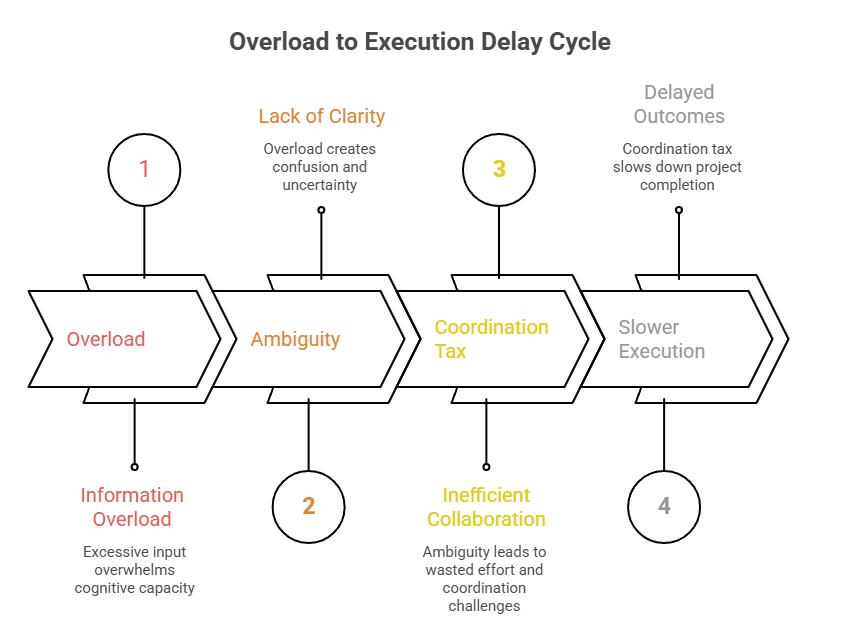
This is cognitive overload—not just as a personal wellbeing issue, but as an operational cost.
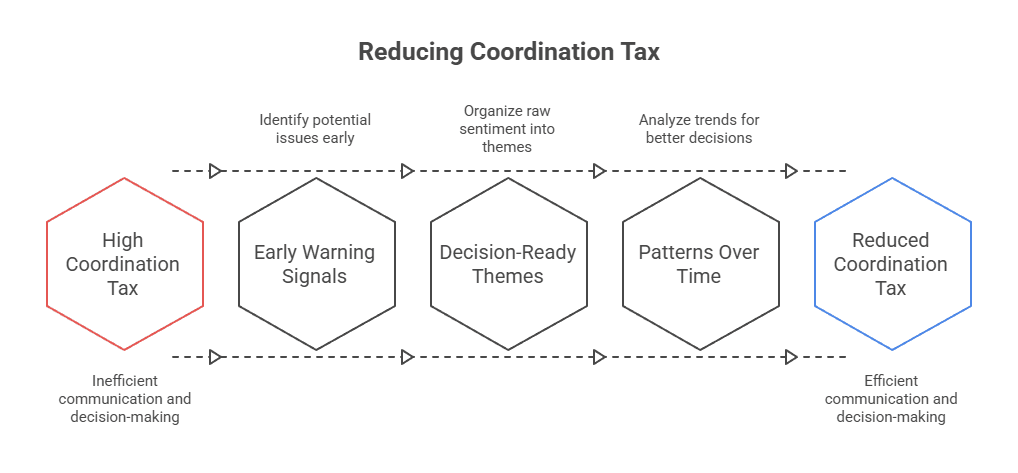
When cognition gets taxed, coordination gets taxed. When coordination gets taxed, execution slows. That is the coordination tax: the hidden time and energy burned not on value creation, but on aligning, clarifying, re-checking, re-explaining, and re-deciding.
Why overload isn’t solved by “better time management”
Leaders often respond to overload with personal productivity advice: inbox zero, meeting hygiene, prioritization frameworks.
Those are helpful at the edges. But overload is increasingly systemic.
It’s driven by:
High interdependence.
More collaboration means more coordination surface area.
Decision churn.
Priorities shift, but the organization’s shared understanding lags behind.
Status as a substitute for clarity.
Teams produce updates to reduce anxiety, not to improve decisions.
Fragmented sense-making.
Everyone is processing the same reality separately—then reconciling it in meetings.
Overload persists because the system keeps generating ambiguity faster than it resolves it.
The real cost: delayed decisions and silent rework
Cognitive overload has two expensive downstream effects:
Decisions slow down.
When people aren’t sure what matters, they wait. Or they ask for confirmation. Or they escalate. The organization becomes conservative by default.
Rework rises quietly.
When understanding is partial, teams build the wrong thing confidently—then reset later.
This is why “busy” and “productive” are no longer correlated. Teams can be saturated with activity and still lose momentum.
Signal vs noise: what executives actually need
Baryons’ content guidance is blunt: executives are time-fragmented and decide whether to engage in seconds. What works is low-friction signal—high insight density, low cognitive effort.
That principle applies inside organizations, too.
If leaders want to reduce the coordination tax, they need:
early warning signals (not retrospective stories),
decision-ready themes (not raw sentiment),
patterns over time (not one-off snapshots).
How to reduce the coordination tax without adding process
Here’s a practical set of moves that reduce cognitive load at the system level:
Create a single “what matters most” narrative per week.
Not a slogan. A short, living statement of focus that teams can reference.
Standardize the language of blockers.
Most “blockers” are actually one of three things: missing decision, missing owner, missing constraint. Label them clearly.
Replace some meetings with structured debriefs.
A debrief captures what changed, what was learned, and what needs to shift—without everyone re-processing reality out loud.
Make reflection a habit, not an event.
Reflection is how humans compress experience into learning. Without it, complexity accumulates.
None of these add bureaucracy. They add coherence.
Where Baryons fits: turning reflection into operational clarity
Baryons is built for brief calls that create clarity—helping people untangle noise, reveal what matters, and create flow for themselves and their teams. At the organizational level, it emphasizes privacy, enterprise-grade security, and anonymized insight collection so leaders can see patterns without turning the tool into surveillance.
In other words: it helps organizations move from “more communication” to “better signal.”
If cognitive overload is showing up as slower decisions, heavier meetings, or constant re-clarification, it may be time to treat clarity as infrastructure. If you’d like to see what that can look like in practice, check out more about what Baryons offers and how brief calls can reduce the coordination tax instead of adding to it.
Learn more at Baryons.com
More articles

Flourishing in Motion: What I Learned from Pavel Bosovik of 27 North
Pavel Bosovik went from selling glue bookmarks on food stamps to building expedition vehicles that help people disappear off-grid. On The New F Word, he shares why flourishing is a daily practice, not a destination, and why movement is medicine.

Data Without Trust & the Psychology of Signal
Modern organizations are over-instrumented and under-informed: dashboards and surveys everywhere, yet leaders still don’t trust what they’re seeing. This blog explains why signal collapses psychologically (not methodologically), how measurement turns into performance theater, and the design principles that create trustworthy, decision-ready signal teams will tell the truth into.

Flourishing as Performance Infrastructure
Flourishing isn’t a perk or a wellness program, it’s performance infrastructure. This blog reframes flourishing as the operating conditions that make execution durable under pressure: clarity, confidence, and curiosity. It explains why ambiguity (not workload) breaks performance, how flourishing functions as an early warning system, and what it looks like when built into the operating system.