Why AI Investments Stall When the Organization Can’t Align Around Decisions

AI is not the constraint anymore
Most leadership teams no longer need to be convinced to invest in AI.
The tools are here. The use cases are expanding. The pressure to move is clear. What we are seeing instead is something more subtle: organizations are investing in AI, but the business impact is uneven. Some teams accelerate. Others stall. In many cases, the technology works exactly as expected, but the performance lift never fully materializes.
The constraint has shifted. Access to AI isn't the limiting factor anymore. Whether the organization can align around decisions fast enough to use it well, that's the real one.
AI increases the cost of misalignment
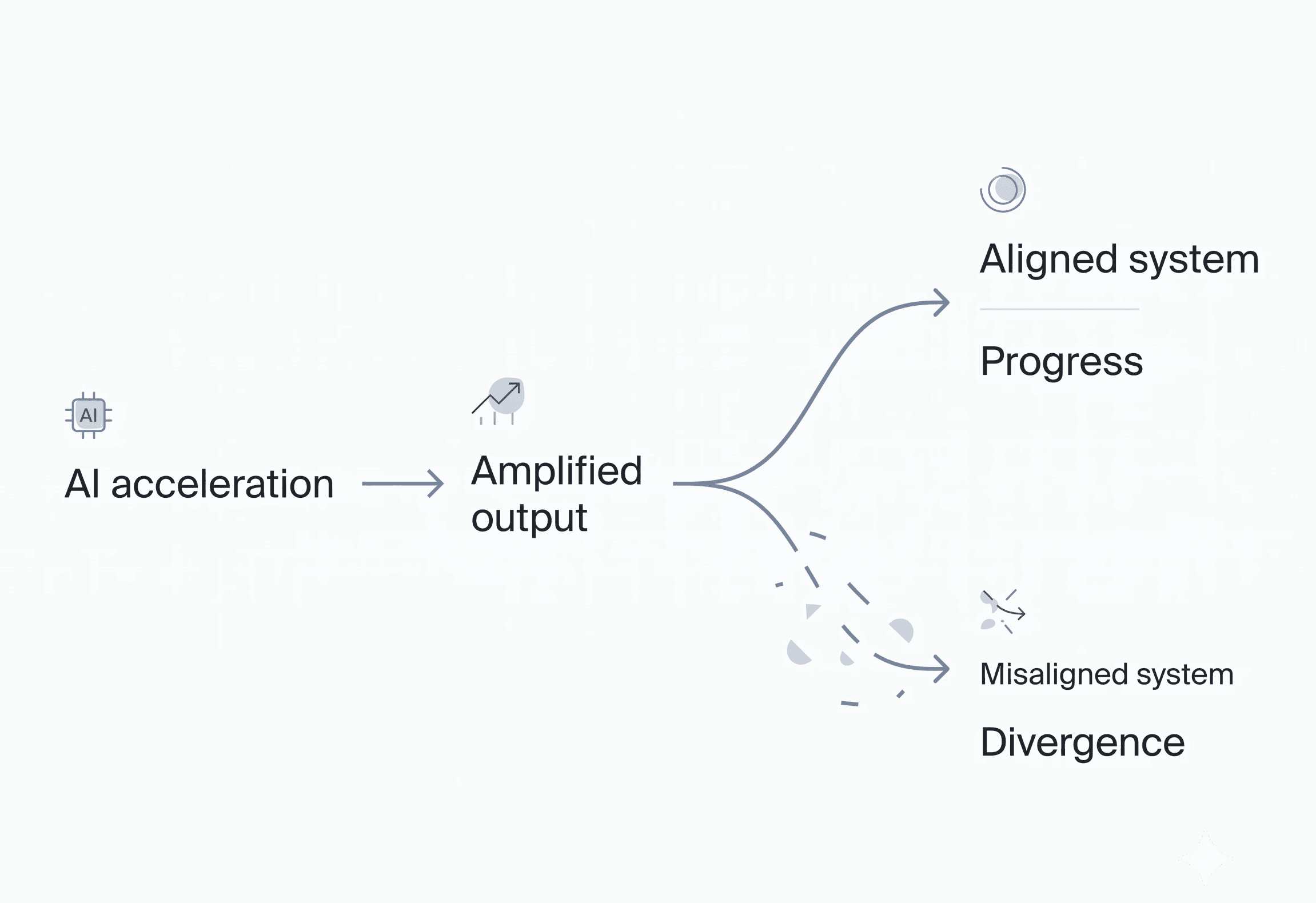
AI does not operate in isolation. It amplifies whatever operating conditions already exist.
If priorities are clear and decision rights are well understood, AI increases speed and leverage. If priorities are unstable and decision boundaries are unclear, AI increases noise and divergence. More output gets created, but less of it moves in the same direction.
This is why some organizations see a surge in activity without a matching increase in progress. The system produces more while coordination quietly weakens.
Microsoft’s 2025 Work Trend Index highlights this shift. As organizations move toward "Frontier Firms" built around human-agent collaboration, most leaders say this is a pivotal year to rethink operations. But that shift assumes that organizations can align human judgment with machine capability. Without that alignment, speed alone does not create advantage. (blogs.microsoft.com)
The real bottleneck is decision clarity
When AI initiatives stall, the issue is rarely the model, the tool, or the technical integration. It's decision clarity.
We see the same patterns repeatedly. Teams generate insights but hesitate to act. Decisions get revisited because tradeoffs were never made explicit. Different parts of the organization interpret priorities differently, so AI outputs get used inconsistently, or not at all.
From the outside, it can look like slow adoption. From the inside, it's usually misalignment.
That's why we define alignment narrowly. Alignment is decision clarity that survives layers, time, and change: people understanding what matters most, why it matters, and where they have the authority to act.
Without that clarity, AI becomes another input into an already ambiguous system.
Why more intelligence can slow organizations down
There's a paradox emerging in many AI-enabled organizations: as intelligence increases, decisiveness often decreases.
More data creates more interpretation. More options create more hesitation. More visibility creates more debate, unless there's a clear path from signal to commitment.
Deloitte’s 2026 Human Capital Trends points to this tension. The research emphasizes that organizations are at a tipping point where adaptability, trust, and work design matter more than ever, and that most organizations aren't yet structured to fully capture the value of new capabilities.
In practical terms, AI can surface better answers faster, but the organization still has to decide what to do with those answers. If that decision layer is weak, the system slows down instead of speeding up. (deloitte.com)
Alignment breaks quietly, then becomes expensive
One of the reasons AI investments stall is that misalignment isn't immediately visible. It builds gradually.
Language starts to drift. Teams describe priorities differently. Decisions get reopened. Confidence weakens. Work gets redone. None of these signals look like failure on their own. Together, they create friction that slows execution.
By the time the issue shows up in missed targets, delayed initiatives, or inconsistent results, the cost is already embedded.
This is why early signal matters so much. When leaders can see where clarity is weakening or alignment is drifting while it's still forming, they can act before the impact compounds.
AI requires a stronger human operating layer
There's a common assumption that AI reduces the importance of human systems. We think the opposite is happening.
As AI takes on more execution, the quality of human judgment, coordination, and decision-making matters more, not less. The organization needs a stronger layer that keeps people interpreting, prioritizing, and acting in a coherent way.
Deloitte’s 2026 research reinforces this, pointing to human performance and organizational design as central to capturing value from technological change. The companies that succeed aren't just adopting tools. They're redesigning how people work together under pressure. (Deloitte 2026)
This is exactly where Baryons sits.
What Baryons strengthens
We are not adding another system on top of AI. We are strengthening the layer that determines whether AI creates value in the first place: human performance.
How clearly people understand priorities.
How confidently they make decisions.
How well teams stay aligned as conditions change.
How quickly leaders can see and respond to emerging friction.
Baryons is the Understanding Engine that turns short daily voice conversations, Check-in and Check-out, into that signal. From there, it surfaces anonymized, aggregated patterns for leaders around clarity, alignment, confidence, and strain, delivered weekly as Resonance Insights with an Act, Watch, and Amplify view.
The goal is earlier, decision-ready signal, private at the individual level and legible at the leadership level, so the pattern reaches leaders without the transcript ever leaving the conversation it came from.
Signal before symptom is what turns an AI investment into a performance gain instead of noise.
The CEO question for Q3
As organizations enter the next phase of AI investment, we think the most important question is operational.
Less "Do we have the right AI tools," more "Are we aligned enough to use them well."
That question shows up in practical ways.
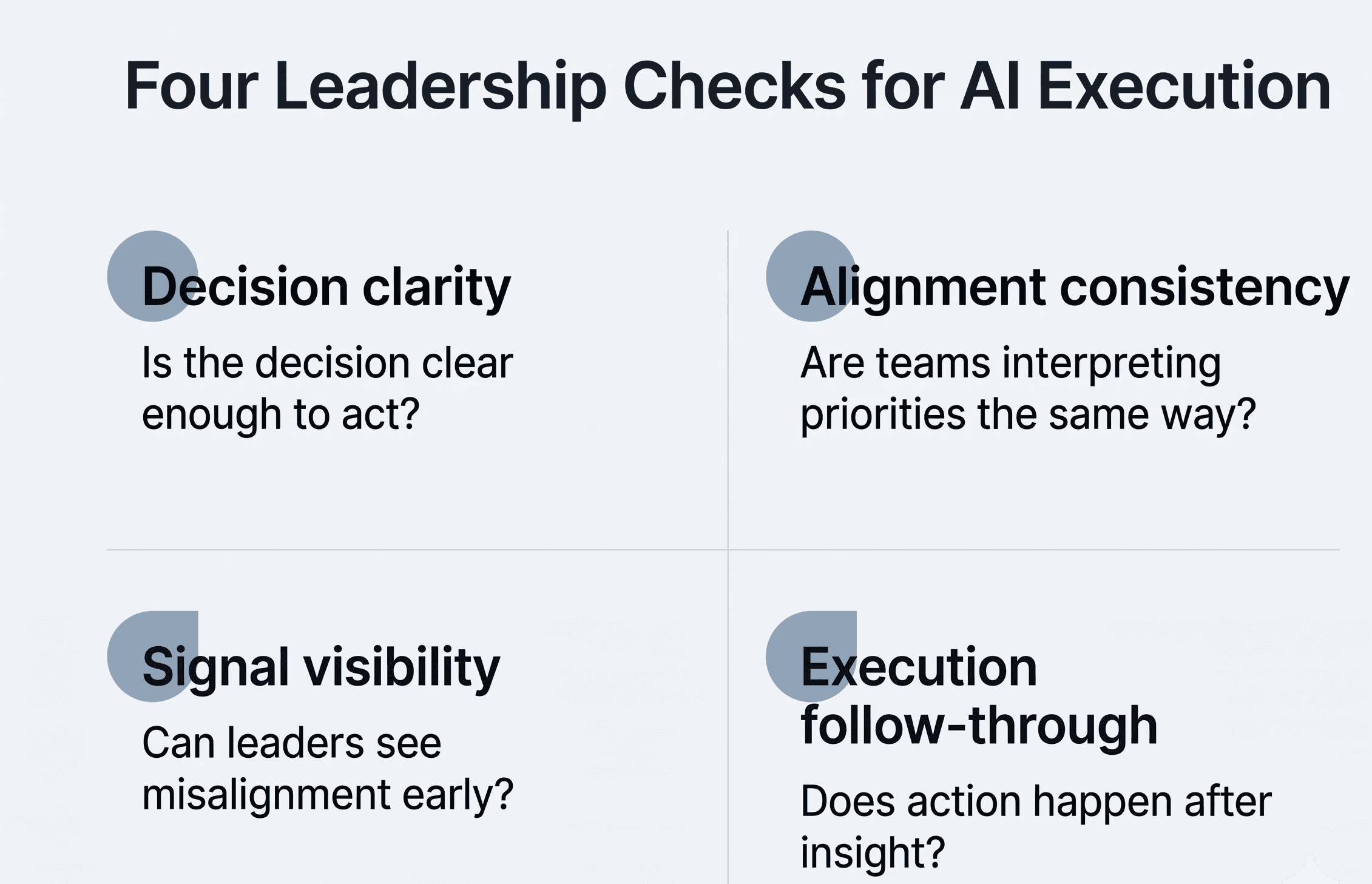
Are decisions clear, or are they being revisited?
Do teams interpret priorities the same way?
Is AI accelerating execution, or amplifying divergence?
Can leadership see early signals of misalignment before they become costly?
If those answers are uncertain, the constraint is organizational alignment.
Final thought
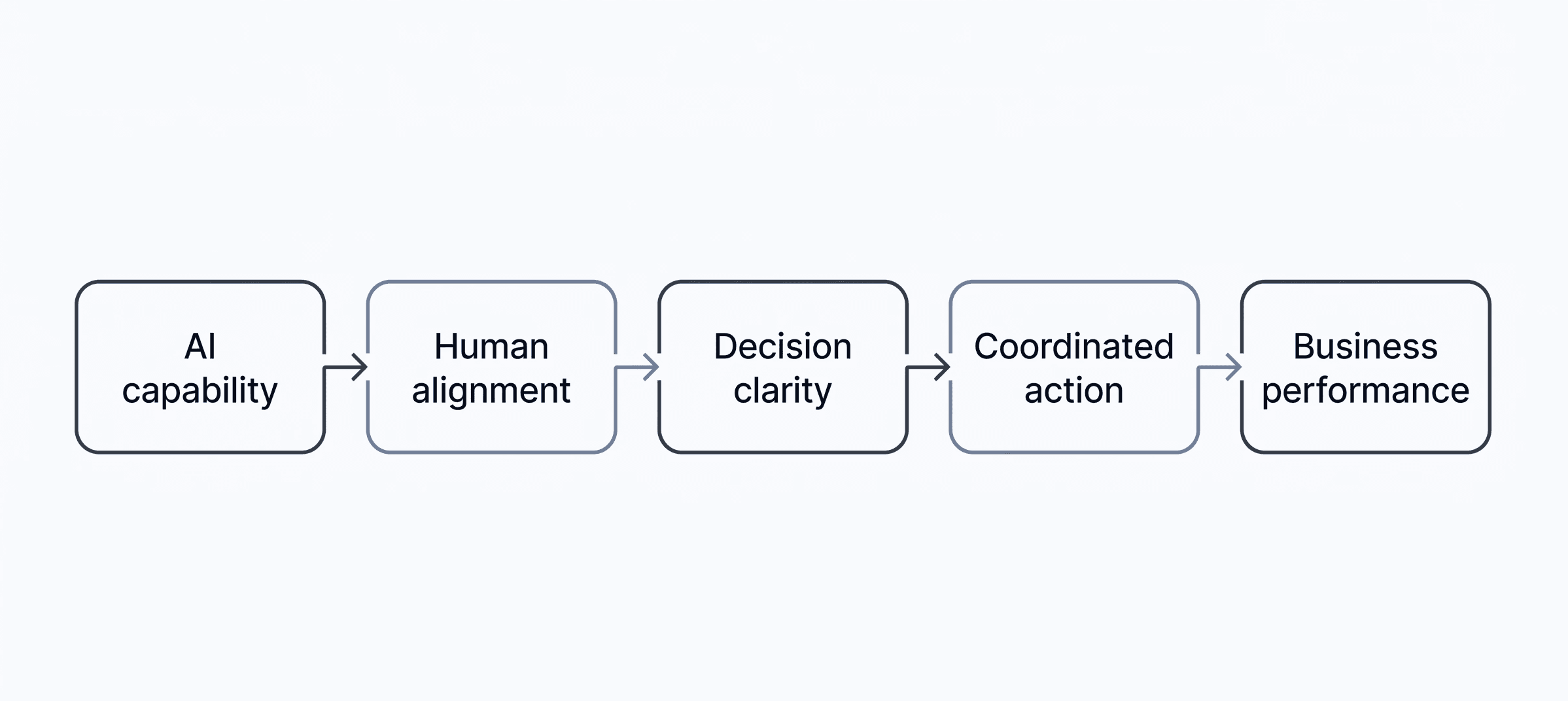
AI can accelerate almost every part of the business. It cannot align an organization on its own.
That still depends on people understanding what matters, making decisions under pressure, and staying coordinated as conditions change. Without that foundation, even strong AI investments can stall.
We think the next phase of advantage comes from organizations that strengthen that layer deliberately.
If you are investing in AI and not seeing the performance lift you expected, it may be worth looking less at the tools and more at the conditions around them. That is exactly where earlier signal and stronger alignment make the difference between activity and real progress.
More articles

The Handoff Problem: Why Execution Loses Context Between Teams
Execution friction is often blamed on effort, but it frequently begins when context, priorities, and decision boundaries weaken as work moves between teams. This article gives COOs and cross-functional leaders a practical way to improve translation quality and preserve strategic intent through the handoff.

Why Strategy Breaks as It Is Retold Across the Organization
Strategy often changes shape as leaders interpret and communicate it through multiple layers and functions. This article explains translation drift as a source of execution friction and offers a practical way for CEOs and COOs to surface divergence before it becomes a lagging business symptom.

The Manager Dependency Trap
Manager overload is not always a workload problem. This article examines how unclear priorities, decision boundaries, and trade-offs turn managers into a routing layer for routine ambiguity, and how COOs and CHROs can restore team agency without sacrificing coordination.
