Why Accountability Fails When Teams Don’t Have Clear Ownership Signals

Accountability breaks before the missed commitment
When execution slips, accountability is often where leaders look first. Who owned the work? Why didn't they follow through? Who should have escalated sooner? Those are reasonable questions, and they often come too late.
Accountability usually starts breaking well before somebody misses a commitment. It breaks when ownership is assumed rather than explicit, when priorities compete without a clear hierarchy, when decision authority becomes ambiguous, or when two teams leave the same conversation with different definitions of "done."
In distributed and matrixed organizations, those conditions multiply quickly. A person can be accountable to a functional leader, contributing to a cross-functional initiative, dependent on another team, and responding to a changing enterprise priority all at once. When that system lacks clear ownership signals, asking people to "be more accountable" does not solve the problem. It can turn accountability into blame.
Accountability without clarity becomes a character judgment
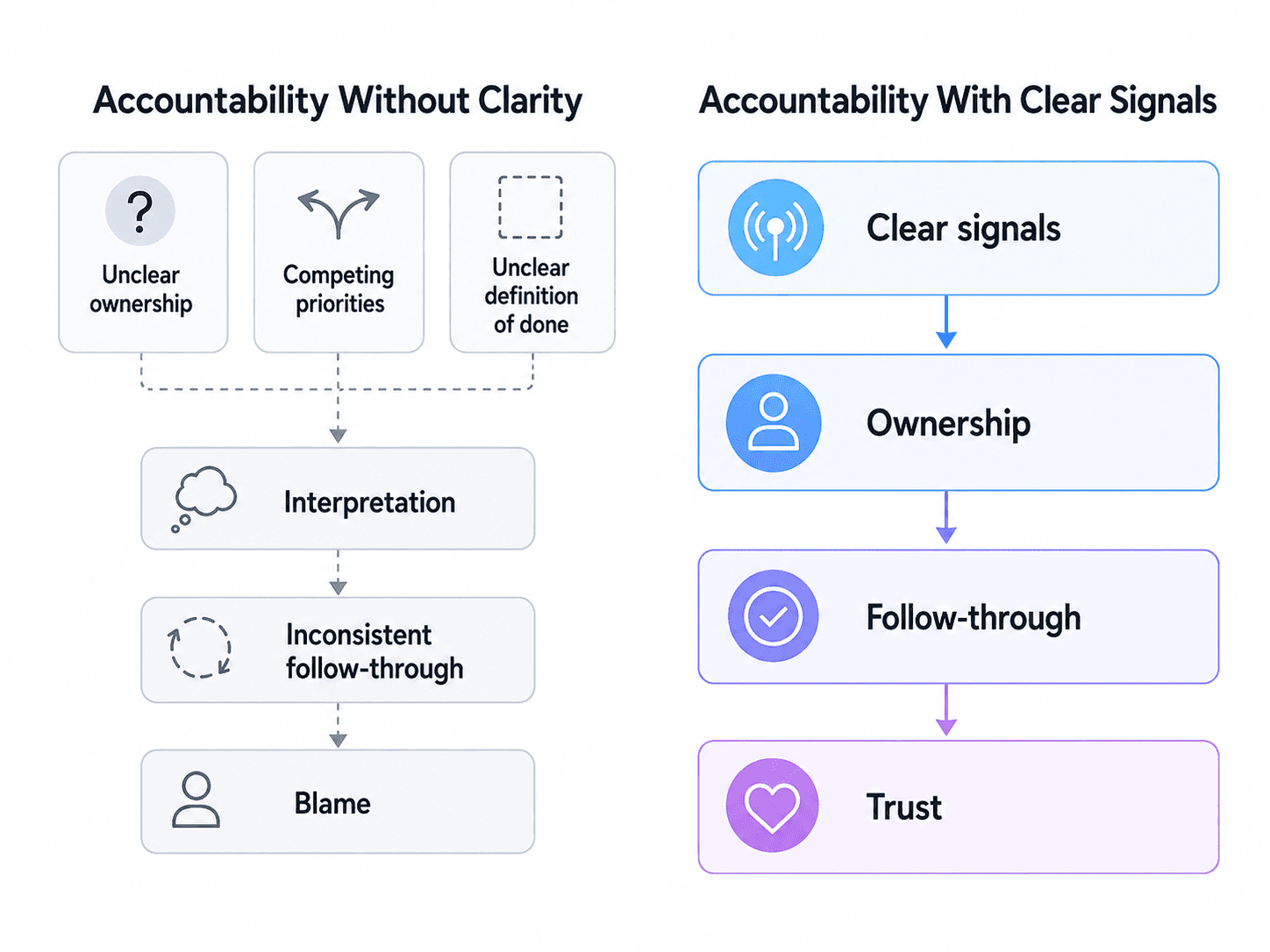
Healthy accountability begins with a simple condition: people need to know what they actually own. That includes more than a name beside an action item.
People need clarity about the outcome, the priority, their decision authority, the dependencies involved, and what completion actually means. If those stay ambiguous, leadership cannot reliably tell poor follow-through apart from a poorly designed operating environment.
Recent research makes the gap clear. In Gallup’s March 2026 research on accountability, fewer than half of leaders rated themselves outstanding or exceptional at creating accountability. Gallup also notes that clarity of expectations has been one of the engagement elements in significant decline, and argues that accountability depends on clear expectations and consistent leadership practices rather than simply corrective conversations. (Gallup.com)
That distinction matters to both COOs and CHROs. The COO needs execution to hold. The CHRO needs the way accountability is created to stay credible and fair. Those objectives should reinforce each other.
Matrixed work makes ownership easier to blur
Modern organizations are built around interdependence. A customer initiative may involve sales, product, finance, operations, and technology. A transformation program can cut across functions and geographies. Distributed teams may depend on people they rarely interact with synchronously. The advantage is access to more expertise. The risk is diluted ownership.
When several functions contribute to an outcome, "shared accountability" can quietly become "somebody else probably has it." Or the opposite happens, and several leaders believe they own the decision while teams receive conflicting direction..
Deloitte’s 2026 Human Capital Trends research on modernizing corporate functions specifically calls for clearer cross-functional accountability and shared outcome measures as organizations redesign how functions work together. Collaboration becomes more effective when accountability for the collective outcome is deliberately designed rather than assumed. (Deloitte)
This is where accountability becomes an operating-system issue. You cannot coach your way out of ownership architecture that nobody understands.
“Done” needs to mean the same thing across the handoff
One of the least discussed accountability problems appears at the definition of done. Team A believes its work is complete when it delivers an output. Team B believes the work is complete only when that output is usable. A manager believes the decision has been finalized while the project team believes it remains open. A corporate function believes guidance has been communicated while a distributed team believes it is still waiting for enough context to act.
Every participant may be behaving reasonably within their own interpretation, and the organization still experiences failure.
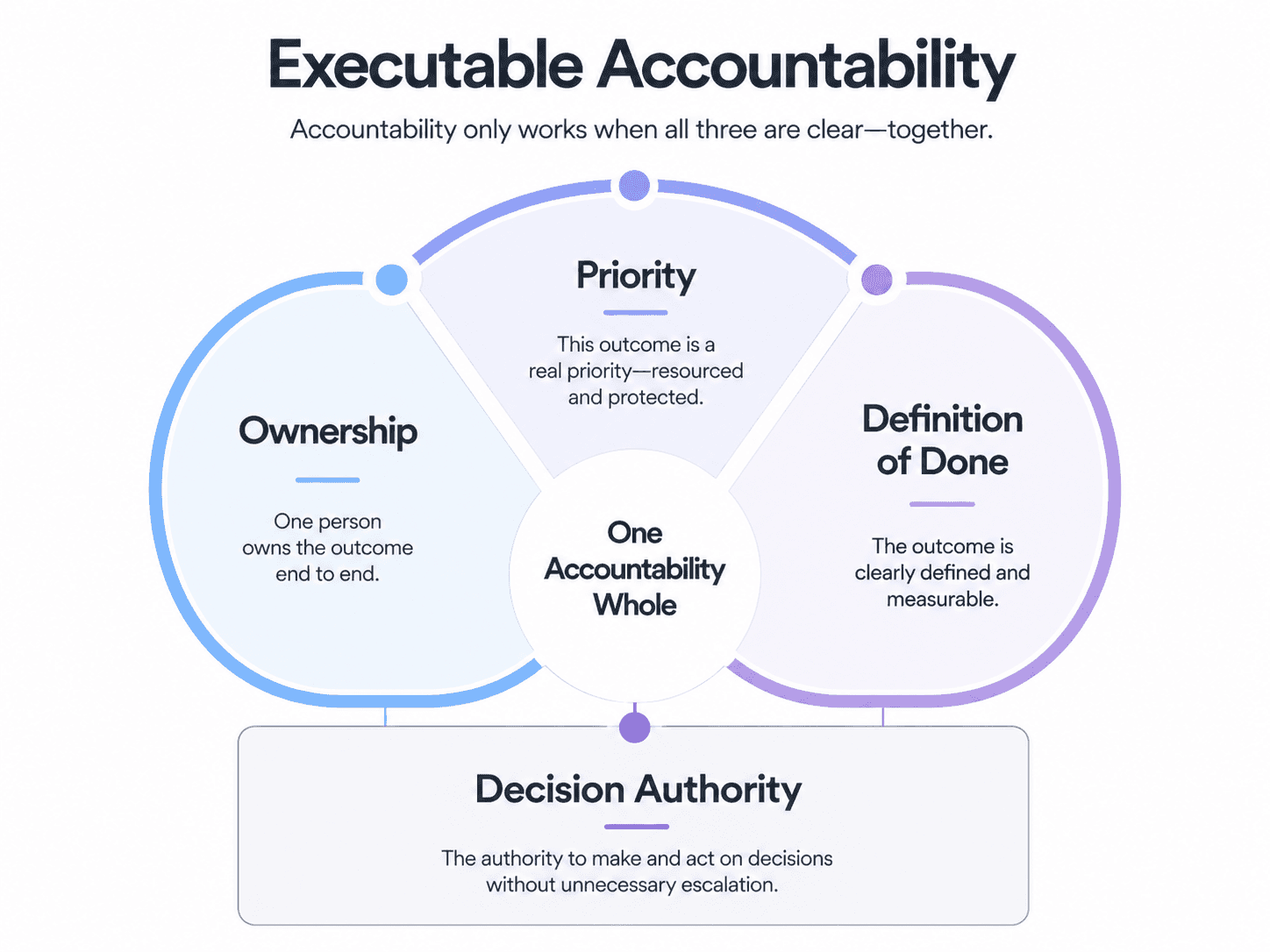
This is why we think accountability needs three conditions to hold together:
Ownership: Who is responsible for moving the outcome forward?
Priority: What takes precedence when this work competes with something else?
Definition of done: What observable condition tells everyone the commitment has actually been fulfilled?
When one of those is missing, follow-through becomes dependent on interpretation. And interpretation does not scale cleanly across a matrix.
Distributed teams need stronger signals, not tighter surveillance
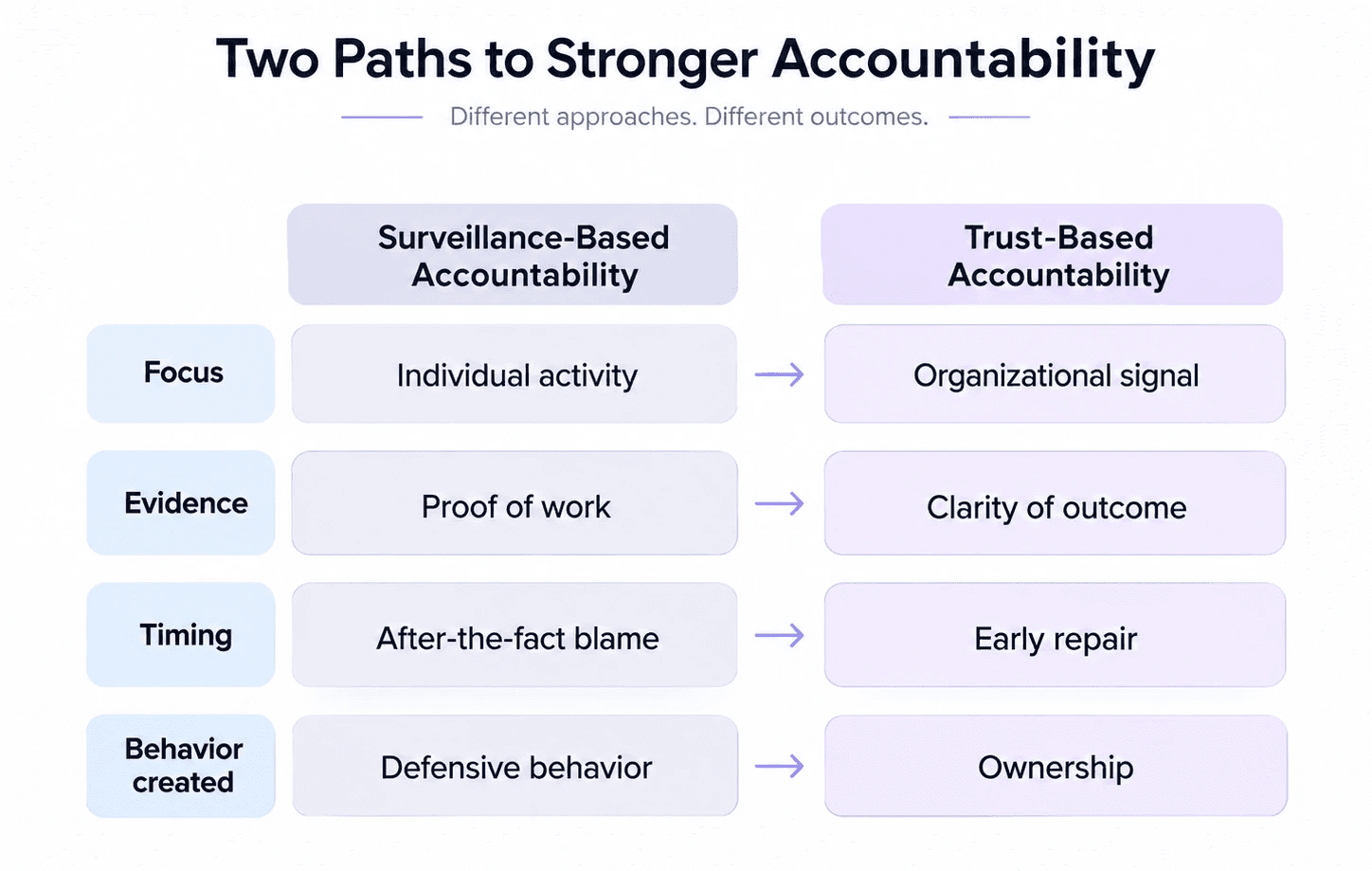
Distributed work can make the instinct to increase visibility especially strong. When leaders cannot physically see work happening, it is tempting to substitute observation for accountability: more status reporting, more activity tracking, more checkpoints, more proof that people are working. That does not create stronger ownership.
Accountability is not knowing whether somebody appears active. It is knowing whether people understand the commitment and have enough clarity and authority to deliver it.
Gallup’s updated 2026 guidance on hybrid and remote teams identifies unclear expectations and trust gaps as risks in distributed work and emphasizes intentional structure, shared routines, and clarity. Its data continue to show hybrid work as the dominant arrangement among U.S. remote-capable employees, which makes this an enduring operating challenge rather than a temporary adjustment. (Gallup.com)
The answer is to make ownership easier to understand and execution easier to coordinate, not to watch distributed teams more closely.
The earliest ownership failures often sound ordinary
Before accountability becomes a visible performance problem, we often hear much smaller signals. "I'm waiting to hear back." "I thought their team owned that." "We decided, but I'm not sure it's final." "I'm unclear which one takes priority." "We delivered our part." "Let's bring it back to the leadership team."
None of these necessarily indicate poor performance. But when they repeat, they tell us something about the operating environment. Decisions may not be holding. Ownership may be diffuse. Teams may lack enough authority to resolve normal tradeoffs. Definitions of completion may differ across a handoff.
This is the point where leadership has an opportunity to intervene constructively, not by finding someone to blame, but by repairing clarity.
Repair loops are part of accountability
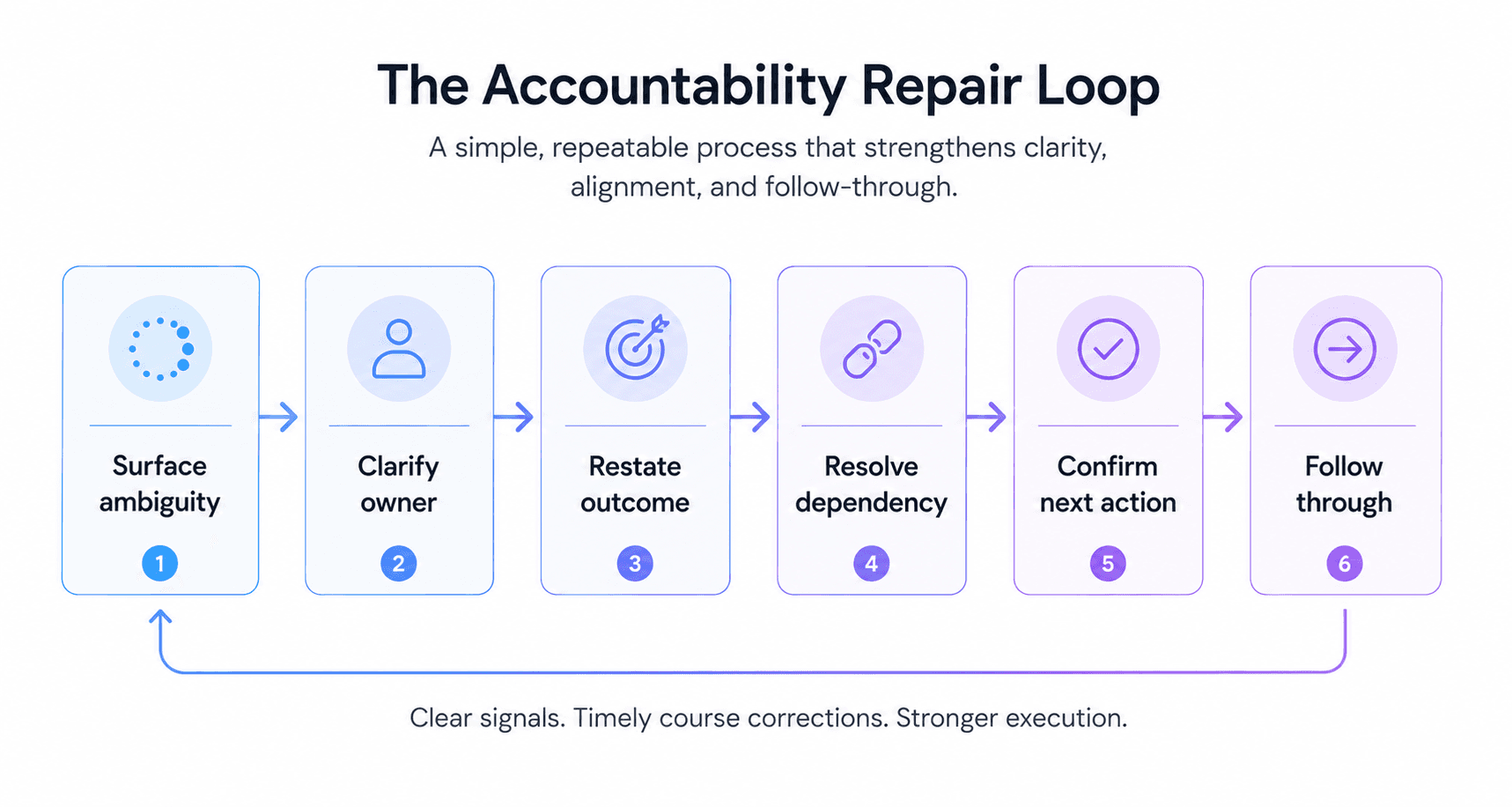
Strong accountability systems cannot depend on everything going perfectly the first time. Work changes. Dependencies fail. New information arrives. People misunderstand each other. What matters is whether the organization can repair those breaks quickly. A useful repair loop is straightforward: surface the ambiguity, clarify the owner, restate the expected outcome, resolve the dependency, and confirm what happens next.
The important part is that the conversation stays centered on the work. "What was unclear?" creates a different operating environment from "Who failed?" That does not remove consequences for genuinely poor performance. It simply prevents leadership from treating every execution breakdown as evidence of an individual motivation problem.
Even Gallup's 2026 leadership material advises leaders to address incomplete follow-through as a systems issue before assuming it is a character issue, noting that clarity, resourcing, or structure can be the underlying cause. (Gallup Store)
That is a much more productive starting point for accountability.
Where Baryons fits
The challenge is that many of these ownership signals stay fragmented. A COO may see missed handoffs but not the uncertainty building before them. A CHRO may hear manager frustration without seeing that the same ownership problem is appearing across several teams. Executives may assume a priority is clear because it was communicated, while people closer to the work navigate competing interpretations. This is the visibility gap we built Baryons to help address.
Our low-friction, voice-first daily practice gives individuals space to prepare, reflect, and make sense of their work. At the organizational level, Baryons surfaces anonymized, aggregated patterns that help leadership understand trajectories around clarity, alignment, confidence, strain, and other human dynamics affecting execution.
We are not trying to identify which employee failed to complete a task, and we are not building a productivity leaderboard. We are trying to make patterns visible enough that leaders can ask better operating questions earlier. Is ownership becoming less clear? Are teams repeatedly hitting the same coordination friction? Is confidence weakening around a critical priority? Is leadership strain increasing because too many decisions are being escalated?
That is organizational insights in service of better accountability.
Accountability should increase trust, not consume it
Many organizations treat accountability and trust as a tradeoff. Leaders do not need to choose. Well-designed accountability strengthens trust because expectations become more predictable. People know what they own. They know where they have discretion. They understand how success will be evaluated. And when something breaks, the organization has a credible way to repair it.
Poorly designed accountability does the opposite. It leaves ownership vague until something goes wrong, then becomes suddenly precise about who should be blamed. That teaches people to protect themselves. They escalate earlier, document defensively, avoid reasonable risks, and spend more time proving they were not responsible. The organization may look more controlled while becoming harder to operate.
For COOs that creates execution drag, for CHROs it creates a trust problem, and for both it is unnecessary.
Final thought
Accountability should not begin after execution fails. It should be designed into the conditions that make reliable execution possible: clear ownership, clear priorities, clear definitions of done, decision authority that holds, and repair loops that resolve ambiguity without immediately turning it into blame.
The real test of any accountability framework is what happens when priorities collide. Can a distributed employee tell which commitment wins? Can a cross-functional team identify who has final decision authority? Does everyone share the same definition of done? When a dependency breaks, is there a clear repair loop? When leadership changes direction, does ownership get reset explicitly? Those are the signals that determine whether accountability works in practice, and the ones leaders need to understand before missed commitments become a pattern.
When those conditions exist, accountability becomes much simpler: people can own outcomes because they understand what ownership requires. When they do not, stronger pressure rarely fixes the system. It usually makes people more defensive inside it.
At Baryons, we believe leaders need earlier visibility into those conditions, not more surveillance of the people working within them. Our role is to help surface the patterns that show where alignment, clarity, and coordination may be weakening, so leaders can repair the operating environment before accountability becomes a blame exercise.
If your organization is asking for more accountability but still seeing repeated handoff failures, unclear ownership, or decisions that do not hold, the better starting question may be: Are we giving people clear enough signals to own the outcome in the first place?
Want to learn more about Baryons - Watch on YouTube - Baryons - The Understanding Engine
Try it, its free!
Want more safe, constructive accountability within your team? Book a demo!
More articles

The Handoff Problem: Why Execution Loses Context Between Teams
Execution friction is often blamed on effort, but it frequently begins when context, priorities, and decision boundaries weaken as work moves between teams. This article gives COOs and cross-functional leaders a practical way to improve translation quality and preserve strategic intent through the handoff.

Why Strategy Breaks as It Is Retold Across the Organization
Strategy often changes shape as leaders interpret and communicate it through multiple layers and functions. This article explains translation drift as a source of execution friction and offers a practical way for CEOs and COOs to surface divergence before it becomes a lagging business symptom.

The Manager Dependency Trap
Manager overload is not always a workload problem. This article examines how unclear priorities, decision boundaries, and trade-offs turn managers into a routing layer for routine ambiguity, and how COOs and CHROs can restore team agency without sacrificing coordination.
