Meetings Should Create Shared Reality, Not Just Shared Attendance

The problem is meeting design, not just meeting volume
Most organizations do not only have a meeting volume problem. They have a meeting design problem.
We all know the feeling of leaving a meeting with more notes but less clarity. The conversation happened. The deck was reviewed. Action items were captured. But the room never converged on what matters, what changed, or what happens next. So we do not treat meetings as simple coordination rituals. They are sensemaking infrastructure. When they work, they help people build shared reality. When they fail, they push interpretation work into everywhere else.
That framing is more than a preference. The research keeps pointing the same way. In Harvard Business Review’s February 2025 article on “meeting hangovers”, the authors report that more than a quarter of workplace meetings leave people with lingering negative effects such as lower engagement and productivity. In other words, a bad meeting does not just waste an hour. It can distort the hours that follow. (Harvard Business Review)
The hidden cost of a bad meeting is downstream confusion
This is where many leadership teams underestimate the problem. They judge meetings by whether they happened, not by what they produced.
A meeting can feel active and still create drag. If no real decision is made, no owner is clear, and no next signal is defined, the uncertainty spills into Slack threads, side conversations, repeated updates, and second-guessing. The cost does not disappear. It gets redistributed across the rest of the week.
That fits what we see inside organizations. When teams are busy but not aligned, the cause is rarely a lack of effort. It is that shared understanding never got built. Status reporting stood in for coordination. Conversation stood in for clarity. Meetings that were supposed to reduce ambiguity ended up exporting it.
The broader teamwork data supports that read.. Atlassian’s State of Teams 2025 says teams have more information than ever but have never been less informed, and its survey of 12,000 knowledge workers and 200 executives found that leaders and teams waste 25% of their time just searching for answers. That is a sensemaking failure as much as a productivity failure. (Atlassian)
A meeting is useful only if it reduces interpretation work
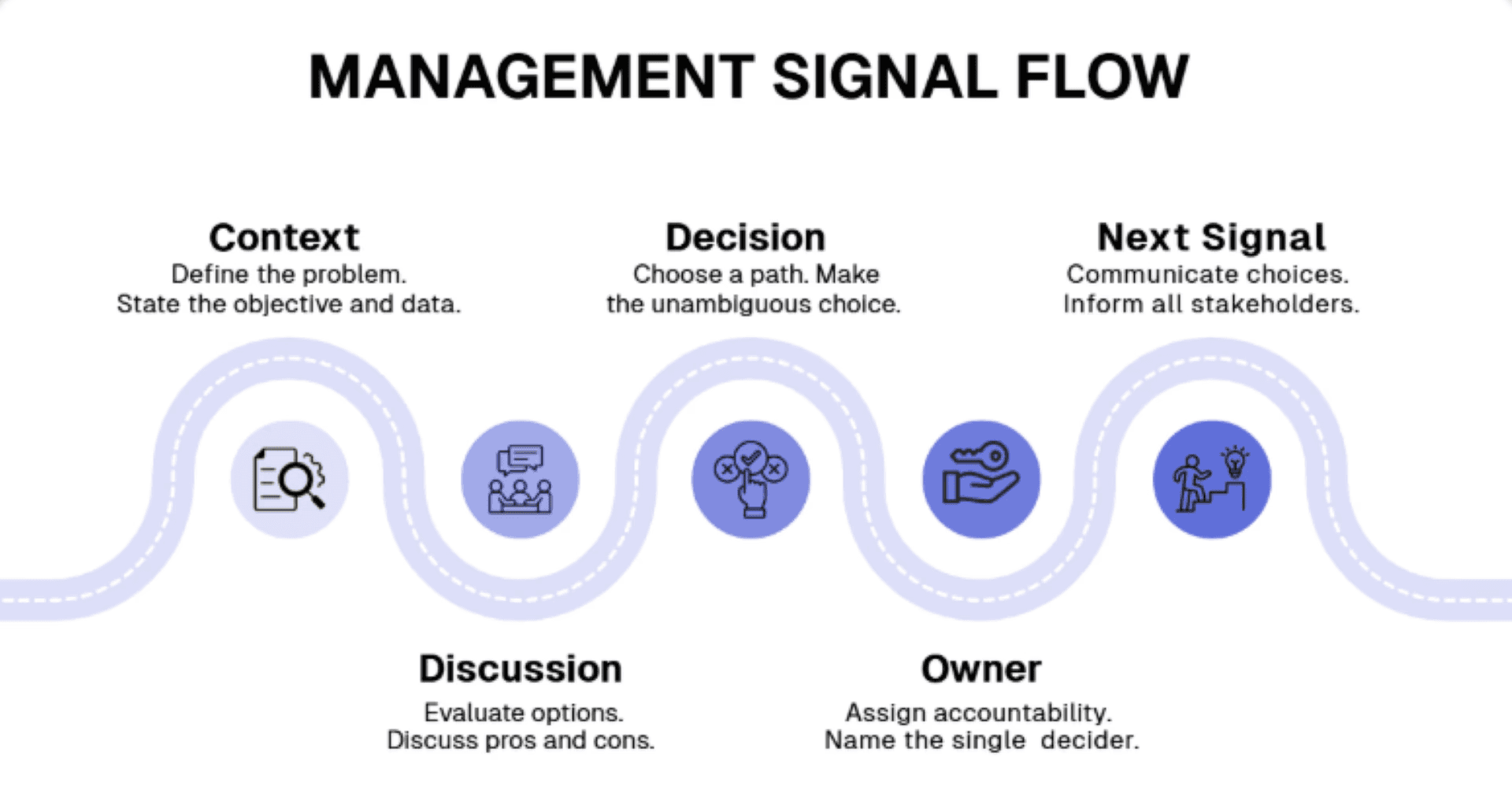
This is the standard we keep coming back to. A good meeting reduces the amount of guessing people have to do afterward.
That means the output is not "we talked." It is something more concrete: a decision, a named owner, and a next signal. A meeting that does not create those three is usually moving information around without producing shared reality. It can feel productive in the moment and still add friction later.
This is why meeting design belongs inside the larger conversation about alignment. Alignment is not agreement. It is the condition where people understand what matters most right now, why it matters, and where they have room to act. Meetings should strengthen that condition. Too often they weaken it by creating motion without momentum.
Better meetings start before the meeting starts
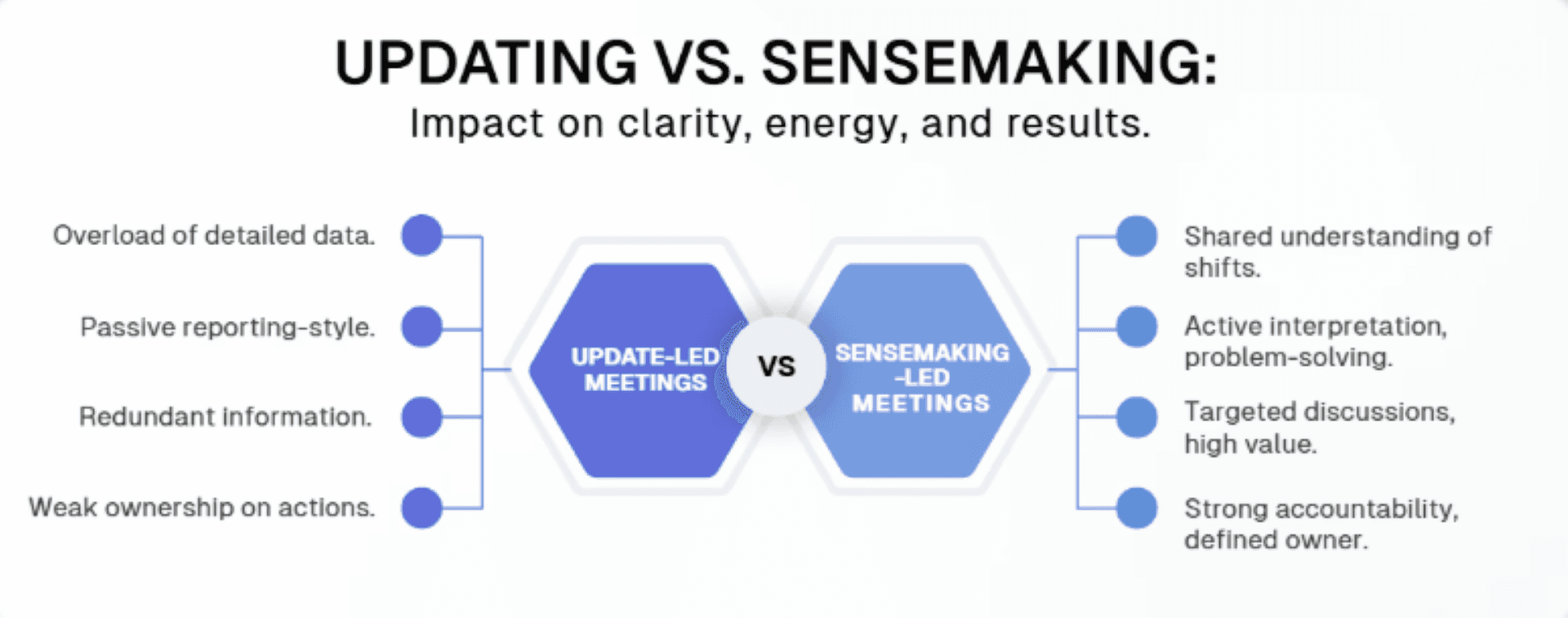
One of the clearest lessons in recent meeting research is that design upstream matters.
Atlassian’s Teamwork Lab found that “page-led meetings,” where a written page sets up context and goals before discussion begins, materially improved the meeting experience. Attendees were 29% more likely to feel energized, 23% less likely to feel frustrated, and 85% of those meetings accomplished their goals, compared with 69% in the control group. The lesson is not that every meeting needs a new template. It is that meetings work better when the room enters with a shared frame rather than building one from scratch under time pressure. (Atlassian Teamwork Lab; Atlassian Team Playbook)
That is consistent with how we think about clarity, and it is where Baryons fits. If people arrive without context, the first half of the meeting goes to reconstructing reality. By the time the room is oriented, there is not enough time left to decide, name tradeoffs, or surface tension early. Baryons gives a team that shared frame before anyone sits down. As an Understanding Engine, it turns a low-friction daily voice rhythm into a weekly Group Resonance Report that shows where alignment, confidence, energy, and strain are actually moving. The room can open already knowing where to focus, rather than spending its best minutes discovering it.
Why unnamed tension makes meetings worse
One reason meetings fail as sensemaking infrastructure is that they move information without making disagreement discussable.
A room can look aligned while people quietly hold different assumptions. Someone thinks the goal is speed. Someone else thinks it is precision. One leader thinks the decision is made. Another thinks the conversation is still exploratory. Those gaps are easy to miss when a meeting is built for updates rather than understanding.
This is one reason bad meetings linger. The problem is not only inefficiency. It is unresolved interpretation. People leave with incompatible versions of what happened, then spend days protecting themselves from being wrong. That is expensive, and it is avoidable. It is also why honest signal has to reach the room before the meeting does. Baryons surfaces that signal through a privacy mesh: leaders see patterns, not transcripts, and people speak candidly because their words never cross into group reporting. Effect without cause. That is what lets a quiet disagreement show up as signal instead of staying buried until it costs something.
Meeting design is leadership design
Meetings are not a neutral calendar artifact. They are a leadership choice about how clarity gets created.
That matters even more now. Microsoft’s 2026 Work Trend Index argues that leaders need to rearchitect work as AI and agents take on more execution. Deloitte’s 2026 Human Capital Trends similarly says organizations are reaching tipping points where speed, orchestration, and intentional work design matter more than simply adding tools. Meetings are part of that architecture. If they do not help people make sense of change together, they become one more place where confusion is amplified rather than resolved. (Microsoft; Deloitte)
So we prefer a different question than "Was this meeting efficient?" We ask whether it increased or reduced the coordination labor the team will carry afterward. That is a harder test, and it is the one that matters.
What meetings should produce
For a meeting to function as real sensemaking infrastructure, it should leave the room clearer than it found it.
That usually means three things are visible by the end. The team knows what decision was made or explicitly deferred. It knows who owns what happens next. And it knows what signal will tell the group whether the current path is working. Those outputs are simple, and they decide whether a meeting reduces friction or exports it.
This is why so much of our work focuses on earlier signal. Better meetings are not only about facilitation skills. They depend on better raw material: patterns in alignment, confidence, clarity, and strain that let leaders address what is changing before the meeting becomes another performance of certainty. Walk in with that, and the conversation can move straight to decision, owner, and next signal. That is what signal before symptom looks like in a room.
Final thought
A meeting should not end with people wondering what just happened.
It should end with a clearer version of reality than the one the room brought in. That is what makes meetings valuable. Not attendance. Not updates. Not the fact that everyone showed up. Shared understanding.
If your meetings are producing more follow-up than clarity, the issue may not be volume. It may be that the meeting system was never built for sensemaking. Redesigning meetings around the outputs that matter, decision, owner, and next signal, starts with giving the room better signal to begin with. That is the kind of operating conversation we like to help teams have.
Curious how to design a different meeting structure? You can start free.
More articles

Going Deeper: The Thinking Partner and the Growth Partner
Both the Thinking Partner and the Growth Partner grow you. The difference is shape. A look at when to reach for each, and why depth is where the magic lives.

Why This Isn’t a Pulse Survey
Baryons is not another employee pulse survey. This blog explains the difference between periodic listening and longitudinal organizational signal, showing how Baryons helps CHROs and People leaders understand what changes between survey moments: clarity, momentum, alignment, strain, and emerging patterns that may matter before they become obvious symptoms.
The Privacy Mesh
People tell their Baryon real things in an organizational context. The Privacy Mesh is how they can, while their leadership still sees a team's energy and never the contents of a life. Here is how that boundary actually holds.