Signal Before Symptom: The Case for Earlier, Lighter Leadership

Most leadership interventions happen too late
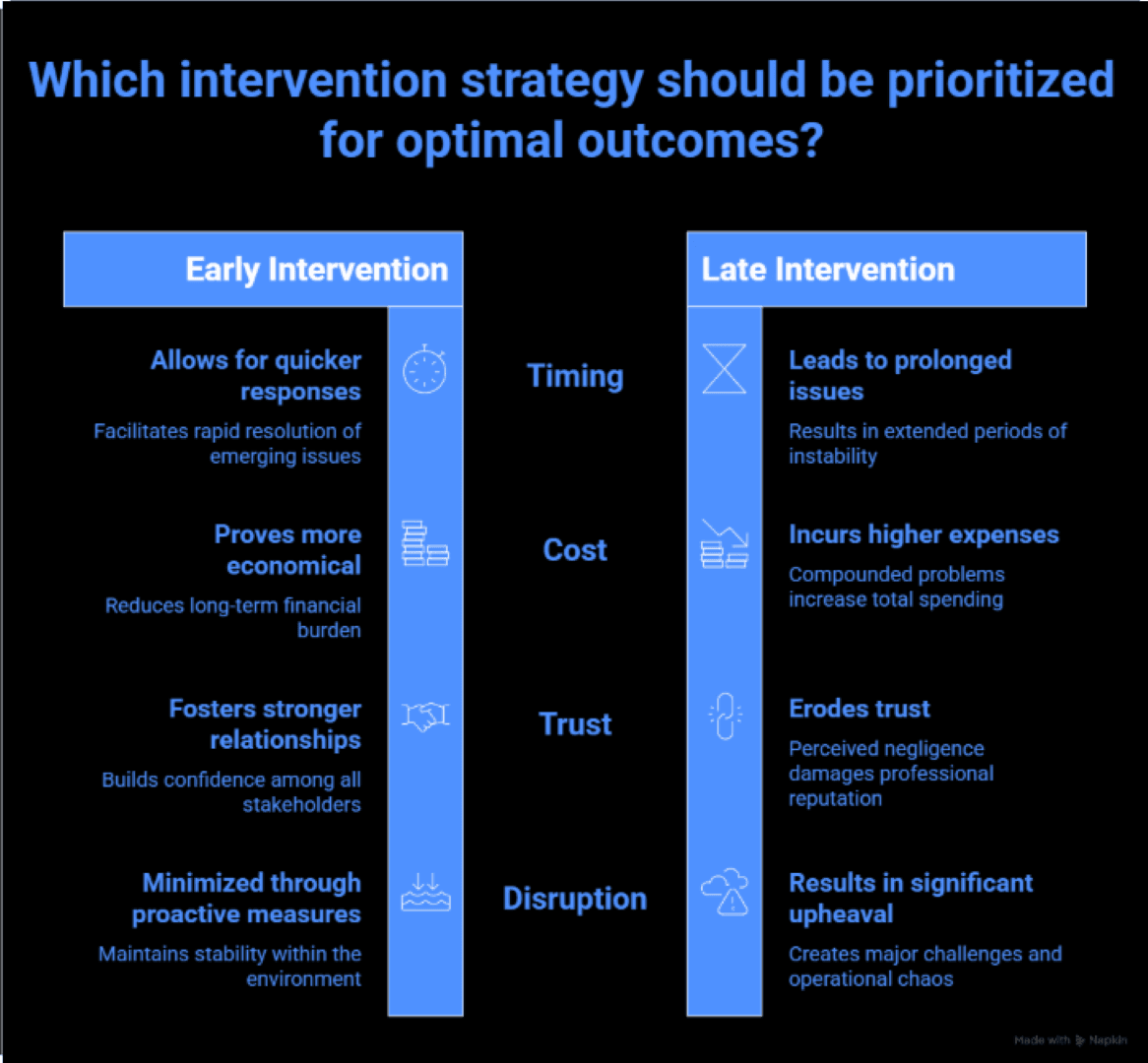
We see this pattern often. By the time leadership decides a problem is serious enough to act on, the cost has already landed.
Delivery has slowed. A strong manager is overloaded. A high performer has quietly disengaged. A tension that one clarifying move could have repaired has spread across a team or a business unit. By then the intervention is heavier than it needed to be. It becomes a reorganization, a new reporting layer, a broad initiative, or a corrective process that treats a late-stage consequence as if it were the original problem.
Our premise is different. The best leaders do not intervene harder. They intervene earlier. That is the more precise standard, not the softer one. It asks leaders to see what is forming before it becomes obvious, expensive, or politically loaded.
Earlier signal creates better options
The value of an earlier signal is practical, not abstract.
When leaders can see a pattern forming, they have more room to respond well. They can clarify a priority before confusion spreads. They can reset a decision boundary before accountability turns into blame. They can address rising strain before it becomes burnout, attrition, or escalation. The intervention stays small because the problem is still small enough to repair cleanly.
That matters more now, because change is arriving faster than most organizations can absorb. In Deloitte’s 2026 Human Capital Trends reporting, only 27% of leaders said their organizations are very or extremely effective at managing change, while one-third of workers reported 15 or more work-related changes in the prior year. In that environment, waiting for the big problem is not prudence. It is a costly operating habit. arriving faster than most organizations can comfortably absorb. In only 27% of leaders said their organizations are very or extremely effective at managing change, while one-third of workers reported experiencing 15 or more work-related changes in the prior year. In that kind of environment, waiting for the “big problem” is no longer prudent leadership. It is a costly operating habit.
Why leaders so often act late
Most leaders are still working from lagging visibility.
They get outcomes, summaries, and survey snapshots. They get escalations once something is obvious enough to surface. Those inputs matter, but they arrive late by design. They report what has already become visible. They do not reliably show what is just beginning to drift.
We have tried to name this gap clearly. Organizations are flying blind between strategy and outcomes because they lack a continuous, trustworthy read of how work is actually being experienced and coordinated. The tools leaders rely on are episodic. Surveys ask once a quarter. Reviews happen after the quarter closes. Between those moments, the signal that predicts performance, strain, and drift lives in everyday conversations that nobody has the bandwidth to have, let alone listen to. Leaders do not act late because they stopped caring. They act late because the system makes late action the default.
The workforce data reinforces the point. Gallup’s 2026 engagement coverage shows global employee engagement declined for a second consecutive year, and manager engagement declined as well. Managers are one of the most important translation layers in any organization. When that layer is saturated or disengaged, the quality of signal moving upward weakens before the business sees the cost.
Anecdotes are not enough
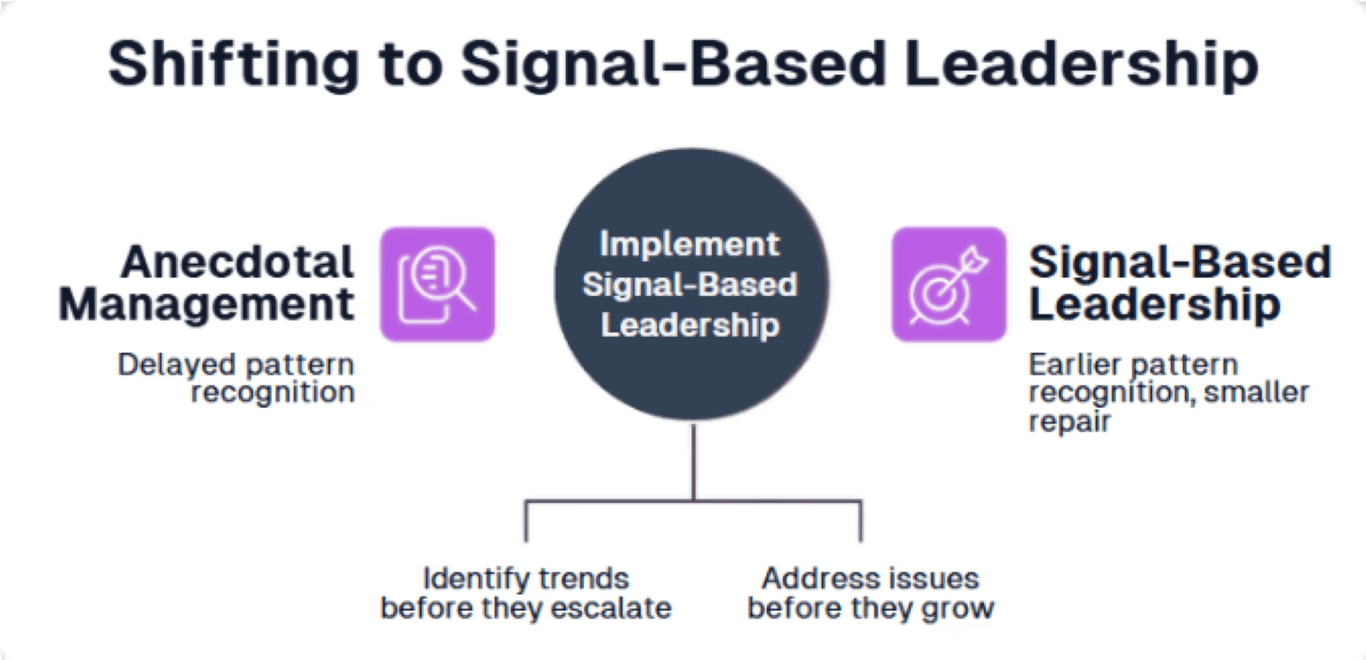
When early signal is weak, leadership falls back on anecdotes.
We know why. Anecdotes are vivid. They feel persuasive. But they are not a reliable operating system. They overrepresent the loudest voices, the latest escalation, and the safest story to tell upward. In a complex organization that produces a predictable pattern: leaders underreact while the real issue is still quiet, then overreact once the evidence is undeniable.
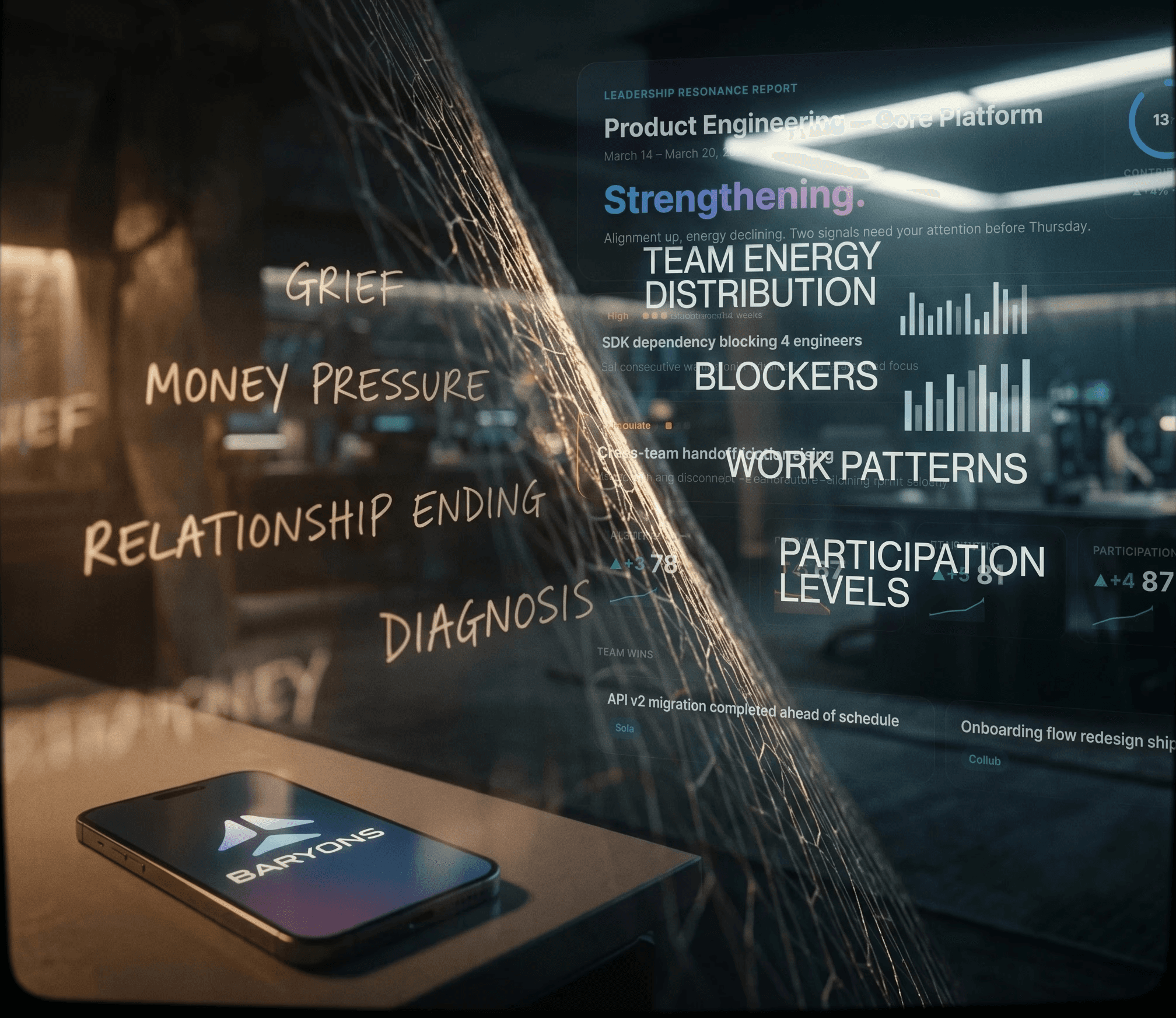
So leadership needs a more dependable path from insight to intervention. This is the work Baryons was built for. Baryons is an Understanding Engine. It turns daily voice conversations into organizational intelligence, and it gives leaders a weekly Leadership Resonance Report that sorts what is forming into three moves: where to act, where to watch, and where to amplify. The signal arrives while it is still quiet, with enough context to respond before the pattern hardens.
It works because people are willing to be honest. A privacy firewall sits between the individual and the organization. Personal detail never crosses into group reporting. Leaders see patterns, not transcripts. Effect without cause. That design is not a compliance footnote. It is the reason the signal is real. People surface what is true earlier when the risk of telling it is lower. A 2026 paper from the Center for Creative Leadership makes a related case: leaders read the room more effectively when they attend to the behavioral and conversational cues that shape psychological safety. Lower the interpersonal risk, and useful signal shows up sooner.
Earlier intervention is the harder discipline
There is a common misunderstanding in leadership language: that lighter intervention means softer leadership. In practice it asks for more. More attention, more precision, more willingness to act before the pain is obvious. It means noticing hesitation, repeated reversals, reduced curiosity, weakening clarity, or rising strain while those patterns are still quiet.
The case for that kind of leadership is stronger now, because uncertainty is shaping how people experience work. The American Psychological Association's 2025 Work in America findings reported that 54% of U.S. workers said job insecurity had a significant impact on their stress, and 65% said their organization had been affected by recent government policy changes. (APA Work in America 2025) In that climate, leaders cannot assume people will raise concerns early and cleanly. The system has to make raising them safe and useful.
A lighter intervention looks unremarkable from the outside. A priority gets clarified. A decision owner gets named. A source of friction gets removed. A manager gets support before overload turns into damage. Those small moves preserve trust and momentum precisely because they remove the need for bigger, harsher action later.
Leadership is clarity design
One of the most useful reframes for leadership is this: leadership is clarity design. The job is not only to energize people. It is to create the conditions where people understand what matters most, why it matters, what has changed, and where they have permission to act. When those conditions are strong, better signal becomes possible. When they are weak, truth gets delayed, filtered, or softened until the cost is too large to ignore.
Continuous understanding is what makes clarity design practical at scale. It shows leaders where clarity is weakening, where strain is rising, and where alignment is drifting, while each of those is still small enough to address with a light touch.
The most humane leadership sees sooner
The most humane leadership is not the leadership that waits for a visible crisis and then responds generously after the damage is done. It is the leadership that sees sooner. It notices the pattern while it is still small. It makes the repair while trust is still intact. It acts with enough precision that people and teams never have to absorb the full cost of delay.
That is what we mean by leadership intervention that is earlier, lighter, and more human. It is also what we mean by signal before symptom.
If your organization is working to reduce heavy-handed interventions, strengthen leadership judgment, or build a clearer path from signal to action, that is exactly the conversation we want to have.
More articles

Going Deeper: The Thinking Partner and the Growth Partner
Both the Thinking Partner and the Growth Partner grow you. The difference is shape. A look at when to reach for each, and why depth is where the magic lives.

Why This Isn’t a Pulse Survey
Baryons is not another employee pulse survey. This blog explains the difference between periodic listening and longitudinal organizational signal, showing how Baryons helps CHROs and People leaders understand what changes between survey moments: clarity, momentum, alignment, strain, and emerging patterns that may matter before they become obvious symptoms.
The Privacy Mesh
People tell their Baryon real things in an organizational context. The Privacy Mesh is how they can, while their leadership still sees a team's energy and never the contents of a life. Here is how that boundary actually holds.