Pilot Scoping Guide: Workflow, Team, or Leadership?

A strong pilot starts with the problem, not the population
When an executive sponsor considers a Baryons pilot, one of the first questions is usually about scope. Where should we start? Our answer is to start one step earlier: what are you trying to understand?
A pilot can center on a critical workflow, a specific team, or a leadership group. Each makes a useful starting point, and they are not interchangeable. A workflow pilot illuminates friction in how work moves. A team pilot surfaces patterns in how a group aligns and operates. A leadership pilot focuses on the people translating strategy into decisions and execution.
The objective of a 90-day pilot is not to expose as many people as possible to Baryons. It is to create a focused environment where leaders can evaluate whether better human signal changes what they understand about an important business problem. That fits why we built Baryons. Organizations already track financial results, activity, engagement, and project status. The gap is what is happening underneath those outcomes, where alignment is breaking, decisions are degrading, energy is draining, or friction is slowing execution before the traditional measures reveal it. (Baryons)
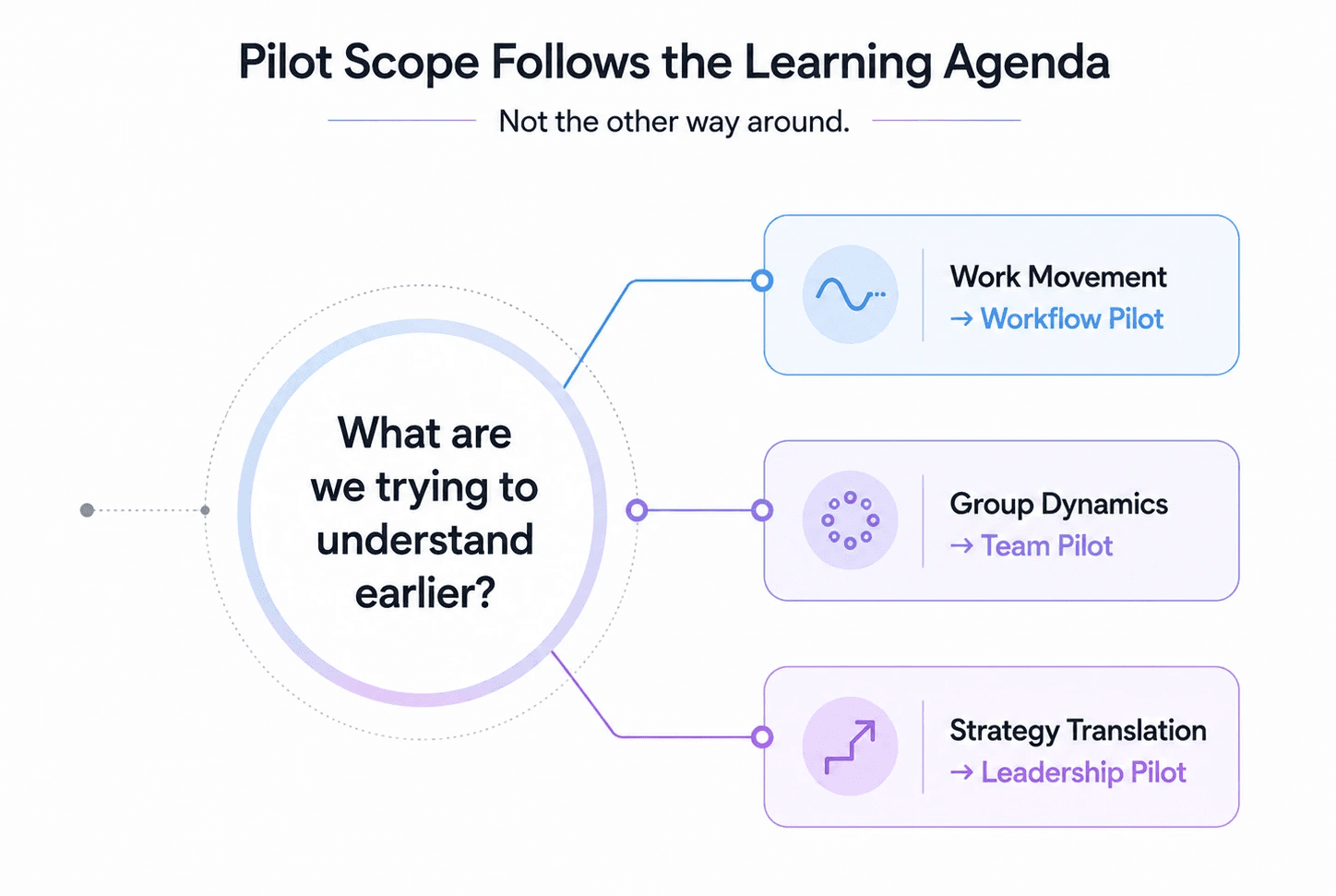
Before choosing a path, define the learning agenda
The best pilot question is specific enough that leadership will know what it learned at the end of 90 days. "Improve culture" is too broad. "Understand why this cross-functional transformation keeps losing momentum between decisions and implementation" is far more useful. That distinction keeps the pilot connected to the business rather than turning it into a technology evaluation in isolation.
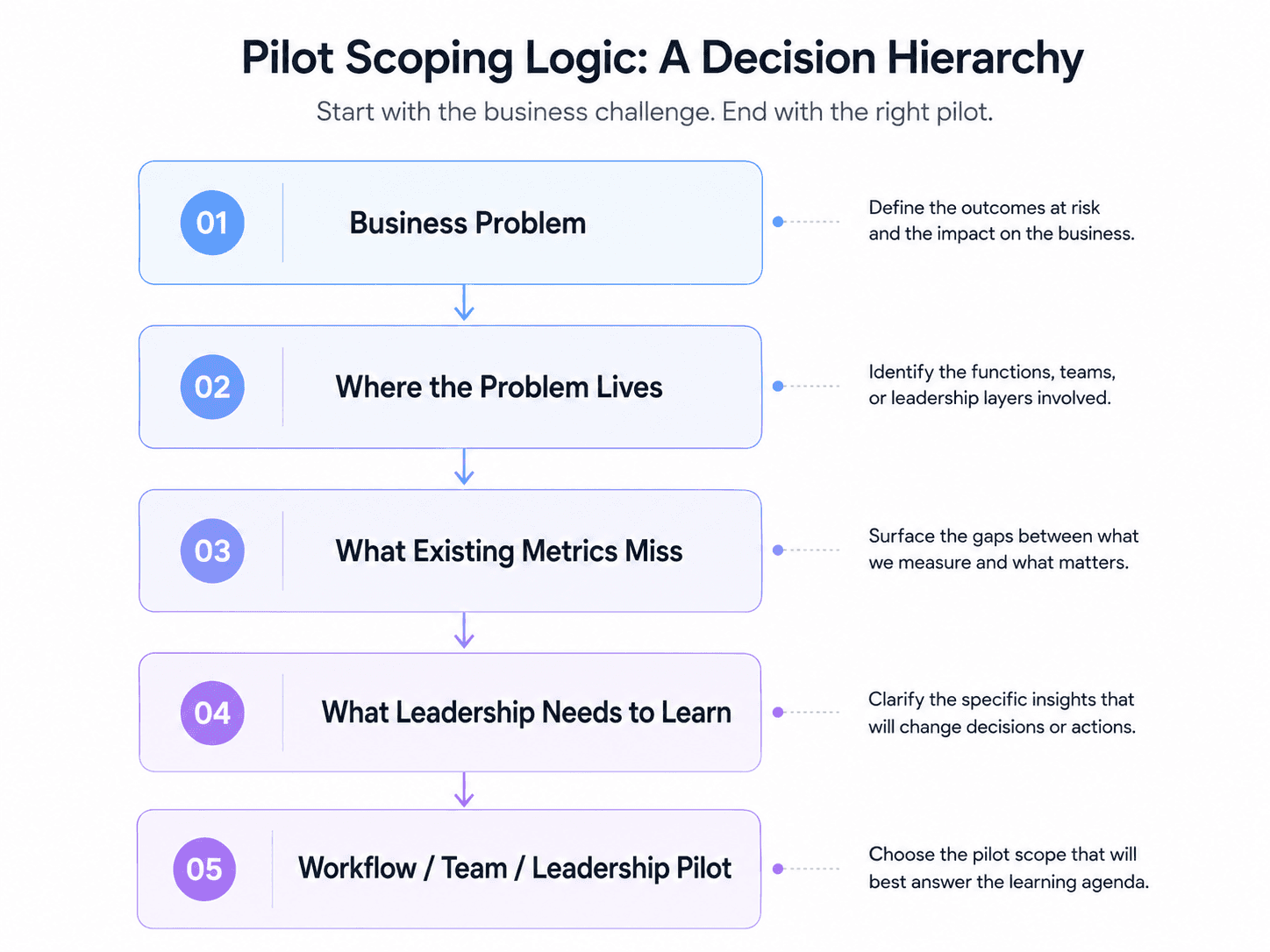
Before choosing a scope, we would ask: What business problem are we trying to understand earlier? Where does that problem actually show up, in a workflow, within a team, or through leadership? What do our existing metrics already tell us, and what remains invisible? What could leaders decide differently with earlier signal?
At the end of 90 days, what would we need to have learned for the pilot to be useful? Once those answers are clear, the right path becomes easier to identify.
Path One: Workflow-focused
A workflow-focused pilot starts with how work moves rather than with the organizational chart. It fits when leadership already knows where a business-critical process is experiencing friction but does not fully understand why.
Consider a transformation that repeatedly misses milestones, a customer implementation that requires too many escalations, a product launch where functions keep revisiting decisions, or a process where handoffs technically happen but downstream teams repeatedly need clarification. The visible problem may be cycle time, rework, missed milestones, or inconsistent execution. The underlying problem is often different. Ownership could be unclear. Teams may interpret priorities differently. Decisions may not survive the handoff from one function to another. Managers may be compensating with extra meetings and informal coordination.
This is exactly the distinction that matters to us: signal before symptom, understanding the human dynamics underneath execution before the missed milestone becomes the first undeniable evidence something is wrong.(Baryons)
The learning agenda here?
Are the people in the workflow aligned on what matters most? Where does confidence weaken as work moves across boundaries? Are decisions holding, or being reopened? Where is coordination harder than the formal process suggests? Is friction improving, persisting, or shifting as leadership intervenes?
Baryons does not replace the workflow's operating KPIs. Those metrics stay essential. Baryons adds another lens on the human conditions developing underneath them.
Path Two: Team-focused
A team-focused pilot starts with a defined group whose ability to operate coherently matters to the business. It fits when the problem is less about one workflow and more about the operating health of the group itself. Perhaps a team went through rapid change, a new strategy altered its priorities, two functions were combined, or AI is changing how the work gets done. Performance is still acceptable, but leadership senses coordination is getting harder.
This is where snapshots mislead. A team can hit its numbers while managers absorb increasing strain. It can look engaged while clarity deteriorates. It can stay busy while momentum weakens.
Baryons makes those changing patterns more legible through Weekly Resonance Insights, which surface anonymized, aggregated patterns across team health, energy, momentum, engagement, relationships, flow, and purpose. The point is not another team score. It is a trajectory. (Baryons)
The learning agenda here?
Is alignment strengthening or weakening as priorities change? Where is momentum building, and where is it getting harder to sustain? Are strain and friction temporary reactions to change or persistent patterns? Are leadership interventions changing the trajectory? What positive patterns should the organization reinforce?
This is why we would not frame a team pilot as an employee-monitoring exercise. Baryons is built around anonymized, aggregated patterns, not individual activity measurement. Leaders are looking for the team signal, not an employee leaderboard, and that distinction is central to the usefulness of the pilot itself.
Path Three: Leadership-focused
The third path begins with the people carrying the greatest concentration of organizational decisions. A leadership-focused pilot fits during a major transformation, after a leadership transition, during rapid growth, or whenever the executive layer is absorbing unusually high complexity.
Leadership teams often appear aligned because they spend significant time together. That does not mean decision clarity is strong. A leadership team can agree on strategy but interpret execution priorities differently. Executives can leave the same conversation with different assumptions about ownership. Decisions can appear settled and then reopen downstream. Leaders can carry significant strain privately while continuing to perform publicly. Those conditions matter because they propagate. If leadership ambiguity goes unresolved at the top, the teams below are forced to interpret it.(Baryons)
The learning agenda here?
Does the leadership team share enough clarity to translate strategy consistently? Where do important decisions create recurring friction? Is ownership understood consistently across the group? Where might leadership strain be affecting how decisions and priorities move? Does alignment hold when pressure increases?
The objective is not to evaluate individual executives through their conversations. It is to understand whether the leadership environment is creating the conditions the broader organization needs to execute.
Three paths, three different starting points
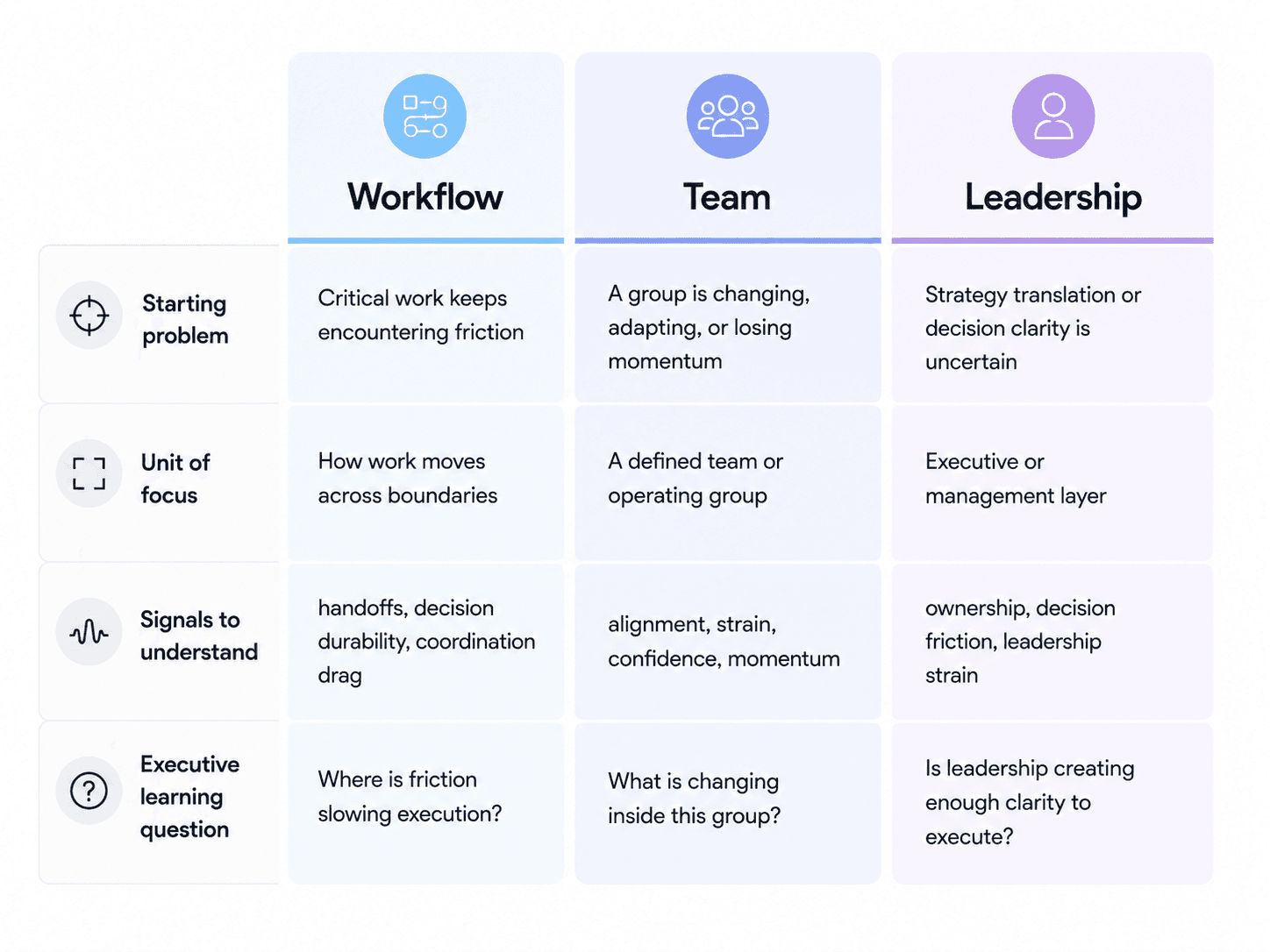
The easiest way to choose is to find where the uncertainty sits. If the question is "Why does this critical process keep hitting friction?", start with the workflow. If it is "What is changing inside this group that our existing measures are not showing us?", start with the team. If it is "Is our leadership layer aligned and equipped to carry the strategy?", start with leadership.
There is always some overlap. A workflow crosses teams, teams depend on leaders, leaders operate through workflows. A pilot still benefits from a primary lens. Without one, the scope goes broad while the learning goes vague.
Keep the business outcome outside Baryons
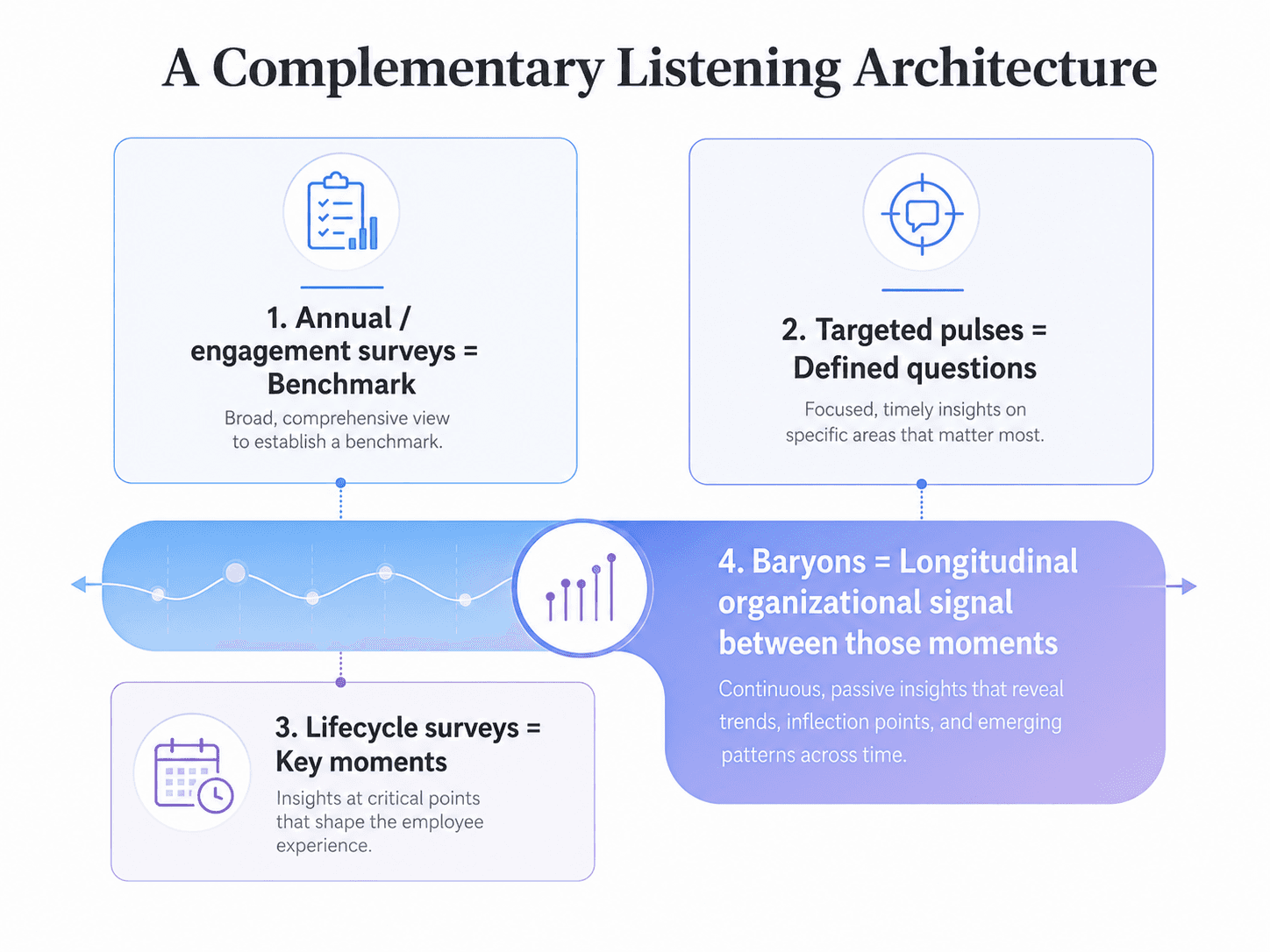
One principle matters when defining success: Baryons should not be the sole judge of whether the pilot worked. If the workflow pilot is tied to a critical transformation, evaluate the operating measures that already matter to it. If the team pilot is about execution conditions, use the business and people outcomes the organization already relies on. If the leadership pilot is tied to a strategic change, examine whether execution against that change is moving as expected.
Baryons provides an additional signal layer. The business still determines whether performance improved. That separation makes a stronger pilot, because it tests whether earlier human signal adds useful visibility to the operating picture rather than manufacturing a self-referential measure of success.
Final thought
When sponsors ask where to pilot Baryons, the best answer is not "everywhere." Start where the question matters. Workflow when you need to understand how friction affects the movement of work. Team when you need to understand how a group is aligning, adapting, and sustaining momentum. Leadership when you need to understand whether the people carrying the strategy are creating enough clarity for the organization beneath them.
A pilot does not need to explain the entire organization. It needs to help leadership understand something important that is hard to see today, tied to a real business problem, an identifiable learning agenda, and the willingness to act on what emerges.
Baryons is building an Understanding Engine for the human dynamics traditional operating systems often cannot see: where alignment is breaking, decisions are degrading, energy is draining, and friction is slowing execution. (Baryons)
A well-scoped 90-day pilot gives you a practical way to test whether seeing that layer changes what leadership understands, and the quality of the decisions it can make. If you are deciding where to begin, we would start with one question: what important business problem are you currently seeing too late? That answer usually points toward the right pilot.
Learn more about what Baryons can do or how it works - Watch on YouTube - Baryons - The Understanding Engine
Try it, its free for everyone!
Want to look into one of these pilots? Book a demo!
More articles

The Handoff Problem: Why Execution Loses Context Between Teams
Execution friction is often blamed on effort, but it frequently begins when context, priorities, and decision boundaries weaken as work moves between teams. This article gives COOs and cross-functional leaders a practical way to improve translation quality and preserve strategic intent through the handoff.

Why Strategy Breaks as It Is Retold Across the Organization
Strategy often changes shape as leaders interpret and communicate it through multiple layers and functions. This article explains translation drift as a source of execution friction and offers a practical way for CEOs and COOs to surface divergence before it becomes a lagging business symptom.

The Manager Dependency Trap
Manager overload is not always a workload problem. This article examines how unclear priorities, decision boundaries, and trade-offs turn managers into a routing layer for routine ambiguity, and how COOs and CHROs can restore team agency without sacrificing coordination.
