See strategy drift while it is still a conversation | The Leadership Enablement Lab

Introducing the Leadership Alignment Lab, a 90-day program for leadership teams.
Every leadership team works hard to build a clear strategy. Then the strategy leaves the room.
A priority passes from an executive to a leader, from that leader to their managers, and from managers to their teams. At each step it gets interpreted, and small differences in understanding compound. By the time they show up as missed milestones, duplicated work, or friction between functions, the moment they began has already passed.
Most organizational reporting describes what has already happened. The Leadership Alignment Lab is built to show leaders something earlier: where understanding of the strategy is beginning to diverge, while there is still time to act on it.
Where the signal comes from
Every participating leader gets a private Baryon, a conversational voice partner available 24/7 by phone at 231-BARYONS or on the web at app.baryons.com. Leaders use it to think through priorities, prepare for consequential conversations, and reflect on decisions after they happen. Those conversations belong to them.
Each week, patterns from across the group return as Team Resonance Insights, aggregated and attributed to teams or functions, never to a person. "Your team speaks. Baryons understands." (baryons.com/platform)
Watch our YouTube video, The Understanding Engine.
How the Lab runs
The Lab runs for thirteen weeks across four phases: Discover, Map, Align, and Improve.
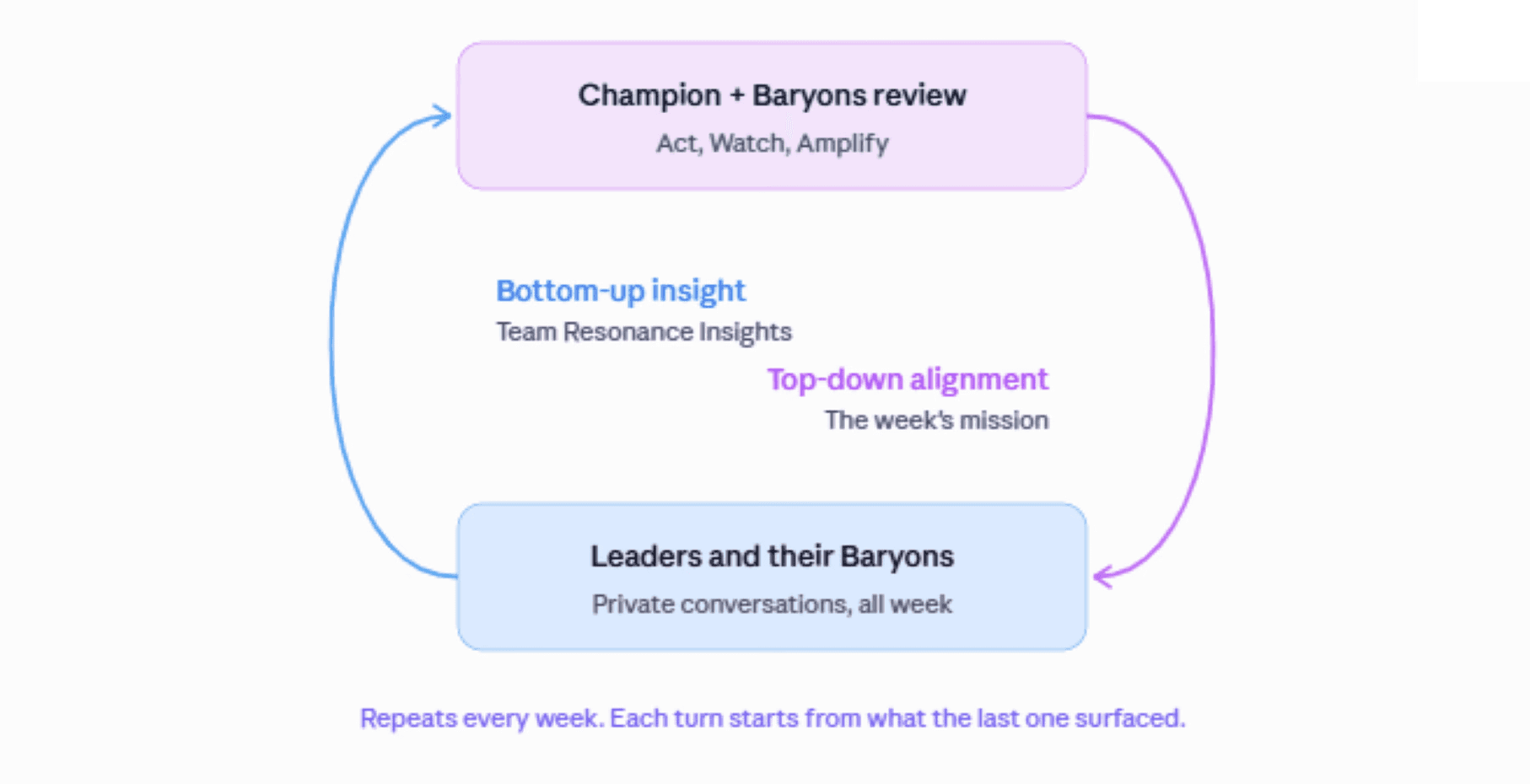
It starts with a baseline: a short questionnaire and a brief conversation that capture how each leader understands the organization's strategic priorities. From there, a weekly cycle takes over:
Each week, the champion sends a short mission from leadership.
Leaders bring the mission into their own conversations.
Team Resonance Insights return on Sunday.
The champion and Baryons review them on Monday, sorting patterns into Act, Watch, and Amplify.
When a pattern warrants it, leadership decides where to intervene. Near the end, the baseline is repeated, and the comparison shows what moved.
Built on privacy
Leaders only think out loud honestly when the boundaries are clear. The privacy mesh follows one principle: effects flow up, causes stay down. Every item in a reflection is classified as personal or professional at the source, and personal content is removed before any Team Resonance Insights are written. Learn more at our Trust Center: trust.baryons.com.

What leaders walk away with
At Day 90, leadership receives written findings, covering:
the divergences surfaced that they had not seen before;
the actions taken and what followed;
the practices worth scaling;
a clear account of what the signal could not tell them.
From there, the organization decides whether to continue as is or extend the model to another leadership population.
The approach is simple: bottom-up insight, top-down alignment.
Two ways in
Book a demo to learn more about the Leadership Alignment Lab: baryons.com/demo
Register to try Baryons for yourself: Once you're in, the full Leadership Alignment Lab guide is waiting in Resources.
Signal before symptom.
More articles

Why a Decision Is Not Finished Until It Is Understood
This article explores why a decision is not truly complete until it is understood and actionable by those expected to execute it. It differentiates between decision-making and decision closure, highlights the risks of incomplete closure, and offers practical steps for leaders to ensure organizational clarity.

Where Is Execution Drifting? The Questions Leaders Need Answered Earlier
This blog explores why CEOs and COOs often discover execution drift only after it becomes costly, and how focusing on earlier organizational signals. Focus on how direction is heard, interpreted, and acted upon can give leaders more room to intervene. It contrasts conventional status updates and outcome metrics with the value of early signal, drawing on recent research and practical leadership questions.

The Hidden Limit on Manager Effectiveness
Span of control tells leaders how many people report to a manager. Span of attention reveals whether that manager has enough practical capacity for decisions, priorities, difficult conversations, and strategic interpretation. This article gives CHROs a more useful way to examine manager effectiveness before capacity pressure becomes a performance problem.